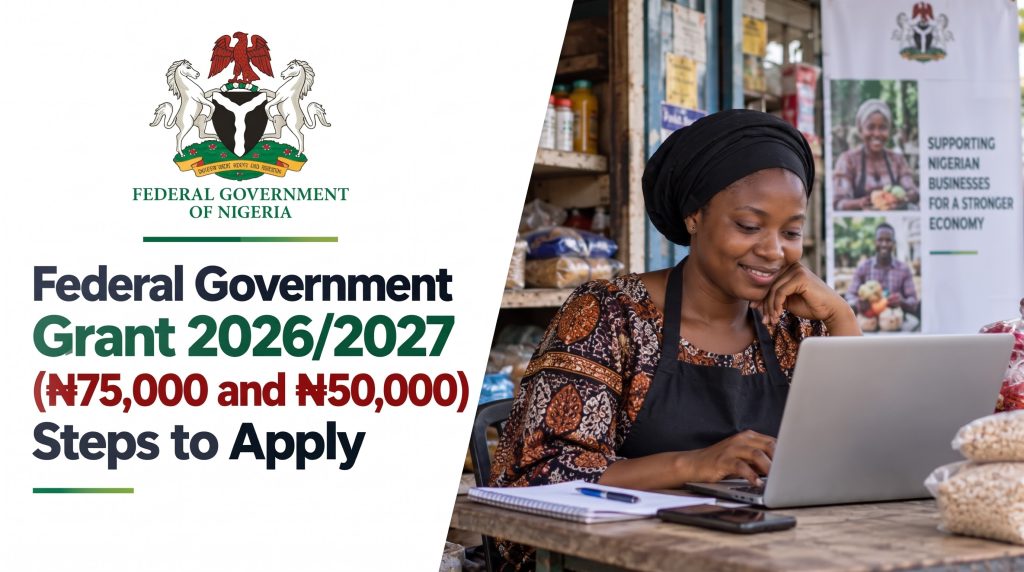
Federal Government Grant in Nigeria 2026/2027: A Complete Guide to NERSI, BOI, SMEDAN, and YEIDEP
As a Nigerian business owner, entrepreneur, or even a student trying to make ends meet in 2026, you already know that keeping your head above water requires more than just passion. The economic landscape has shifted significantly, and the cost of doing business has made it absolutely critical to seek out external funding. Fortunately, the Federal Government of Nigeria has rolled out several high-impact grant and loan initiatives for the 2026/2027 cycle. If you have been searching for a legitimate way to scale your business without the suffocating interest rates of traditional banks, you are in the right place.
In this comprehensive guide, we are going to break down everything you need to know about the Federal Government Grant in Nigeria for 2026 and 2027. We will look specifically at the National Emergency Relief and Stabilisation Intervention (NERSI), the Bank of Industry (BOI) funds, the Small and Medium Enterprises Development Agency of Nigeria (SMEDAN) grants, and the Youth Entrepreneurship and Innovation Development Programme (YEIDEP). By the time you finish reading this article, you will have a clear, step-by-step roadmap on how to position yourself, prepare your documents, and successfully apply for these government funds without falling victim to scammers.
Understanding the 2026/2027 Economic Empowerment Initiatives
Before we dive into the specific programs, it is very important to understand why the Federal Government is distributing these funds and how they actually work. A lot of people confuse grants with loans. Let us clear the air right now: a grant is essentially “free money” given to you by the government or an organization to start or boost your business, complete your education, or run a community project. Unlike a loan, you do not have to pay back a grant, and it does not accrue interest. However, the government does not just hand out cash to anyone who asks. These grants are highly targeted, purpose-driven, and strictly monitored to ensure they are used to stimulate the Nigerian economy.
On the flip side, some of the interventions, particularly those from the Bank of Industry (BOI), come as single-digit interest loans. Even though they are not entirely free, accessing a loan with a 5% to 9% interest rate in an economy where commercial banks charge upwards of 30% is a massive win for any business owner. The 2026/2027 initiatives are specifically engineered to target vulnerable households, nano businesses (like petty traders and artisans), small and medium-sized enterprises (SMEs), and youth-led tech startups.
Let us take a deep dive into the four major pillars of the 2026/2027 Federal Government funding programs.
1. NERSI: National Emergency Relief and Stabilisation Intervention
The National Emergency Relief and Stabilisation Intervention, popularly referred to as NERSI, is one of the most recent and highly discussed welfare programs introduced by the Federal Government. Officially announced in late October 2026, NERSI was created as a direct response to the rising cost of living and the immediate financial challenges faced by ordinary Nigerians.
What Exactly is NERSI?
Unlike standard business grants that require you to submit a massive business plan, NERSI functions more as a social safety net and a direct cash transfer initiative. Eligible Nigerians approved for this program are slated to receive a monthly stipend of ₦50,000. This steady injection of cash is meant to stabilize vulnerable households, allowing them to purchase basic food items, offset utility bills, and maintain a baseline standard of living while the economy stabilizes. It is part of a broader federal narrative that pairs this relief with other ₦75,000 palliative packages across the country.
Who is Eligible for NERSI?
Because NERSI is an emergency relief fund, the eligibility criteria differ slightly from corporate business grants. The primary targets are:
- Vulnerable Households: Families currently registered on the National Social Register.
- Petty Traders and Artisans: Individuals running unstructured nano businesses who need daily capital to survive.
- Unemployed Youth and Widows: Demographics that are disproportionately affected by inflation and economic downturns.
To qualify for NERSI, having a valid National Identification Number (NIN) and a Bank Verification Number (BVN) linked to an active commercial bank account is non-negotiable. The government uses these dual verification systems to prevent identity fraud and ensure that one person does not claim the ₦50,000 monthly stipend from multiple channels.
2. Bank of Industry (BOI) Grants and Loans
If you run an established business, a registered startup, or a manufacturing outfit, the Bank of Industry (BOI) is your best friend in 2026. The BOI is the primary institution tasked with disbursing the heaviest financial interventions to Nigerian SMEs. Under the 2026/2027 framework, the Federal Government earmarked a massive ₦200 billion for MSME support, managed directly by the BOI.
The ₦75 Billion Presidential Conditional Grant Scheme (PCGS)
One of the most popular programs managed by the BOI right now is the ₦75 Billion Presidential Conditional Grant. There has been a lot of misconception about this specific fund, so let us set the record straight. The ₦75 billion is the total pool of money. The government is targeting 75,000 Micro, Small, and Medium Enterprises (MSMEs) nationwide. This means that the “75,000” refers to the number of businesses that will benefit, not the amount of money they will receive.
Under this specific MSME scheme, qualified businesses can receive up to ₦1,000,000 to scale their operations. The best part? The BOI has structured this as a zero-percent interest loan spread over three years. This gives business owners unprecedented breathing room to buy equipment, expand their workforce, and boost production without the anxiety of high-interest monthly repayments.
BOI RAPID and BOI YES Programmes
Beyond the PCGS, the BOI manages several other critical funds:
- BOI RAPID Programme: Designed to stimulate rapid growth for businesses operating in high-impact sectors like agriculture, local manufacturing, and technology.
- BOI Youth Entrepreneurship Support (YES) Programme: The YES program specifically targets young Nigerians between the ages of 18 and 35. If you have a brilliant business idea but lack the capital to kick it off, this program offers funding of up to ₦5 million at single-digit interest rates. Unlike commercial banks that demand massive real estate as collateral, the BOI YES program has highly flexible collateral requirements, often accepting standard guarantors.
What You Need to Succeed with BOI
The Bank of Industry does not joke with documentation. To access any BOI fund, your business must be registered with the Corporate Affairs Commission (CAC). You must also have a very clear, specific, and data-driven business plan. Saying “I want to open a boutique” will get your application thrown out. However, stating “I manufacture customized native wear for corporate workers in Abuja, currently selling 50 units monthly, and I need ₦2 million to purchase three industrial sewing machines to triple my production” shows that you are a serious entrepreneur who understands cash flow.
3. SMEDAN: Conditional Grant Scheme and MSME Clinics
The Small and Medium Enterprises Development Agency of Nigeria (SMEDAN) plays a massive role in the 2026/2027 empowerment ecosystem. While the BOI handles larger-scale manufacturing and tech funding, SMEDAN is deeply focused on the grassroots—the nano businesses, the corner shop owners, the pure water sellers, and the local market women.
The ₦50,000 Nano Business Conditional Grant Scheme (CGS)
Through the SMEDAN Conditional Grant Scheme, the Federal Government is disbursing ₦50,000 outright grants to thousands of nano businesses across all 774 local government areas in Nigeria. Unlike the BOI loans, this ₦50,000 is a 100% free grant. It does not require repayment. The goal is to provide immediate working capital for petty traders so they can restock their shops, buy raw materials, or stay afloat amidst inflation.
A huge advantage of the SMEDAN ₦50,000 grant is that you do not always need a CAC registration to qualify. The primary requirement is that you actually operate a verifiable micro-business. Food vendors, artisans, vulcanizers, POS agents, and market traders are the exact demographics this grant was built for. The slots are heavily skewed to favor women and youths, with special allocations set aside for senior citizens and persons with disabilities.
The Importance of MSME Clinics and SMEDAN Registration
One of the best-kept secrets to securing federal funding in 2026 is attending the National MSME Clinics. SMEDAN organizes these clinics across different states (such as the recent ones in Ondo and Katsina). During these physical events, multiple government agencies like CAC, NAFDAC, BOI, and SMEDAN come together in one venue. Entrepreneurs who attend these clinics can get their businesses registered at reduced costs, connect directly with financial institutions, and sometimes secure on-the-spot grants.
Furthermore, having a SMEDAN Registration Number is increasingly becoming a mandatory requirement for accessing any government fund. Getting your SMEDAN certificate is completely free and can be done online on their official website. It instantly gives your business a layer of federal recognition, opening doors to free business development services, training workshops, and priority consideration for future grants.
4. YEIDEP and Youth-Focused Initiatives
The Youth Entrepreneurship and Innovation Development Programme (YEIDEP) represents the government’s commitment to harnessing the creative and technological power of young Nigerians. Alongside programs like the National Youth Investment Fund (NYIF) and the Student Venture Capital Grant (S-VCG), these initiatives aim to turn job seekers into job creators.
National Youth Investment Fund (NYIF)
The NYIF is open to Nigerian youths aged 18 to 40. It is a hybrid funding structure that offers a mix of both grants and low-interest loans. If you are a young person in tech, agriculture, logistics, or creative arts, the NYIF provides the seed capital needed to scale. Applications require a solid business plan, a CAC registration, and a verifiable training certificate from a government-approved entrepreneurship center.
Student Venture Capital Grant (S-VCG)
For the first time, massive attention is being paid to student entrepreneurs. The Federal Ministry of Education now runs the Student Venture Capital Grant specifically for students in accredited tertiary institutions who have viable business ideas in Science, Technology, Engineering, Mathematics (STEM), or medical sciences. If you are at least in your third year and have a CAC-registered business name, you can pitch your venture via video. Selected student startups can receive funding that scales up to ₦50 million, disbursed in milestone-based stages.
Comprehensive Eligibility Criteria for 2026/2027 Grants
You might be reading this and thinking, “This sounds amazing, but am I actually qualified?” While each specific program has its own unique rules, there is a general baseline of eligibility that applies to almost every Federal Government grant in Nigeria in 2026. If you fail to meet these basic criteria, your application will be automatically rejected by the system before a human even looks at it.
- Nigerian Citizenship: You must be a documented citizen of Nigeria.
- Age Limitations: You must be at least 18 years old to apply for any federal grant or loan. Some youth-specific grants cap the maximum age at 35 or 40.
- Valid Means of Identification: Your National Identification Number (NIN) is the most critical document. In some cases, a valid Voter’s Card, International Passport, or Driver’s License may be requested as supplementary ID.
- Bank Verification Number (BVN): Your BVN must perfectly match the name on your NIN and your bank account details. Any discrepancy in your names (e.g., John Doe Smith on NIN but John Smith on the bank account) will result in immediate disqualification.
- Business Operation: For SME and MSME grants, you must provide proof that you actually run a business. This could be a business address, a utility bill, or photographs of your shop.
Essential Documents You Need Before Applying
If there is one major reason why millions of Nigerians miss out on government grants, it is poor documentation. Many entrepreneurs wait until the grant portal opens before they start scrambling to find their documents. By the time they get everything ready, the portal has closed. To secure the 2026/2027 grants, you must prepare a “Grant Readiness Folder” on your phone or computer right now. Here is exactly what you need:
- CAC Certificate: Get your business registered with the Corporate Affairs Commission. A simple Business Name registration is enough for most SME grants.
- SMEDAN Certificate: Go to the SMEDAN portal and register your business. It takes less than 10 minutes and is 100% free.
- Clean Bank Statements: Ensure you have at least 6 months of bank statements showing active business transactions. If you are applying for a corporate grant, use a corporate bank account, not your personal savings account.
- A Detailed Business Plan: You need a written document explaining what your business does, your target market, your monthly revenue, and exactly what you will use the grant money for. Keep it realistic.
- Proof of Address: A recent electricity bill (not older than 3 months) or a tenancy agreement for your shop or home.
- Active Contact Details: Ensure the phone number and email address you use for the application are active. Important updates, OTPs, and shortlisting information will be sent there.
Step-by-Step Application Guide: Navigating the Portals
Applying for the Federal Government Grant in Nigeria requires patience and attention to detail. Follow these exact steps to ensure your application goes through successfully without technical glitches:
Step 1: Identify the Right Portal
Do not just apply blindly. If you are looking for the Presidential Conditional Grant (₦50,000), you should be targeting the central portal at fedgrantandloan.gov.ng. If you want the BOI MSME loans, you should visit fgnboimsmeinterventionloan.boi.ng. For SMEDAN-specific grants, head over to smedan.gov.ng.
Step 2: Create a Secure Account
Once you are on the correct official website, look for the “Apply Now” or “Register” button. You will need to create a profile using your active email address and phone number. Create a strong password and write it down somewhere safe.
Step 3: Complete Your Profile Carefully
Log into your newly created dashboard. You will be presented with a multi-page form. Fill in your personal details, your BVN, your NIN, and your business information exactly as they appear on your official documents. Do not rush this step. A single typo in your account number will send your money to the wrong destination—or worse, disqualify you.
Step 4: Upload Required Documents
Scan your documents clearly. Do not take blurry pictures in a dark room. Ensure your CAC certificate, ID card, and business plan are in PDF or clear JPEG format, adhering to the portal’s file size limits.
Step 5: Review and Submit
Before you hit the final submit button, go back to page one and read through everything. Cross-check your phone number and bank account twice. Once you submit, you will usually receive an application reference number. Save this number; you will need it to check your status later.
Step 6: Wait for Verification and Shortlisting
Government processes take time. Your submitted data will pass through multiple verification layers. If you are shortlisted, your name will be published on the official portal, or you will receive a direct SMS/Email. Following successful screening, disbursement is made directly into the bank account you provided.
How to Avoid Grant Scams in Nigeria
Whenever the Federal Government announces a new grant, scammers immediately create fake websites and WhatsApp groups to defraud desperate Nigerians. In 2026, grant scams have become highly sophisticated. Here is how to protect yourself and ensure you are dealing with genuine government agencies:
- Never Pay an Application Fee: Federal Government grants are 100% free to apply for. If any website, agent, or WhatsApp group asks you to pay a “processing fee,” “registration fee,” or “form fee,” it is a scam. Walk away immediately.
- Check the Website Address: Genuine government grant portals will always end in .gov.ng (e.g., smedan.gov.ng, fedgrantandloan.gov.ng). Avoid websites that end in .com, .org, or .xyz claiming to be federal portals.
- Do Not Share Banking PINs: The government will ask for your BVN and Account Number to verify your identity and send you money. They will never ask for your ATM card number, your CVV, or your mobile banking PIN.
- Avoid the “Share to 5 Groups” Trap: If a website tells you that your grant is approved, but you must share a link to 5 WhatsApp groups to receive the money, it is a phishing scam designed to steal your data.
7 Practical Tips to Guarantee Your Application Success
Why do some people always seem to win grants while others get rejected year after year? It is not just about luck; it is about strategy. If you want to be among the successful applicants in the 2026/2027 cycle, apply these seven principles:
1. Apply Very Early: Government grants operate on a limited budget. Once the targeted number of beneficiaries (e.g., 75,000 for PCGS) is reached, the portal closes. Do not wait for the deadline. Apply on the first day the portal opens.
2. Sync Your Data: The number one cause of rejection is data mismatch. Ensure the date of birth on your NIN matches the date of birth on your BVN. If there is a mistake, go to a NIMC office and fix it before applying.
3. Be Specific in Your Business Plan: Stop using generic phrases. Funder boards read thousands of applications. Tell a compelling story about your business, explain the exact problem you are solving in your community, and show them the math behind your expected profits.
4. Apply to Multiple Programs: You are not restricted to just one grant. You can apply for the SMEDAN grant, the BOI MSME fund, and private foundation grants simultaneously. Applying broadly increases your statistical chances of securing funding.
5. Maintain Active Communication Lines: Do not use a SIM card that you frequently switch off. Use your primary phone number and an email address that is logged into your smartphone. Check your spam folder regularly so you don’t miss screening invitations.
6. Attend MSME Clinics: We cannot overstate this. Physical attendance at SMEDAN-organized MSME clinics in your state puts you directly in front of the people making the funding decisions.
7. Be Persistent: Rejection is part of the entrepreneurial journey. If you get rejected for the NERSI or BOI funds this month, it does not mean your business is bad. It means you need to refine your application, update your documents, and apply for the next cycle.
Frequently Asked Questions (FAQs)
Is the application for the Federal Government Grant 2026 currently ongoing?
The active status of these portals fluctuates based on government release schedules. For instance, the general fedgrantandloan.gov.ng portal experiences periods of closure and reopening. However, SMEDAN’s Conditional Grant Scheme often remains active for expressions of interest. Always monitor official portals for real-time updates.
Is the ₦50,000 and ₦75,000 Federal Grant Real?
Yes, it is entirely real. The funds are part of the broader federal narrative introduced to serve as a palliative measure for vulnerable households, petty traders, and nano businesses. It is managed systematically through the National Cash Transfer Office and agencies like SMEDAN.
Do I absolutely need a registered business to get a grant?
It depends on the specific grant. For the ₦50,000 NERSI relief fund or the SMEDAN nano business grant, you do not need CAC registration. However, for anything above ₦250,000, particularly BOI loans and MSME intervention funds, a CAC certificate is strictly mandatory.
Can civil servants apply for these business grants?
Generally, federal government business grants are designed for full-time entrepreneurs, unemployed youths, and private-sector players. Civil servants already draw a salary from the government and are usually disqualified from conditional business grants to prevent double-dipping, though they may have access to separate civil service loan schemes.
How long does it take to receive the money after applying?
There is no fixed timeline. Because millions of Nigerians apply, data verification takes time. It can take anywhere from a few weeks to several months. This is why patience and continuous monitoring of your email and dashboard are critical.
Conclusion
The Federal Government Grant in Nigeria for 2026/2027—encompassing NERSI, BOI interventions, SMEDAN’s Conditional Grant Scheme, and YEIDEP—represents a golden opportunity for entrepreneurs to survive and thrive in a challenging economy. The funds are real, the government is actively disbursing them, and businesses across the country are utilizing this capital to scale their operations.
Your success in securing these funds comes down to preparation. Stop relying on hearsay and start organizing your documentation. Register your business with the CAC, secure your SMEDAN certificate, align your NIN with your BVN, and draft a business plan that clearly communicates your vision and financial needs. The era of doing business purely out of pocket is over; it is time to leverage the institutional support available to you.
Take action today. Prepare your files, monitor the official government portals, and apply early. The future of your business might just depend on the moves you make right now.
Get Started Here: To begin your application process or expression of interest, visit the official SMEDAN portal at smedan.gov.ng or the central Federal Government grant portal at fedgrantandloan.gov.ng.
Source: CareerPointer, NaijaSabi, and Bet9ja Foundation Grant Guide.