Step-by-Step on How to Apply for Free CAC Registration Under FG’s 250,000 MSME Programme

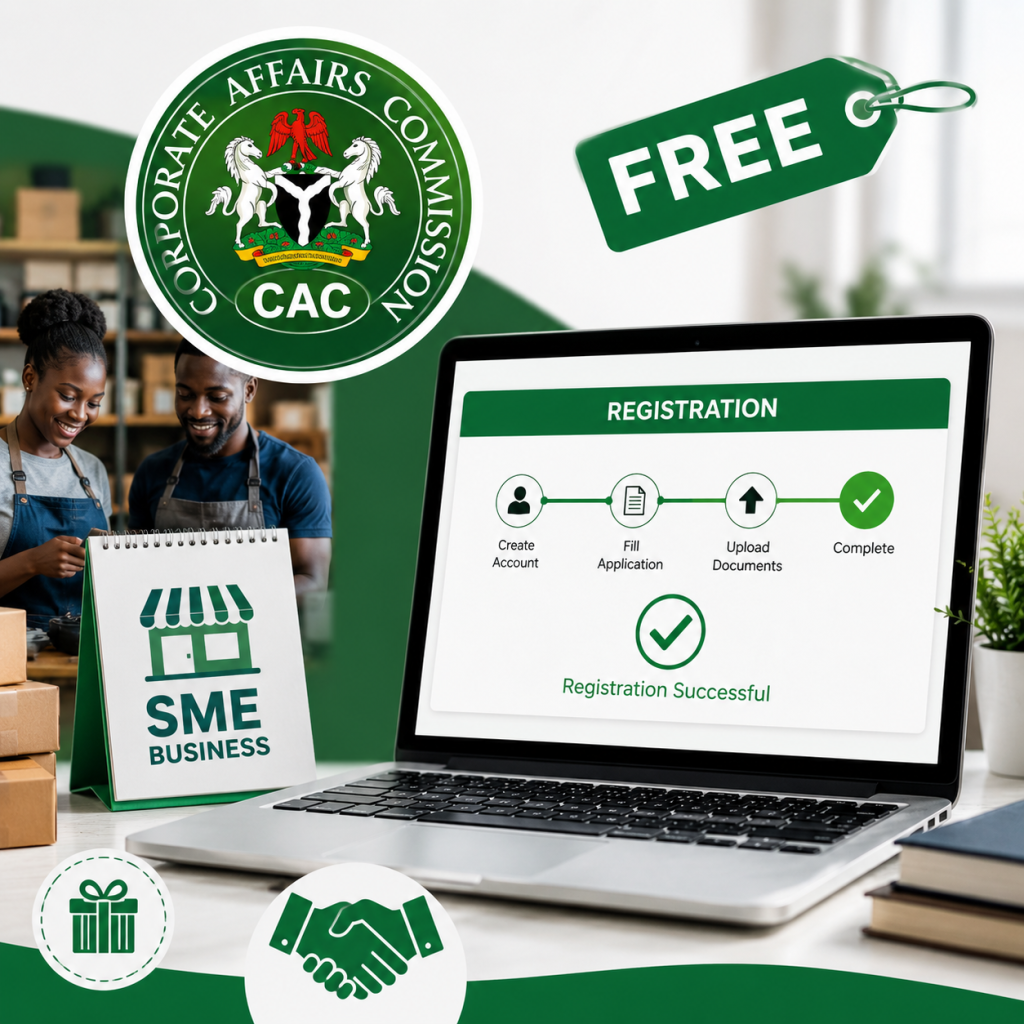
Step-by-Step on How to Apply for Free CAC Registration Under FG’s 250,000 MSME Programme
Starting and running a small business in Nigeria is no small feat. From sourcing capital to dealing with daily operational challenges, entrepreneurs have a lot on their plates. One of the biggest hurdles that many small business owners face early in their journey is the formalization of their enterprise. The cost, the bureaucracy, and the sheer lack of information often keep millions of brilliant Nigerian entrepreneurs trapped in the informal sector. But what if you could cross this major hurdle without spending a single kobo? That is exactly what the Federal Government of Nigeria is offering right now.
In a massive push to support the growth of small businesses and boost the economy, President Bola Ahmed Tinubu recently approved the free corporate registration of 250,000 Micro, Small, and Medium Enterprises (MSMEs) nationwide. This groundbreaking initiative, announced during the 8th National MSME Awards in June 2026, is a strategic collaboration between the Corporate Affairs Commission (CAC) and the Small and Medium Enterprises Development Agency of Nigeria (SMEDAN).
If you have been putting off registering your business because of the high statutory fees, or if you simply didn’t know where to start, this is your ultimate golden opportunity. In this comprehensive, SEO-friendly guide, we are going to break down everything you need to know about this scheme. We will hold you by the hand and show you the exact step-by-step process to secure your free CAC registration, the documents you need, the common mistakes that lead to disqualification, and the immense benefits that await your business once you get that certificate.



Understanding the Federal Government’s 250,000 MSME Free CAC Registration Scheme
Before we dive into the application steps, it is incredibly important to understand what this programme is all about and why the government is essentially giving away registrations that normally cost thousands of Naira. Let us look at the mechanics of the scheme.
Under the “Renewed Hope” agenda, the federal government recognized that a thriving economy is built on the back of small businesses. However, a significant percentage of Nigerian businesses operate informally. To fix this, the CAC and SMEDAN signed a Memorandum of Understanding (MoU) to waive the registration fees for 250,000 previously informal businesses. By doing this, the CAC is effectively giving up roughly ₦3 billion in statutory revenue just to ensure that everyday Nigerians can legitimize their hustles.
The core objective here is simple: to completely remove the financial difficulties that prevent nano, micro, and small-scale entrepreneurs from integrating into Nigeria’s formal banking and regulatory ecosystem. When your business is formalized, it stops being just a “hustle” and becomes a recognized corporate entity. This opens the doors to unimaginable opportunities, both locally and internationally.
It is also worth noting that this intervention goes beyond just handing you a certificate. Beneficiaries of this scheme are integrated directly into the SMEDAN database, meaning they will receive continuous aftercare, moral support, specialized technical training, and access to future government grants and loan interventions.
Why You Must Not Miss This Free Registration Opportunity
You might be wondering, “Why is having a CAC certificate so important? Can’t I just keep running my business quietly on Instagram, WhatsApp, or from my physical shop?” While operating informally might seem easier in the short term, it severely limits your growth potential. Let us explore the massive benefits of formalizing your business under this free scheme.
1. Access to Corporate Bank Accounts
In today’s business environment, asking clients to pay into your personal savings account screams unprofessionalism. Many high-paying corporate clients, government agencies, and even cautious individuals will simply refuse to do business with you if you do not have a corporate bank account. To open a corporate account with any commercial bank in Nigeria, a CAC certificate is the mandatory first requirement. Once you secure this free registration, you can walk into any bank and open an account in your business name.
2. Eligibility for Government Grants and Interventions
Whenever the federal or state government rolls out financial interventions—such as the recent ₦200 billion economic assistance programme for nano businesses, SMEs, and manufacturers—the very first screening criteria is always your CAC registration and your SMEDAN number. Without these, you are automatically disqualified from receiving free government money or single-digit interest loans from the Bank of Industry (BOI).
3. Building Trust and Credibility
Having “Registered” or “Enterprise” attached to your brand name instantly builds trust. In an era where online scams are rampant, customers want to know that they are dealing with a legally traceable entity. A CAC certificate proves that your business exists in the eyes of the law, making it easier to close sales, attract investors, and secure partnerships.
4. Protecting Your Brand Identity
Imagine building a solid reputation, gaining thousands of customers, and spending money on branding, only for someone else to register your exact business name with the CAC. If they register it before you, they legally own the name, and they can force you to rebrand or sue you for trademark infringement. Securing your business name now protects your brand identity nationwide.
5. Seamless Visa Applications for Business Travel
If you ever plan to travel abroad for business exhibitions, conferences, or to source for goods in countries like China, Turkey, or the UK, having a registered business makes your visa application process significantly smoother. Embassies view registered business owners as established individuals with strong ties to their home country.
Who Qualifies for This Free CAC Registration?
The beauty of this 250,000 MSME programme is that it is highly inclusive. It is targeted primarily at Nano, Micro, and Small enterprises. But what exactly do these terms mean, and do you fit into the picture?
A Nano business is typically a one-person operation or a business with less than three employees. A Micro business has a small team and modest revenue, while a Small enterprise is slightly larger but still growing. The truth is, the vast majority of everyday Nigerian hustles fall into these categories.
To put it in practical terms, if you run a digital platform—for instance, a blog like naijaplac.ng with hundreds of posts sharing job recruitment updates, or an educational platform providing WAEC preparation materials—you are essentially running a micro-enterprise. Perhaps you manage a digital marketing agency writing copy and running Meta ads for international job placements, or you are an artisan, a fashion designer, a local caterer, a POS operator, or a freelance tech developer. These are all valid, wealth-generating ventures that perfectly qualify for this scheme. Even if you are a content creator primarily focused on Google AdSense revenue, your platform is a digital asset that requires legal backing.
As long as you are a Nigerian, you operate a legitimate business, and your business is not yet registered with the Corporate Affairs Commission, you are 100% eligible to apply and claim your slot.
Prerequisites: What You Need Before Starting the Application
Before you rush to the portal, you need to gather some essential details to ensure your application process is smooth, fast, and error-free. Having these documents ready will prevent you from timing out on the portal or making mistakes that could lead to rejection.
- National Identification Number (NIN): This is non-negotiable. Your NIN must be active, and the details on it (especially your date of birth and spelling of your name) must be perfectly accurate. The CAC portal integrates with the NIMC database, and any discrepancy will halt your registration.
- Two Proposed Business Names: You need to come up with at least two unique names for your business. The primary name, and an alternative name just in case your first choice is already taken by someone else or rejected by the CAC for conflicting with an existing brand.
- Active Email Address: You will receive OTPs (One-Time Passwords), updates, and eventually your digital certificate via email. Ensure you have access to the email address you provide.
- Valid Phone Number: Your primary contact number is required for your SMEDAN and CAC profiles.
- Clear Passport Photograph: You will need a digital copy of your recent passport photograph, well-lit and clearly showing your face.
- Scanned Signature: Simply sign your signature clearly on a plain white piece of paper, take a sharp picture of it, and crop it neatly.
- Business Address: You must provide a valid physical address where your business operates. If you run a purely digital business (like a blog or remote agency), you can use your residential address.
Step-by-Step Guide on How to Apply for the Free CAC Registration
Now that you know the benefits and have gathered your documents, let us get into the core of the matter. The application process is divided into phases. First, you must get onboarded onto the SMEDAN database, and then you proceed to the CAC integration.
Phase 1: Registering on the Official SMEDAN Portal
The gateway to this free scheme is the Small and Medium Enterprises Development Agency of Nigeria (SMEDAN). You cannot go directly to the CAC portal expecting a waiver; you must pass through SMEDAN.
Official Sign-Up Link: Get started by registering on the official portal here: portal.smedan.gov.ng (You can also use smedanregister.ng).
Step 1: Create an Account. Once you are on the portal, locate the “Register” or “Sign Up” button. You will be prompted to enter your basic personal details: your full name, email address, active phone number, and a secure password. Make sure there are no typos in your email address.
Step 2: Verify Your Email. Check your email inbox (and your spam/junk folder) for a verification link or OTP sent by SMEDAN. Click the link or enter the code to verify your account.
Step 3: Fill in Your Business Information. Log back into the portal. You will now be required to provide details about your business. This includes your proposed business name, the sector you operate in (e.g., Information Technology, Agriculture, Fashion, Education, Media), your estimated staff strength, and your business address.
Step 4: The Crucial Question. During the form-filling process, you will be asked a very specific question: “Do you have a CAC registration number?” You must select “No”. Selecting “Yes” implies your business is already formalized, which automatically disqualifies you from the free registration scheme.
Step 5: Submit and Get Your SUIN. Review all the information you have provided to ensure absolute accuracy. Once you are satisfied, hit the submit button. Upon successful submission, the system will generate a SMEDAN Unique Identification Number (SUIN) for you. You may also receive a digital SMEDAN certificate via email. This SUIN is your primary proof that you are recognized by the agency.
Note for Existing SMEDAN Users: If you had previously registered your business on the SMEDAN database months or years ago but never proceeded to get a CAC certificate, you do not need to create a new account. Simply log into your existing dashboard, update any outdated contact details, and ensure your profile indicates that you do not have a CAC number. You are automatically qualified for the free drive.
Phase 2: Transitioning to the CAC Registration Process
After successfully securing your spot on the SMEDAN database, you will be contacted via email with the next steps. The integration between SMEDAN and CAC ensures that eligible candidates are seamlessly moved to the CAC’s Company Registration Portal (iCRP) for the actual certification.
Step 1: Accessing the CAC Portal. You will be directed to the CAC service portal at services.cac.gov.ng. If you do not already have an account there, you will need to click on “Sign Up” to create a public user account using your NIN and basic details.
Step 2: Name Reservation. On your CAC dashboard, click on the “Name Reservation” tab. Select “Business Name” as the specific entity type you wish to register. (Note: This free scheme is specifically for Business Names/Enterprises, not for registering Limited Liability Companies). Input your proposed business name exactly as you typed it on the SMEDAN portal.
Step 3: Availability Check. The robust CAC system will instantly run a search against millions of existing names to see if yours is available. If it clashes with an existing name, it will be flagged, and you will need to input your alternative name. Once an available name is confirmed, proceed to submit it.
Step 4: Generating the AV Code. Normally, reserving a name costs a small fee (around ₦1,000). However, under this federal intervention, the system is designed to waive this fee at the point of allocation. Once the name is approved, you will be issued an Availability Code (AV Code). This alphanumeric code is the key to unlocking the final registration form.
Step 5: Completing the Business Registration Form. Go back to your dashboard and select “Register New Business”. A prompt will appear asking for your AV Code. Input the code, and the main registration form will open. Here, you will be required to input the final details:
- Nature of Business: Give a concise description of what you do.
- Date of Commencement: When did you officially start operations?
- Proprietor Details: Enter your full name, nationality, residential address, and your NIN.
- Document Uploads: This is where you will securely upload the digital copy of your passport photograph, your scanned signature, and any valid ID card requested.
Step 6: Review and Submission. Carefully preview the entire form. Check for spelling errors, ensure your NIN matches the name on the application, and verify that the uploaded documents are clear and legible. Once you confirm everything is perfect, click submit.
Step 7: Bypassing the Payment Gateway. At the final stage, you will be redirected to the Remita payment gateway. For a standard Business Name registration, you would normally be required to pay the balance of the registration fees (usually around ₦10,000 to ₦11,000). However, because your application is linked to the 250,000 MSME waiver scheme, the total amount due should reflect as zero (₦0.00). Confirm the transaction to finalize your submission.
Step 8: Downloading Your CAC Certificate. The new, upgraded CAC iCRP system utilizes advanced Artificial Intelligence to auto-approve perfectly filled business name applications with incredible speed. Within a few hours to a day, your dashboard status should change from “Pending” to “Approved”. Once approved, you can immediately download your official CAC Certificate of Registration, alongside your Status Report, directly to your phone or computer. Print it out in color, frame it, and celebrate—your business is now a legally recognized entity in Nigeria!
Crucial Mistakes to Avoid During Your Application
While the government has made the process free and accessible, thousands of applications are queried or outrightly rejected every day due to simple, avoidable errors. To ensure you don’t lose your slot in the 250,000 quota, keep these warnings in mind:
1. Choosing Prohibited or Highly Restricted Names
The CAC has strict guidelines on what you can name your business. Avoid names that contain words like “National,” “Federal,” “Government,” “Holding,” “Group,” “Chamber of Commerce,” or names that sound like existing major corporations (e.g., trying to register “Dangote Digital Solutions” when you are not affiliated with the Dangote Group). Keep your name creative, simple, and relevant to your niche. If you use restricted words, your name reservation will be rejected, delaying your entire process.
2. NIN Data Mismatch
This is arguably the most common reason for rejection. The name, date of birth, and gender you provide on the CAC portal must perfectly match what is on the NIMC database for your NIN. If your NIN reads “Abubakar John Doe” and you apply on the CAC portal as “John Doe Abubakar,” the system will flag the inconsistency. Ensure absolute uniformity across all your documents.
3. Uploading Blurry Documents
When uploading your passport photograph and signature, ensure they are sharp and clear. Taking a picture of a passport photograph with a low-quality phone camera in a dark room will result in a blurry upload. If the CAC officials cannot clearly see your face or verify your signature, they will query the application.
4. Falling Victim to Fraudulent “Agents”
The entire essence of this scheme is that it is FREE. Unfortunately, whenever the government rolls out a beneficial programme, scammers spring up. Do not pay any individual, social media agent, or unverified website claiming they can “fast-track” your free CAC registration for a fee. Ensure you are only inputting your details on the official portal.smedan.gov.ng and services.cac.gov.ng websites. Beware of copycat sites that look identical but have slightly different web addresses.
What Happens After You Get Your Certificate? (Post-Registration Benefits)
Getting your CAC certificate is not the end of the journey; it is the beginning of a much larger, more profitable chapter for your business. The SMEDAN DG, Charles Odii, emphasized that “Formalization is the gateway to support.” So, what comes next?
First, you will now have access to SMEDAN’s continuous aftercare programs. This includes localized business clinics, capacity-building workshops, and technical training specifically tailored to help small business owners scale their operations. You will learn modern bookkeeping, digital marketing strategies, and how to structure your business for long-term survival.
Secondly, your formalized status places you in the direct line of sight for market linkages. SMEDAN actively works to connect verified Nigerian MSMEs with larger corporate buyers and international export opportunities. Your business is no longer hidden in the shadows.
Addressing the Fear of Taxation: A major reason many small business owners run away from the CAC is the fear that the Federal Inland Revenue Service (FIRS) will immediately start demanding heavy taxes the moment they register. This fear has been effectively addressed. According to recent reforms and the new tax framework taking effect in 2026, the exemption thresholds for small businesses have been significantly raised. This means that as a newly registered nano or micro-enterprise, you are legally protected from crushing tax burdens while you grow. The focus of the government right now is your growth and survival, not aggressive taxation.
Frequently Asked Questions (FAQs) About the MSME Registration
To ensure absolutely no stone is left unturned, let us address some of the most pressing questions entrepreneurs have about this initiative.
Q1: Is the registration really 100% free?
Yes, it is entirely free. The federal government, through the CAC, has waived the statutory N10,000 to N11,000 fee usually required for registering a Business Name. You will not be asked to pay any money on the official portals.
Q2: Can I use this scheme to register a Limited Liability Company (LLC)?
No. This specific intervention is designed exclusively for registering Business Names (Enterprises). If you wish to incorporate a Limited Liability Company, an NGO, or an Incorporated Trustee, you will have to undergo the standard CAC process and pay the appropriate fees.
Q3: I live in a rural area and I am not very good with computers. How can I apply?
The government has made provisions for this. If you are not a “digital native” or you struggle with navigating online portals, you can visit any of the physical SMEDAN State Offices located across the 36 states and the FCT. The officials there have been mandated to provide physical onboarding assistance and help you complete the process at no cost.
Q4: How long does the entire process take?
If you follow the steps meticulously and provide all accurate documents, the process is incredibly fast. Getting your SUIN from SMEDAN is instant. The CAC name reservation takes a few hours to a day, and final approval of the business registration can take anywhere from 24 to 48 hours, thanks to the CAC’s newly deployed AI auto-approval system.
Q5: What if I already started the CAC registration process manually and paid the name reservation fee before hearing about this?
If you have already initiated a paid application on the CAC portal, it cannot be converted into a free slot retroactively. This scheme is strictly for fresh applications that begin their journey through the SMEDAN portal integration.
Q6: Will the upcoming CAC fee review affect this free offer?
No. SMEDAN has confirmed that despite any planned review of general corporate registration fees by the CAC, the 250,000 slots reserved for small businesses under this MoU are fully protected and will remain absolutely free until the quota is exhausted.
Q7: Do I need a lawyer or a chartered accountant to help me apply?
Absolutely not. The upgraded iCRP portal is designed to be user-friendly, allowing everyday individuals to register their businesses by themselves. You do not need to hire an accredited CAC agent, a lawyer, or an accountant to process a Business Name under this scheme. You can do it directly from your smartphone or laptop.
Final Thoughts: Take Action Now Before the Slots Run Out
The business landscape in Nigeria is evolving rapidly, and the divide between formal, recognized businesses and informal hustles is widening. Government interventions, massive corporate partnerships, and single-digit interest loans are exclusively reserved for those who have taken the vital step of legalizing their operations.
The Federal Government’s 250,000 MSME Free CAC Registration Programme is a rare, monumental gift to the Nigerian entrepreneur. It removes the only valid excuse—lack of funds—that prevents brilliant business minds from going corporate. Whether you are typing code in a small tech hub, baking cakes from your kitchen, teaching students online, or publishing daily content on your website, your business deserves the dignity, protection, and opportunities that come with a corporate identity.
Remember, this is a quota-based system. The government has capped the intervention at exactly 250,000 businesses across all 36 states and the Federal Capital Territory. Once these slots are filled up, the window closes, and latecomers will have to revert to paying the full statutory fees out of their own pockets.
Do not procrastinate. Do not wait until you desperately need a corporate account to receive a massive payment before you start scrambling for registration. Gather your NIN, pick your business names, take a clear picture of your signature, and head over to the SMEDAN portal right now to secure your legacy.
Your business is valid. Your hustle is important. Now, go and make it official.