Apply to Youth Engagement in Governance & Policy (YEGP) Fellowship 2026/2027

Apply to Youth Engagement in Governance & Policy (YEGP) Fellowship 2026/2027
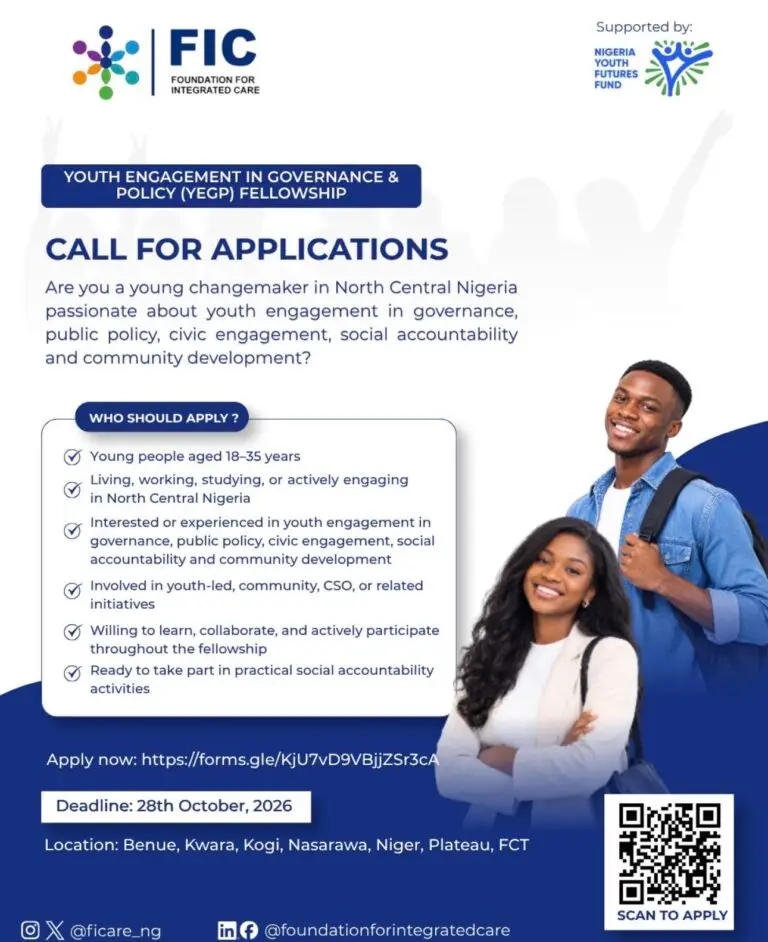
The landscape of leadership, public administration, and civic participation in Nigeria is currently undergoing a massive and necessary paradigm shift. As the demand for transparency, accountability, and inclusive decision-making intensifies across all levels of government, the Youth Engagement in Governance & Policy (YEGP) Fellowship 2026/2027 has officially opened its doors, emerging as a vital beacon of opportunity for young changemakers. Organized by the prestigious Foundation for Integrated Care (FIC), this highly competitive and transformative fellowship is meticulously designed to equip dynamic young leaders from North Central Nigeria with the practical tools, institutional knowledge, and strategic networks required to meaningfully participate in local and national governance structures.
If you have ever felt disconnected from the policies that shape your community, or if you possess a burning desire to influence budgetary allocations, track the implementation of public services, and hold public officials accountable, this comprehensive guide will provide you with everything you need to know about applying for, and securing your spot in, the YEGP Fellowship. This is not just another youth seminar; it is a rigorous, action-oriented program aimed at bridging the gap between young citizens and the government systems that serve them.
For decades, young people have been relegated to the background of policy formulation, often viewed merely as beneficiaries rather than active partners and co-creators of sustainable development. The YEGP Fellowship seeks to dismantle this outdated narrative. By targeting grassroots and community-level advocates, the fellowship will select a cohort of 35 exceptional individuals who will undergo intensive capacity building. These selected fellows will be deployed as civic ambassadors in their respective states, armed with the evidence-based advocacy skills necessary to drive systemic change. Read on to discover the eligibility criteria, the core objectives of the program, a detailed breakdown of the target locations, and actionable tips on how to submit a winning application before the deadline on 28 October 2026.
The Critical Need for Youth Engagement in Governance in Nigeria
To fully appreciate the magnitude and importance of the Youth Engagement in Governance & Policy (YEGP) Fellowship, it is crucial to understand the broader socio-political context of Nigeria. Nigeria boasts one of the largest youth populations in the world, with over 60% of its citizens under the age of 35. Theoretically, this demographic dividend should translate into a massive driving force for economic innovation, progressive policy-making, and rapid national development. However, the reality on the ground often paints a different picture. Systemic barriers, lack of institutional funding for youth-led initiatives, and entrenched political gatekeeping have historically marginalized young people from the corridors of power.


When young people are excluded from governance, the resulting policies often fail to address the unique challenges they face—such as youth unemployment, educational deficits, digital divide issues, and inadequate healthcare infrastructure. The YEGP Fellowship recognizes that sustainable community development is impossible without the active, informed, and strategic participation of the youth. Engaging in governance goes beyond merely voting during election cycles; it involves a continuous, daily commitment to monitoring government activities, understanding how public funds are allocated, and advocating for the equitable distribution of resources.
Furthermore, the digital age has empowered young Nigerians with unprecedented access to information and organizing tools. From social media advocacy to digital civic tech platforms, the youth are already demonstrating their capacity to mobilize and demand better governance. What is often missing, however, is the structural knowledge required to navigate complex government bureaucracies and translate online activism into tangible policy reforms. This is precisely the knowledge gap that the YEGP Fellowship aims to fill. By transitioning young activists from outside agitators to informed policy influencers who can sit at the decision-making table, the fellowship is laying the groundwork for a more resilient and accountable democratic system.
About the Organizing Body: Foundation for Integrated Care (FIC)
The Foundation for Integrated Care (FIC) is a forward-thinking, impact-driven organization committed to fostering sustainable development, improving public health outcomes, and promoting civic participation across Nigeria. With a deep understanding of the intersection between social well-being and good governance, FIC operates on the philosophy that a healthy society is built on the foundations of transparent institutions and active citizen engagement. Their initiatives consistently prioritize marginalized groups, ensuring that the voices of the youth, women, and rural populations are amplified in the policy-making arena.
By launching the YEGP Fellowship, the Foundation for Integrated Care is demonstrating its long-term commitment to human capital development. FIC understands that to improve public service delivery—whether in healthcare, education, or infrastructure—citizens must be empowered to hold their leaders accountable. Through strategic partnerships with government stakeholders, civil society organizations (CSOs), and community leaders, FIC provides its fellows with a unique platform that bridges the gap between grassroots realities and high-level policy formulation. Fellows selected for this program will benefit immensely from FIC’s extensive network, gaining access to mentorship from seasoned policy experts and development practitioners.
Core Objectives of the YEGP Fellowship
The YEGP Fellowship is structured around a comprehensive curriculum designed to yield specific, measurable outcomes in the realm of civic engagement. The program is not merely theoretical; it is deeply rooted in practical application. Below are the primary objectives that guide the fellowship’s activities:
1. Meaningful Participation in Governance Structures
The primary goal of the fellowship is to transition young people from passive observers to active participants in the democratic process. Fellows will be trained on how to navigate local government councils, state houses of assembly, and municipal planning committees. They will learn the structural hierarchy of government ministries, departments, and agencies (MDAs), enabling them to identify the right pressure points for advocacy. By understanding the mechanics of local governance, fellows can ensure that youth perspectives are integrated into community development plans from the onset.
2. Effective Engagement with Government Systems and Stakeholders
Advocacy without diplomacy often leads to dead ends. The YEGP Fellowship places a strong emphasis on constructive engagement. Fellows will be equipped with the soft skills and strategic communication techniques necessary to dialogue effectively with political office holders, traditional rulers, and bureaucratic civil servants. Rather than adopting an entirely adversarial approach, fellows will learn how to build coalitions, negotiate policy concessions, and present themselves as valuable partners in the quest for improved public service delivery.
3. Evidence Generation and Policy Influence
In modern governance, data is the ultimate currency. Emotional appeals are rarely sufficient to change entrenched public policies or redirect government budgets. The fellowship will train participants in the art of evidence-based advocacy. This involves conducting grassroots research, administering community surveys, analyzing government reports, and compiling actionable data. Fellows will learn how to draft policy briefs, white papers, and research summaries that can be presented to lawmakers to justify the need for specific interventions. By rooting their advocacy in solid evidence, fellows will significantly increase their chances of influencing public policies and budgetary allocations.
4. Driving Social Accountability
Social accountability refers to the broad range of actions and mechanisms beyond voting that citizens can use to hold the state to account. The YEGP Fellowship aims to create a cadre of social accountability champions. Fellows will be trained in budget tracking, procurement monitoring, and the use of the Freedom of Information (FOI) Act. They will learn how to track capital projects from the budget proposal stage down to the actual implementation in their local communities, ensuring that public funds are utilized efficiently and transparently.
Target Locations and Quota Distribution
To ensure focused and impactful interventions, the 2026/2027 YEGP Fellowship is specifically targeting North Central Nigeria. The region is a vital socio-economic and political hub, often serving as the bridge between the northern and southern parts of the country. A total of 35 fellows will be carefully selected, with a strict quota of five (5) fellows from each of the seven mapped locations. This equal distribution ensures that every state in the region receives adequate representation and localized civic intervention.
Benue State (5 Slots)
Known as the “Food Basket of the Nation,” Benue State has a massive youth population deeply involved in agriculture and local commerce. However, the state also faces unique challenges related to resource management, infrastructure deficit, and security. Fellows selected from Benue will have the critical task of advocating for agricultural policies that favor young farmers, tracking investments in rural infrastructure, and promoting peacebuilding initiatives through inclusive governance.
Kogi State (5 Slots)
Kogi State, the “Confluence State,” occupies a strategic geographical position, bordering multiple states. The youth in Kogi are vibrant and increasingly vocal about the need for industrialization and job creation. YEGP fellows from Kogi will be empowered to engage with state actors on policies related to solid mineral development, environmental sustainability, and youth employment schemes, ensuring that the state’s natural wealth translates into tangible benefits for its younger generation.
Kwara State (5 Slots)
Kwara State has seen a recent surge in youth political awareness and participation. The state’s transition towards more inclusive governance structures makes it a fertile ground for the YEGP Fellowship. Fellows from Kwara will focus on consolidating these gains, utilizing their training to monitor educational policies, healthcare delivery, and small and medium-sized enterprise (SME) support funds. Their role will be to institutionalize youth participation in Kwara’s policy frameworks.
Nasarawa State (5 Slots)
As a rapidly developing state in close proximity to the nation’s capital, Nasarawa is experiencing an influx of investments and infrastructural expansion. It is crucial that the youth are not left behind in this development wave. Nasarawa-based fellows will be trained to track government spending on urban development, advocate for affordable housing policies, and ensure that indigenous youth are prioritized in state-sponsored empowerment programs.
Niger State (5 Slots)
Being the largest state in Nigeria by landmass, Niger State presents unique governance challenges, particularly regarding rural outreach and decentralized public service delivery. Fellows from Niger State will need to champion policies that bridge the gap between the urban centers and the remote local government areas. Tracking budgets for rural electrification, primary healthcare centers, and educational facilities will be a core focus for the Niger cohort.
Plateau State (5 Slots)
Plateau State, renowned for its tourism potential and temperate climate, has a rich history of resilient youth advocacy. The YEGP fellows selected from Plateau will play a vital role in peacebuilding through civic engagement. By advocating for policies that promote social cohesion, equitable resource distribution, and tourism development, these young leaders will help shape a prosperous and harmonious future for the state.
Federal Capital Territory – FCT (5 Slots)
The FCT is the epicenter of national policy-making. While it houses the federal government, its local area councils also require intense civic scrutiny. Fellows from the FCT will have the dual advantage of engaging with both local municipal authorities and national policy frameworks. Their focus will be on urban governance, tracking the implementation of public services in satellite towns, and advocating for policies that protect the rights of marginalized urban youth.
Comprehensive Eligibility Criteria
The Foundation for Integrated Care has outlined strict eligibility criteria to ensure that the fellowship attracts individuals who are not only passionate but also capable of driving real change. Before beginning your application, you must critically assess whether you meet all the following requirements:
- Age Limitation: Applicants must be between 18 and 35 years old at the time of application. This ensures that the program strictly serves the youth demographic, providing them with early-career leverage in public policy.
- Geographical Residency or Engagement: You must currently be living, working, studying, or actively engaging in grassroots activities within one of the six North Central states (Benue, Kogi, Kwara, Nasarawa, Niger, Plateau) or the Federal Capital Territory (FCT).
- Demonstrable Experience and Interest: The fellowship is not for beginners looking to simply pad their resumes. Applicants must demonstrate a clear interest, prior experience, or active involvement in areas such as youth participation, governance, accountability, civic action, advocacy, or community development. You must be able to point to past or ongoing initiatives you have contributed to.
- Commitment to Learning: Selected fellows must demonstrate a willingness to learn, unlearn, and relearn. The policy landscape is complex, and participants must be open to receiving constructive feedback, attending rigorous training sessions, and actively participating in all fellowship activities throughout the program’s duration.
- Collaborative Spirit: Governance is a team sport. Applicants must be willing to collaborate with other young people, civil society organizations (CSOs), community actors, and relevant government stakeholders. A lone-wolf mentality will not succeed in this fellowship.
- Action-Oriented Mindset: Perhaps the most critical criterion is the commitment to execution. Applicants must demonstrate a clear willingness to undertake practical, evidence-informed social accountability actions both during and following the fellowship. The organizers are looking for doers, not just talkers.
The Tangible Benefits of the YEGP Fellowship
Participating in the Youth Engagement in Governance & Policy Fellowship is a career-defining opportunity for young Nigerians interested in the development sector, public administration, or political leadership. The benefits extend far beyond a mere certificate of participation.
1. Intensive Capacity Building
Fellows will undergo world-class training modules facilitated by seasoned experts in public policy, economics, and civic tech. You will learn the intricacies of the Nigerian budget cycle, how to read and interpret complex government financial documents, and how to utilize digital tools to track public procurement processes. This specialized knowledge is highly sought after in the non-profit and international development sectors.
2. High-Level Networking and Mentorship
One of the greatest hurdles for young advocates is gaining access to decision-makers. The YEGP Fellowship serves as a bridge, connecting you directly with influential government officials, veteran civil society leaders, and international development partners. Furthermore, the mentorship provided during the program will help you navigate your career path, refine your advocacy strategies, and avoid common pitfalls in civic engagement.
3. Funding and Resource Access
While the fellowship focuses heavily on capacity building, being part of the FIC alumni network positions you favorably for future grants, funding opportunities, and micro-grants aimed at executing community-based projects. The skills you acquire in proposal writing and evidence-based reporting will drastically improve your chances of securing independent funding for your NGOs or community initiatives in the future.
4. Enhanced Professional Profile
Graduating from a highly competitive fellowship that selects only 35 individuals from a massive region significantly boosts your professional credibility. It signals to future employers, donor agencies, and political organizations that you are a vetted, highly capable leader with a proven track record of civic responsibility. It is an exceptional addition to the resume of anyone pursuing a career in public policy, law, international relations, or social entrepreneurship.
Deep Dive: Understanding Social Accountability for Your Application
To submit a highly competitive application, it is vital to fully grasp the concept of Social Accountability, as this is the cornerstone of the YEGP Fellowship. When drafting your application essays or motivation statements, incorporating a deep understanding of this concept will set you apart from other candidates.
Social accountability is an approach toward building accountability that relies on civic engagement, where ordinary citizens and/or civil society organizations participate directly or indirectly in exacting accountability. Unlike traditional accountability mechanisms (like government audits or legislative oversight), which often happen behind closed doors, social accountability is grassroots-driven. It includes initiatives such as:
- Participatory Budgeting: Where citizens have a direct say in how a portion of the local government budget is spent.
- Public Expenditure Tracking Surveys (PETS): Where youth groups monitor the flow of resources from the government treasury down to the actual service delivery point (e.g., ensuring funds allocated for a primary school roof actually buy the roofing materials).
- Citizen Report Cards: Where community members grade the performance of public services, such as water supply, healthcare facilities, and waste management, providing empirical data to pressure government agencies for improvements.
- Social Audits: A process where citizens gather to review official government records and compare them against physical realities in their neighborhoods to expose discrepancies and corruption.
If you can clearly articulate how you plan to use these tools within your specific state—whether in Benue, Kogi, Kwara, Nasarawa, Niger, Plateau, or the FCT—your application will strongly resonate with the selection committee.
Step-by-Step Guide on How to Apply and Win
The application process for the YEGP Fellowship is straightforward but requires careful thought and preparation. With only 5 slots available per state, the competition will be fierce. Follow these strategic steps to ensure your application stands out:
Step 1: Audit Your Civic Profile
Before you click the application link, take stock of your past and present civic activities. Have you volunteered for a community sanitation project? Have you written blog posts advocating for youth rights? Have you organized a local town hall meeting? Gather evidence of these activities—photos, links to articles, certificates, or reference letters. You need to prove that you are already an active citizen.
Step 2: Define Your Core Policy Interest
Do not be a generalist. Decide on one or two specific policy areas you are deeply passionate about. Is it maternal healthcare? Is it rural electrification? Is it youth unemployment or digital literacy? By focusing on a specific niche, your application will appear more focused and realistic. The selection committee wants to see a clear vision, not vague promises to “change the world.”
Step 3: Prepare a Powerful Motivation Statement
Most fellowships require an essay or a statement of purpose. Ensure your motivation statement follows a logical flow:
a) The Problem: Identify a specific governance or policy failure in your local community.
b) The Evidence: Provide a brief statistic or factual observation backing up this problem.
c) Your Action: Explain what you have done so far in your own small way to address it.
d) The Bridge: Explain exactly how the YEGP Fellowship will equip you to scale your impact and solve the problem structurally.
Step 4: Complete the Online Application Form
Ensure you fill out every section of the online form meticulously. Do not use complex jargon or overly academic language; write clearly, passionately, and concisely. Double-check your contact information, especially your email address and phone number, to ensure the organizers can reach you if selected.
Step 5: Submit Before the Deadline
The strict deadline for the application is 28 October 2026. Do not wait until the final day to submit your application. Technical glitches, internet downtimes, and server overloads are common on deadline days. Aim to submit your application at least three days before the deadline.
Post-Fellowship Expectations
The Foundation for Integrated Care (FIC) views the end of the fellowship training as the beginning of the real work. Upon completion, the 35 fellows are expected to return to their respective states and initiate practical social accountability projects. You will be expected to organize step-down training sessions for other youth in your community, transferring the knowledge you have acquired. Furthermore, fellows will be mandated to form active tracking teams to monitor specific local government budgets, write policy briefs, and maintain continuous dialogue with their state representatives. The fellowship is a lifelong commitment to national development.
Official Application Link to Get Started
If you meet the eligibility criteria and are ready to take your civic advocacy to the structural level, do not miss this golden opportunity. This is your chance to move from the sidelines to the center of policy influence in Nigeria.
Ready to transform your community? Start your application right now by visiting the official YEGP Fellowship application portal.
Official Application Link: Click Here to Apply for the YEGP Fellowship
Source: Yeshub.ng
Remember, the future of Nigerian governance lies in the hands of informed, strategic, and proactive youth. Prepare your application thoroughly, believe in your capacity to drive change, and take that bold step toward policy leadership today. Good luck!