

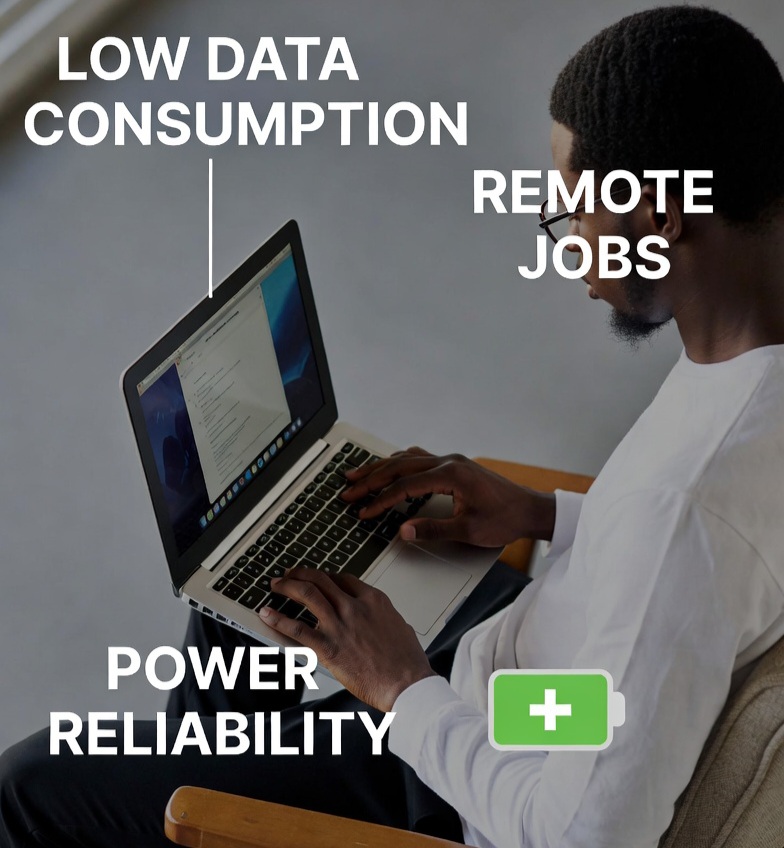
Remote Jobs With Low Data Consumption & Power Reliability Strategies in Nigeria: Thriving in a Challenging Digital Economy
Navigating Nigeria’s Digital Infrastructure: Turning Limitations into Opportunities
Many Nigerians, the dream of working remotely faces two formidable challenges: unreliable internet connectivity and frequent power outages. Yet, rather than viewing these as insurmountable barriers, innovative professionals are discovering ways to thrive in the digital economy by strategically selecting low-data remote jobs and implementing smart power solutions. This comprehensive guide reveals practical strategies for building a sustainable remote career despite Nigeria’s infrastructure challenges.




The Current Landscape: Understanding Nigeria’s Digital Realities
Recent statistics paint a clear picture of Nigeria’s digital environment:
- Internet Reliability: According to the Nigerian Communications Commission, internet penetration stands at approximately 55%, but connection stability remains inconsistent, especially outside major urban centers
- Data Costs: Nigeria ranks among countries with relatively high data costs relative to average income, with 1GB typically costing 2-4% of average monthly earnings
- Power Availability: The World Bank estimates Nigeria’s power outages cost businesses approximately $29 billion yearly, with many households experiencing daily disruptions
Despite these challenges, the remote work revolution offers unprecedented opportunities for those who adapt strategically.
Remote Jobs Ideal for Low and Unstable Internet Connections
1. Content-Based Work with Offline Capabilities
Content Writing and Editing
Many content platforms allow offline work:
- Platforms: Upwork, Fiverr, Constant Content
- Strategy: Download research materials during stable connections, write offline using Google Docs’ offline mode or Microsoft Word, upload when connectivity returns
- Data Requirements: Minimal—primarily for uploading finished documents (typically less than 1MB per article)
Transcription Services
- ·Requirements: Good listening skills, typing speed (60+ WPM)
- Data Strategy: Download audio files during stable periods, transcribe offline, upload completed work
- Recommended Tools: Express Scribe (free version), oTranscribe
- Earnings Potential: $5-$20 per audio hour depending on complexity
2. Data-Light Technical and Administrative Roles
Email Management and Customer Support
- Platforms: Remote.co, We Work Remotely
- Data Strategy: Use email clients with offline capabilities (Thunderbird, Outlook)
- Typical Data Consumption: Less than 100MB daily for email-based roles
Data Entry and Virtual Assistance
- Characteristics: Often asynchronous, deadline-based rather than real-time
- Tools: Spreadsheet software with offline functionality
- Data Needs: Mainly for receiving assignments and submitting completed work
3. Creative Work with Minimal Connectivity Requirements
Graphic Design (Basic)
- Suitable For: Logo design, social media graphics, basic layouts
- Tools: Canva (with offline planning), Adobe Spark
- Strategy: Prepare templates and assets offline, finalize and upload when connected
Book Formatting and Layout Design
- Requirements: Understanding of publishing standards
- Tools: Microsoft Word, free desktop publishing software
- Data Use: Primarily for final file transfers
Essential Data-Saving Tools and Strategies for Nigerian Remote Workers
Browser Optimization for Maximum Efficiency
Essential Extensions and Settings:
1. Data Saver Extensions:
- Data Saver (Chrome): Compresses web pages by up to 80%
- Opera Browser’s built-in data saving: Reduces data usage by 50% on average
- Brave Browser: Blocks ads and trackers, significantly reducing data load
2. Critical Browser Settings:
- Disable auto-play videos on all websites
- Enable “Lite mode” in Chrome or similar features in other browsers
- se text-only modes for news and research sites
Communication Tools That Minimize Data Usage
Text-First Platforms:
- Telegram: Offers extremely data-efficient text communication
- Signal: Minimal data consumption for messaging
- Slack with optimizations: Disable image previews, use thread-only views
Email Management Strategies:
- Use desktop clients (Thunderbird, Outlook) instead of webmail
- Configure to download headers only, not full messages
- Schedule sends for when connectivity is strongest
Productivity Software with Offline Capabilities
Document and Spreadsheet Tools:
- Google Docs Offline: Enable in settings before going offline
- Microsoft Office: Full offline functionality with OneDrive sync when available
- LibreOffice: Free, open-source alternative with excellent offline performance
Project Management:
- Trello: Offers offline mobile functionality
- Notion: Limited offline capability but useful for planning
- Simple text files with folder organization: Surprisingly effective for many projects
Power Reliability Strategies: Staying Productive During Outages
1. Power Backup Solutions for Every Budget
Entry-Level Solutions (₦20,000 – ₦50,000):
- Power Banks: High-capacity banks (20,000mAh+) can power laptops for 6-8 hours
- Inverter Systems: Small 650VA-1KVA inverters with one battery can provide 4-6 hours of laptop power
- Solar Laptop Chargers: Portable 20W-40W panels with battery storage
Mid-Range Systems (₦80,000 – ₦200,000):
- Hybrid Solar/Inverter Systems: 1.5KVA systems with 2 batteries can power laptops, routers, and lights
- Quiet Generators: Inverter generators (1-2KVA) for critical work hours
- Uninterruptible Power Supplies (UPS): For seamless transition during power cuts
Premium Solutions (₦300,000+):
- Full Solar Installations: 3KVA+ systems with battery banks for 24/7 operation
- Automatic Changeover Systems: Seamless transition between grid, solar, and generator
2. Device Optimization for Extended Battery Life
Laptop Power Management:
- Enable battery saver modes
- Reduce screen brightness (cuts power consumption by 30-40%)
- Close unnecessary applications and browser tabs
- Consider Chromebooks or ARM-based laptops for superior battery life
Mobile Device Strategies:
- Use smartphones as hotspots only when necessary
- Enable extreme battery saving modes
- Carry multiple power banks for extended outages
3. Workspace Arrangement for Power Efficiency
Strategic Timing:
- Schedule high-power tasks (video calls, large uploads) for periods with most reliable power
- Use low-power devices (tablets, smartphones) during outages for light tasks
- Implement the “Pomodoro Technique” with power-conscious timing
Physical Workspace Design:
- Position near natural light to reduce lighting needs
- Use LED lighting exclusively
- Keep devices in cool areas to prevent overheating and battery drain
Platform-Specific Strategies for Popular Remote Work Sites
Upwork and Similar Platforms
Connection Strategies:
- Use platform’s mobile apps (often more data-efficient than web interface)
- Disable automatic proposal updates
- Prepare proposals offline and paste when submitting
Schedule connects usage during stable periods
Client Communication:
- Set clear expectations about connectivity limitations
- Use asynchronous communication as default
- Establish “check-in” times rather than expecting immediate responses
Fiverr and Gig Economy Platforms
Profile Optimization:
- Highlight reliability and deadline adherence despite challenges
- Offer services with flexible delivery timelines
- Create gig videos that can be uploaded during optimal connectivity periods
Order Management:
- Download order requirements immediately upon receipt
- Use the “request extension” feature proactively if outages affect delivery
- Build buffer time into all delivery estimates
Financial Considerations: Budgeting for Remote Work Infrastructure
Realistic Monthly Budget Allocation
Typical Remote Worker Expenses:
- ·Data: ₦10,000–₦25,000 monthly (depending on work type)
- Power Solutions: Amortized cost of ₦5,000–₦15,000 monthly for equipment
- Equipment Maintenance: ₦3,000–₦8,000 monthly allocation
- Backup Connectivity: ₦5,000–₦10,000 for secondary ISP or mobile data
ROI Calculation for Power Investments
Example Scenario:
- Investment: ₦150,000 for solar/inverter system
- Monthly savings from reduced generator fuel: ₦8,000
- Increased productivity value: ₦15,000 monthly
- Payback period: Approximately 7 months
Success Stories: Nigerians Thriving with Limited Infrastructure
Case Study 1: Content Writer in Enugu
Challenge: 3-4 hour daily power cuts, expensive and unreliable data
Solution:
- Invested in 650VA inverter with two batteries (₦85,000)
- Switched to Opera browser with data saving enabled
- Negotiated deadlines based on connectivity patterns
Result:Increased monthly earnings from $200 to $850 in 8 months
Case Study 2: Virtual Assistant in Kano
Challenge: Frequent network congestion making real-time work impossible
Solution:
- Focused on email management and data entry roles
- Implemented strict offline work protocols
- Used scheduled sends for all communications
Result:Built roster of 5 consistent clients, earning ₦180,000 monthly
Case Study 3: Graphic Designer in Port Harcourt
Challenge: Unpredictable outages during critical upload periods
Solution:
- Purchased portable solar charger for laptop (₦45,000)
- Switched to primarily vector-based work (smaller file sizes)
- Implemented “upload windows” during most reliable periods
Result:Consistently meets deadlines, increased client retention by 60%
Future Trends: Emerging Opportunities and Technologies
1. Starlink and Satellite Internet
While currently expensive, prices are expected to decrease, potentially revolutionizing rural remote work opportunities in Nigeria.
2. Edge Computing for Remote Work
Applications that process data locally rather than in the cloud will become increasingly valuable in low-connectivity environments.
3. Low-Earth Orbit Satellite Integration
Future mobile devices with built-in satellite connectivity may bypass terrestrial network limitations entirely.
4. Nigerian-Specific Solutions
Local startups are developing:
- Community mesh networks for shared connectivity
- Pay-as-you-go solar solutions tailored for digital workers
- Data-efficient platforms optimized for Nigerian networks
Actionable Checklist for Starting Your Low-Data Remote Career
Week 1-2: Foundation Building
- Assess current connectivity patterns (stable/unstable periods)
- Inventory existing equipment and power capabilities
- Implement basic data-saving measures on all devices
- Research 3-5 suitable job types for your skills and infrastructure
Week 3-4: Skill Development and Tool Setup
- Master offline functionality of essential software
- Create offline portfolio or work samples
- Establish power backup plan within your budget
- Practice completing sample projects offline
Month 2: Implementation
- Apply for suitable positions with honest infrastructure disclosures
- Establish clear communication protocols with first clients
- Refine systems based on real-world experience
- ·Begin saving for infrastructure upgrades
Ongoing: Optimization
- Monthly review of data and power expenses
- Regular research on new tools and strategies
- Gradual infrastructure investment as earnings increase
- Network with other Nigerian remote workers for shared solutions
Conclusion: Building Resilience and Success on Your Terms
The limitations of Nigeria’s digital infrastructure need not limit your professional aspirations. By strategically selecting appropriate remote work opportunities, implementing intelligent data-saving practices, and developing reliable power solutions, you can build a sustainable and profitable remote career.
The most successful Nigerian remote workers aren’t those with perfect infrastructure, but those who have developed systems to work effectively within their constraints. Your challenges with connectivity and power have likely developed in you valuable traits—resilience, creativity in problem-solving, and meticulous planning—that are assets in the remote work world.
Begin today by implementing just one strategy from this guide. Whether it’s configuring your browser for data efficiency, investing in a basic power backup solution, or applying for your first data-light remote position, each step moves you closer to a career unconstrained by geography or local infrastructure limitations.
Remember: In the global digital economy, your value is determined by the quality of your work and your reliability in delivery—not by the stability of your internet connection. With the right strategies, you can deliver exceptional value to clients worldwide while building a career that thrives despite Nigeria’s infrastructure challenges.