AgriSpark Kaduna Agritech Bootcamp and Innovation Challenge 2026: Revolutionizing Agriculture Through Technology
The future of agriculture will not be built by simply relying on the traditional farming methods that have sustained previous generations. Instead, it will be engineered by visionary minds, bold innovators, and tech enthusiasts who are willing to confront and solve the complex agricultural problems that others often overlook. This year, the spotlight is firmly on Northern Nigeria as the AgriSpark Kaduna Agritech Bootcamp and Innovation Challenge 2026 officially opens its doors. This highly anticipated event is set to bring together Kaduna-based founders, developers, and agricultural stakeholders to build solutions capable of creating real, scalable impact across the entire agricultural value chain.
If you are building an agritech startup, developing a technology-driven solution to a real-world agricultural problem, or simply sitting on a groundbreaking idea that deserves to be brought to life, AgriSpark 2026 is your golden opportunity. This is not just another tech conference where people gather to discuss the future; this is an intensive, hands-on battleground where ideas get tested, products get challenged, teams get sharper, and promising concepts get the rare opportunity to transition from mere blueprints to market-ready innovations.
What is the AgriSpark Kaduna Agritech Bootcamp and Innovation Challenge?
The Kaduna Agritech Bootcamp, Hackathon, and Pitchathon—popularly branded as AgriSpark—is a premium innovation programme specifically designed to encourage technology-driven approaches to pressing agricultural challenges. The 2026 edition is structured to bridge the gap between technology and grassroots farming by empowering local innovators with the tools, mentorship, and funding they need to succeed.
According to the official programme announcement, participants will undergo an intensive innovation challenge over the course of a few days. This immersive experience will culminate in a high-stakes pitch competition, where the most promising startup teams will present their refined solutions to a panel of industry stakeholders, seasoned investors, and sector experts. The core philosophy of AgriSpark is that the convergence of various fields of expertise—such as software development, agronomy, data science, and engineering—ensures a holistic and highly effective approach to problem-solving within the agricultural sector.
The Strategic Importance of Hosting AgriSpark in Kaduna
When discussing agriculture in Nigeria, Kaduna State holds a position of immense strategic and economic importance. Known for its vast arable land and a deeply rooted farming culture, Kaduna serves as a major food basket for the nation. However, despite its massive agricultural output, the state—and the broader region—faces significant challenges that stifle maximum productivity. Issues such as post-harvest losses, lack of access to actionable climate data, inefficient supply chains, and poor resource management continue to plague local farmers.
Hosting the AgriSpark Innovation Challenge 2026 in Kaduna is a highly strategic move. It brings technological innovation directly to the heart of the agricultural action. By developing agritech solutions locally, innovators are positioned to interact directly with the end-users (the farmers), understand the unique environmental variables, and build products that are culturally and economically viable for the African market. Kaduna’s rapidly growing tech ecosystem, supported by hubs like GreyHobb, creates the perfect incubator for these agricultural technologies to thrive and scale globally.
Core Focus Areas and Hackathon Tracks
To ensure that the solutions developed during the bootcamp are highly relevant and immediately applicable, AgriSpark 2026 has outlined specific focus areas. Participants are expected to build products, software, or hardware that address these critical tracks:
1. Agricultural Data Governance
In the modern world, data is just as valuable as the soil crops are planted in. The challenge, however, is that the agricultural sector in emerging markets is heavily fragmented and lacks proper data management. This track focuses on exploring how agricultural data can be securely collected, managed, and utilized to support better decision-making. Innovators are encouraged to build platforms that can provide real-time data on weather patterns, soil health, market prices, and yield predictions, allowing farmers to transition from guesswork to precision agriculture.
2. Sustainability and Regenerative Agriculture
With the looming threats of climate change and environmental degradation, sustainable farming practices are no longer optional—they are mandatory for survival. This focus area promotes solutions that support efficient resource use, long-term agricultural development, and regenerative practices. Participants can explore solutions surrounding water security (improving water efficiency for irrigation), soil health restoration, and the reduction of carbon footprints within farming operations.
3. Supply Chain Optimization and Market Access
One of the most heartbreaking realities of farming in developing economies is post-harvest loss. Farmers often lose a significant percentage of their harvest due to poor storage facilities and a lack of direct access to profitable markets. AgriSpark welcomes solutions that aim to streamline the agricultural supply chain. Whether it is an e-commerce platform connecting rural farmers directly to urban bulk buyers, or an IoT-based storage solution that monitors temperature and humidity for perishable goods, innovations in this space are highly sought after.
Who Should Apply for AgriSpark 2026?
The beauty of the AgriSpark Agritech Bootcamp lies in its emphasis on cross-disciplinary collaboration. Building a successful agritech startup requires more than just knowing how to write code; it requires a deep understanding of agricultural policies, farming realities, and business development. The organizers strongly emphasize the value of assembling teams with diverse skill sets and backgrounds. The target participants for this year’s challenge include:
- Software Developers and Engineers: The technical architects who will build the digital platforms, mobile applications, AI algorithms, and IoT devices necessary to bring the agritech solutions to life.
- Farmers and Agronomists: The domain experts who understand the practical realities of farming, soil science, and crop management. Their input ensures that the tech built is actually useful on the farm.
- Data Scientists: Professionals capable of analyzing complex datasets to draw actionable insights that can help farmers predict yields and mitigate risks.
- Policy Makers and Business Strategists: Individuals who understand the regulatory landscape and can build sustainable business models to ensure the startups remain profitable post-hackathon.
- Founders and Innovators: Anyone sitting on an idea that has the potential to disrupt the agricultural value chain.
Key Dates and Event Schedule
If you are planning to participate, it is crucial to mark your calendars and adhere strictly to the timeline provided by the organizers. The event is structured to be fast-paced, ensuring that participants maintain high momentum from registration through to the final pitch.
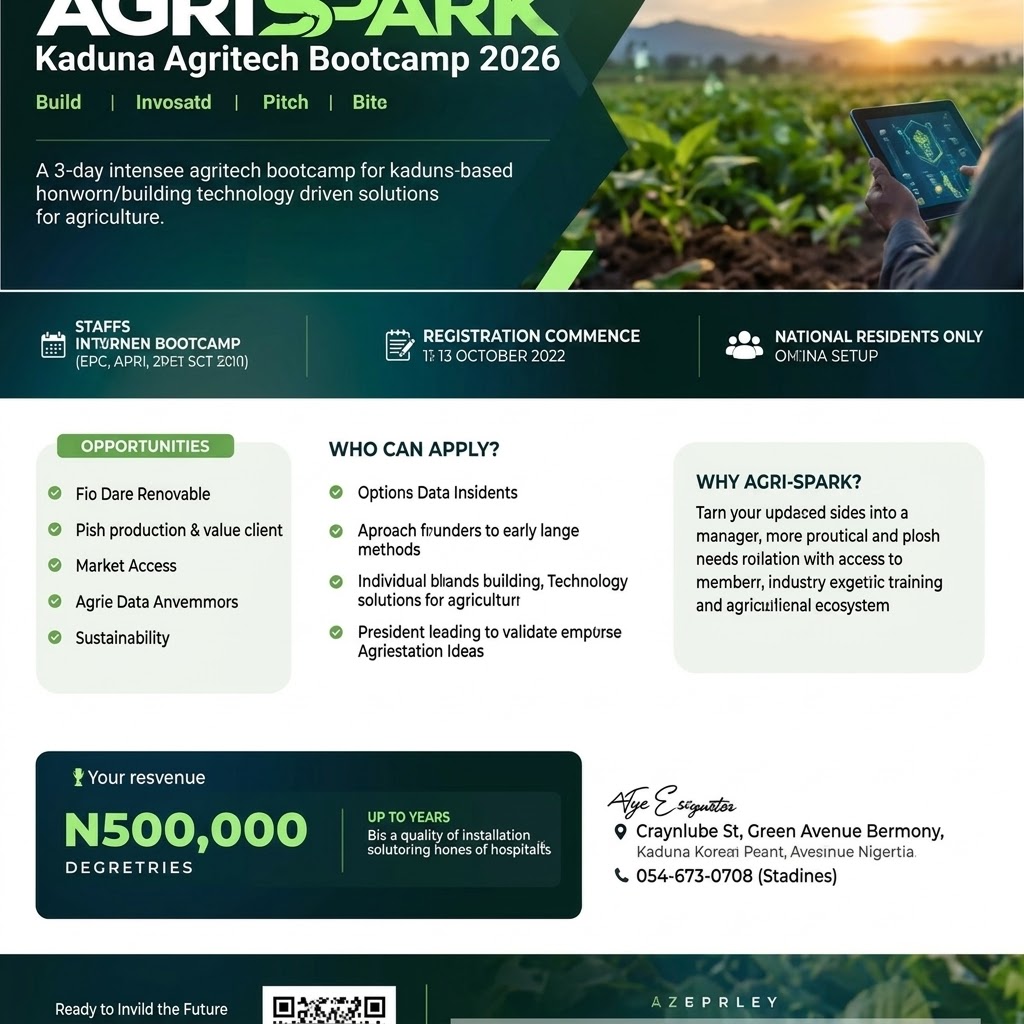
- Registration Window: October 7 – October 17, 2026. Late applications will not be entertained, so early registration is highly advised.
- Bootcamp & Innovation Challenge Dates: October 29 – October 31, 2026. This is the core of the event, encompassing three days of intense brainstorming, coding, building, and refining.
- Format and Location: The event is fully in-person. It will be hosted at GreyHobb, located at #31, Gwari Avenue, Barnawa, Kaduna. Participants must be physically present to collaborate with their teams and engage with mentors.
Prizes and Benefits: What is at Stake?
AgriSpark 2026 is not just an academic exercise; it offers tangible, high-value rewards designed to help the winning teams transition their hackathon prototypes into fully functional, market-ready businesses. Selected participants will gain access to practical learning opportunities and immense post-event support. The benefits of participating include:
- Grand Financial Prize: A massive ₦500,000 grand prize will be awarded to the winning team to serve as seed capital for their agritech startup.
- Incubation and Workspace: The top three teams will receive 3 months of premium incubation and co-working access at GreyHobb. This is arguably more valuable than the cash prize, as it provides the teams with a professional environment to work, stable internet, and continuous business support.
- Expert Mentorship: Participants will receive direct mentorship and guidance from seasoned sector experts, agritech founders, and business coaches.
- Networking Opportunities: The bootcamp serves as a bridge, offering unparalleled opportunities to connect with agricultural industry stakeholders, potential investors, and government representatives.
- Hands-on Innovation Experience: Every participant, regardless of whether they win the grand prize, will walk away with an enriched portfolio, having gained intensive bootcamp training and real-world product development experience.
How to Prepare a Winning Pitch for AgriSpark 2026
Surviving the hackathon phase is only half the battle; the ultimate decider is the Pitchathon. Presenting your innovation to a room full of judges and stakeholders requires finesse, clarity, and deep market understanding. To position your team for the ₦500,000 grand prize, you must master the art of the pitch. Here are proven strategies to help you stand out:
1. Focus on the Problem, Not Just the Technology
Many tech enthusiasts make the mistake of spending their entire pitch talking about the complexity of their code, the sophistication of their AI, or the sleekness of their app design. Investors and agritech judges care primarily about the problem you are solving. Start your pitch by painting a vivid picture of the pain point. How much money are local farmers losing due to poor data? How severe is the supply chain bottleneck? Make the judges feel the weight of the problem before introducing your technology as the savior.
2. Prove the Viability of Your Solution
Your solution must be practically applicable to the average Nigerian farmer. If your technology requires high-speed 5G internet to function, it will likely fail in rural farming communities. Your pitch must demonstrate that you have considered infrastructure limitations, digital literacy levels of the target users, and the overall cost of deployment. A simple USSD-based market linkage platform might score higher than a highly complex, data-heavy mobile app simply because it is more viable for the target demographic.
3. Showcase a Clear Revenue Model
No matter how noble your solution is, it must make financial sense to survive. How will your startup generate revenue? Will you charge a subscription fee, take a commission on transactions, or monetize agricultural data? Ensure your business model is clearly outlined in your pitch. The judges want to fund a sustainable business, not just a charity project.
4. Highlight Your Team’s Synergy
Investors invest in people just as much as they invest in ideas. Use a segment of your pitch to highlight the diverse expertise within your team. Show that you have the technical capacity to build the product, the agricultural knowledge to ensure its relevance, and the business acumen to drive it to profitability.
The Role of GreyHobb in Kaduna’s Tech Ecosystem
The choice of venue for AgriSpark 2026 is no coincidence. GreyHobb has rapidly emerged as a cornerstone of technological advancement and startup incubation in Kaduna State. Located in the accessible area of Barnawa, GreyHobb provides a nurturing environment for creatives, tech developers, and entrepreneurs to collaborate and innovate. By offering the top three teams three months of incubation space, GreyHobb is effectively ensuring that the brilliant ideas born during the hackathon do not die after the event. The hub will provide these emerging startups with the structural foundation necessary to build viable Minimum Viable Products (MVPs) and attract follow-on venture capital funding.
Addressing Real Agricultural Problems Through Innovation
The urgency for technological intervention in agriculture cannot be overstated. Africa’s population is booming, and food security is becoming an increasingly critical issue. Traditional farming is heavily reliant on predictable weather patterns, which are currently being disrupted by climate change. Agritech offers a lifeline.
Imagine a scenario where a local farmer in Kaduna can receive automated SMS alerts predicting drought conditions, allowing them to adjust their planting schedule accordingly. Imagine an integrated drone system that can scan hectares of farmland in minutes to detect early signs of pest infestation before it destroys the entire yield. These are not futuristic sci-fi concepts; these are the exact types of solutions that the AgriSpark Bootcamp expects its participants to build. The focus is strictly on actionable, scalable, and economically sustainable innovation.
Conclusion: The Time to Build is Now
The narrative surrounding African agriculture is rapidly shifting from one of subsistence and manual labor to one of precision, data, and immense profitability. The AgriSpark Kaduna Agritech Bootcamp and Innovation Challenge 2026 represents a critical stepping stone in this transformation. It is a clarion call to the dreamers, the coders, the agronomists, and the entrepreneurs to bring their best ideas to the table.
As the organizers aptly put it: “Don’t just talk about the future of agriculture. Build it”. Whether you are looking to secure the ₦500,000 grand prize, gain invaluable mentorship, or simply want to contribute to solving one of humanity’s most essential challenges, this bootcamp is the place to be.
How to Apply and Get Started
Do not let this opportunity pass you by. Ensure you gather your team, refine your ideas, and submit your application before the October 17 deadline. Due to the competitive nature of the challenge, it is highly recommended to apply as early as possible.
Official Sign Up & Source Links:
- To view the full details of the challenge and apply, visit the official publication source here: MSME Africa Online – AgriSpark 2026 Call for Applications.
- Alternative Source Information: Echo News – Agritech Bootcamp, Hackathon and Pitchathon.