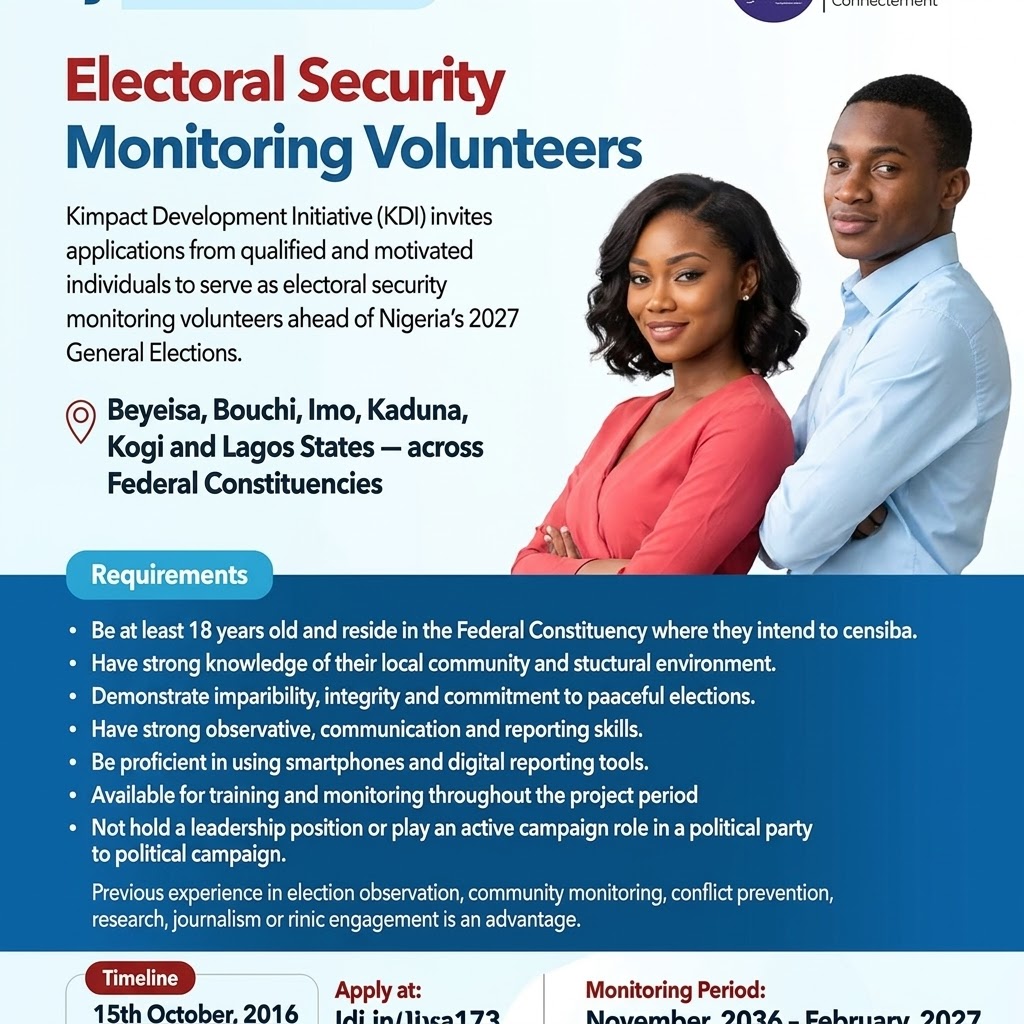
KDI Electoral Security Monitoring Volunteers Opportunity Across Nigeria 2026
Elections in Nigeria are far more than just a single day where citizens head to the polls to cast their ballots; they are a complex, months-long journey that tests the very fabric of our democracy. As the country gradually gears up for the 2027 general elections, the pre-election environment is already taking shape. Political alignments are shifting, campaigns are brewing, and the sociopolitical climate is becoming increasingly charged. In the midst of this anticipation, the need for proactive, citizen-led oversight has never been more critical. This is exactly where the Kimpact Development Initiative (KDI) steps in with a groundbreaking call to action for civic-minded Nigerians.
Currently, there is a massive opportunity for young, passionate, and dedicated individuals to play a direct role in safeguarding the integrity of our democratic process. The KDI Electoral Security Monitoring Volunteers Opportunity Across Nigeria 2026 is officially open, seeking to recruit Long-Term Election Security Monitors (LTSMs) under the prestigious International Election Observers Mission (IEOM) Project. If you have ever felt the urge to do more than just complain about the state of electoral security and actually want to be part of a structured, data-driven solution, this is your moment.
This comprehensive publication is designed to give you an exhaustive breakdown of everything you need to know about this opportunity. We will dive deep into what Kimpact Development Initiative stands for, the exact responsibilities of a Long-Term Security Monitor, the specific states targeted for this 2026/2027 cohort, and a step-by-step guide on how you can position your application to be selected. Whether you are a fresh graduate, a community leader, or simply a patriotic citizen looking to contribute to peaceful elections, grab a seat and read through this detailed guide.
The Critical Importance of Early Electoral Security Monitoring
When people think about election observation, their minds immediately jump to Election Day—individuals wearing customized observer jackets, standing at polling units, and watching voters drop papers into ballot boxes. However, global democratic standards, as well as Nigeria’s unique political terrain, have proven that the events which occur months before the election are often more indicative of the election’s credibility than the day itself.
The pre-election period is usually characterized by intense political party primaries, voter registration drives, grassroots mobilization, and, unfortunately, instances of voter intimidation, hate speech, and early signs of electoral violence. Recognizing these early warning signs is the primary purpose of Long-Term Election Security Monitoring. By deploying monitors from November 2026 through February 2027, KDI aims to capture the buildup to the general elections in real-time.
Why does this matter? Because violence and electoral malpractice do not happen in a vacuum. They are often the climax of weeks or months of unaddressed tensions. When volunteers on the ground document instances of political thuggery, destruction of campaign billboards, incendiary rhetoric on local radio stations, or the systemic disenfranchisement of certain demographics, this data serves as an early warning system. It allows stakeholders—including the Independent National Electoral Commission (INEC), security agencies, and international bodies—to intervene proactively rather than reacting when it is already too late.
Getting to Know Kimpact Development Initiative (KDI)
Before you commit your time and energy to any organization, it is deeply important to understand their core mission, track record, and underlying philosophy. Kimpact Development Initiative (KDI) is not just another non-governmental organization; it is a leading, youth-led civic institution in Nigeria renowned for its rigorous, data-driven advocacy, and relentless pursuit of strong democratic institutions.
Over the years, KDI has carved out a niche for itself by inspiring citizen-led democratic development. They operate on the belief that public policies and democratic institutions function best when citizens are actively involved in the process, rather than sitting on the sidelines. KDI is heavily involved in capacity development, advancing equitable public policies, and pushing for electoral reforms.
One of the most notable aspects of KDI’s work is its focus on empirical data. Instead of making generic statements about election violence, KDI builds comprehensive tracking systems (like their renowned Election Violence Monitoring mechanisms) that map out exact incidents, geographical hotspots, and the nature of electoral breaches. By volunteering with KDI, you are aligning yourself with an organization that values precision, integrity, and actionable intelligence. Their reports are widely consumed by international election observation missions, making your localized input part of a global democratic scorecard.
What is the International Election Observers Mission (IEOM) Project?
The Long-Term Election Security Monitors (LTSMs) are being recruited specifically for the International Election Observers Mission (IEOM) Project. But what exactly does this mean for a volunteer on the ground?
The IEOM framework is a collaborative effort designed to bring international observation standards to local grassroots monitoring. International observers often face limitations; they may not understand the local dialects, they might not be familiar with the historical nuances of specific communities, and they certainly cannot be present in every remote local government area across Nigeria months ahead of the election.
To bridge this gap, organizations like KDI recruit grassroots monitors who are thoroughly embedded in their communities. As an LTSM under the IEOM project, you act as the crucial link between the micro-level realities of your Federal Constituency and the macro-level analysis of international observers. The data you gather on your smartphone from your local community in Bauchi or Bayelsa feeds directly into a centralized database that shapes the international community’s perspective on the fairness, safety, and credibility of the Nigerian electoral environment.
Who is a Long-Term Election Security Monitor (LTSM)?
If you are selected for this role, what exactly will your day-to-day responsibilities look like during the monitoring period of November 2026 to February 2027? Understanding the core duties of an LTSM is vital for anyone looking to apply, as it requires a blend of vigilance, neutrality, and consistent reporting.
First and foremost, an LTSM is an unbiased observer. You are not a law enforcement officer, nor are you a judge. Your primary mandate is to watch, listen, document, and report. Here is a breakdown of the typical activities you will be engaged in:
- Tracking Pre-Election Tensions: You will monitor the political atmosphere in your specific Federal Constituency. This involves keeping an eye out for clashes between rival political supporters, the destruction of campaign materials, or localized disputes that could escalate into broader electoral violence.
- Monitoring Media and Hate Speech: In today’s digital age, electoral violence often starts with words. Monitors pay close attention to local radio broadcasts, community town halls, and even regional social media spaces for incendiary language, misinformation, and hate speech designed to incite violence or suppress voter turnout.
- Observing Political Campaigns and Rallies: LTSMs attend or closely monitor political rallies to observe the conduct of politicians, security personnel, and citizens. They note whether public spaces are equitably accessible to all political parties or if incumbency powers are being abused to stifle opposition campaigns.
- Documenting Security Force Conduct: A key aspect of electoral security is the behavior of the police, military, and paramilitary forces. Monitors report on whether security forces are acting impartially to protect all citizens, or if they are showing bias toward specific political actors.
- Utilizing Digital Reporting Tools: Gone are the days of paper-based, delayed reporting. Modern monitors are equipped with specialized mobile applications or web portals where they log incidents in real-time. This requires you to be highly proficient with your smartphone, ensuring that data reaches the KDI command center swiftly and securely.
Comprehensive Eligibility Requirements: Do You Fit the Profile?
Electoral monitoring is sensitive work. A single biased report or an inability to properly communicate an observation can skew data and create false narratives. Because of the high stakes involved, Kimpact Development Initiative has laid out strict eligibility criteria for the 2026 LTSM recruitment. Let us deeply analyze each requirement so you understand exactly what the selection committee is looking for.
1. Age Requirement: Must be at least 18 years old
This is a foundational legal requirement. Monitoring elections exposes you to adult political environments, security personnel, and potentially volatile situations. KDI requires all volunteers to be legal adults who can take responsibility for their own safety and fully comprehend the legal implications of the electoral process.
2. Residency: Must reside in the Federal Constituency you intend to monitor
This is perhaps the most critical requirement. You cannot monitor a constituency in Lagos if you live in Kaduna. KDI relies heavily on local context. An observer who lives in a community already understands the local geography, knows the key political actors, understands the local language or dialect, and can easily distinguish between normal community friction and election-related tension. Your permanent residence must be the area you are applying to cover.
3. Community Understanding
Having a strong grasp of your local environment goes beyond just living there. Do you understand the historical flashpoints in your area? Do you know the traditional and religious institutions that hold sway? An effective monitor must be deeply in tune with the socioeconomic and political dynamics of their immediate environment to provide accurate contextual reports.
4. Impartiality, Integrity, and Commitment to Peace
This cannot be overstated. If you are deeply partisan, this role is not for you. As an observer, your loyalty is to the democratic process, not to a specific candidate, political party, or ethnic group. You must possess the integrity to report facts exactly as they happen, even if those facts reflect poorly on a political figure you personally admire. Your overarching goal is the promotion of peaceful elections.
5. Strong Observation and Communication Skills
Observing an incident is only half the job; you must be able to articulate what happened clearly, concisely, and objectively. When writing a report, you must answer the essential questions: Who was involved? What exactly happened? When did it occur? Where did it take place? Why is it relevant to electoral security? Strong written communication skills are absolutely mandatory.
6. Digital Proficiency
You must own a functional smartphone and know how to use it beyond basic social media browsing. KDI utilizes modern digital reporting tools, secure messaging applications, and data-gathering software. You must be comfortable navigating mobile applications, capturing clear photographic evidence (when safe to do so), and submitting real-time digital forms.
7. Availability for Training and Monitoring
The monitoring period stretches from November 2026 to February 2027. While this does not mean you will be working 24 hours a day, it does require a consistent commitment of your time. Furthermore, you must be available for mandatory preparatory training sessions where you will be taught the nuances of the KDI methodology, security protocols, and reporting formats.
8. Strict Non-Partisanship
You must not hold a leadership position in any political party, nor can you play an active role in any political campaign. KDI’s credibility relies entirely on the neutrality of its volunteers. If an observer is found to be a card-carrying executive of a political party or an active campaigner, it immediately invalidates their data and damages the reputation of the entire mission.
Focus States for the 2026/2027 Pre-Election Cycle
For this specific deployment, KDI is focusing its resources on specific states across the country. Applications are currently open only to eligible residents in the Federal Constituencies of the following states: Bayelsa, Bauchi, Imo, Kaduna, Kogi, and Lagos. Let us explore why these specific geopolitical zones hold such immense strategic importance for the upcoming electoral cycle.
Lagos State: The Commercial and Demographic Giant
Lagos is the economic heartbeat of Nigeria and boasts one of the highest numbers of registered voters in the country. The political dynamics here are always intense due to the diverse, cosmopolitan nature of the population. Monitoring Lagos requires keeping an eye on massive grassroots mobilization, ethnic-political tension, and the heavy use of digital media for political campaigning. It is a high-stakes environment where pre-election dynamics heavily influence the national mood.
Kaduna State: The Complexity of the North-West
Kaduna is historically known as the political capital of Northern Nigeria. It is a state with deep religious and ethnic diversity, which unfortunately has occasionally been exploited for political gain. Early security monitoring in Kaduna is vital for tracking hate speech, mapping out potential conflict zones, and ensuring that campaign periods do not reignite historical communal clashes. Observers here play a profound role in conflict prevention.
Kogi State: The Confluence of Tension
Situated in the North-Central region, Kogi state shares borders with numerous other states, making it a transit hub and a geopolitical bellwether. Kogi has a history of highly competitive and sometimes volatile elections. The topography and the intense rivalry among its major ethnic blocs mean that LTSMs in Kogi must be highly vigilant. Early monitoring here often focuses on tracking the proliferation of small arms, political thuggery, and voter intimidation tactics.
Imo State: Navigating the South-East Dynamics
The political climate in the South-East, particularly in Imo State, has been complex over the last few electoral cycles due to off-season elections, security challenges involving non-state actors, and varied voter turnout levels. An observer in Imo will be tasked with monitoring not just political party activities, but also the general security environment to gauge whether citizens feel safe enough to participate in pre-election civic duties like voter registration and attending town halls.
Bayelsa State: The Riverine Challenge
Located in the heart of the Niger Delta, Bayelsa presents unique logistical and political challenges. Electoral security here involves monitoring activities across difficult riverine terrains where access can be heavily restricted. Political stakes in Bayelsa are incredibly high, and early warnings regarding the mobilization of political thugs or the stockpiling of weapons in remote creeks are essential data points for national security agencies.
Bauchi State: The North-East Political Fervor
Bauchi has consistently recorded massive voter turnouts and possesses a highly politically aware citizenry. While generally more stable than some of its North-East neighbors, the sheer volume of political participation means campaigns are highly charged. Monitors in Bauchi will focus on the equitable use of public spaces, tracking campaign financing, and ensuring that marginalized groups, particularly rural women, are not excluded from the pre-election buildup.
Beyond the Ballot: The Personal and Professional Benefits of Volunteering
You might be asking yourself, “With all these responsibilities and the potential risks, why should I volunteer?” Volunteering as an electoral security monitor is not just an act of patriotism; it is a profound professional development opportunity that offers significant long-term benefits.
- Building a Robust Professional CV: In today’s competitive job market, employers and international organizations look for candidates who have demonstrated civic leadership, community engagement, and the ability to work under pressure. Having “Long-Term Election Security Monitor for an International Mission” on your resume instantly signals integrity, analytical capability, and digital literacy.
- Acquisition of Specialized Skills: Volunteers do not just go out blindly; they are trained. You will receive world-class training in data collection, security mapping, objective reporting, and digital tool utilization. These are highly transferable skills that are extremely valuable in sectors like non-profit management, journalism, public policy, and research.
- High-Level Networking: Volunteering puts you in the same room with like-minded, driven young leaders from your state. Furthermore, you gain visibility within the civil society ecosystem. Outstanding volunteers often get recommended for further opportunities, fellowships, and even full-time roles within local and international NGOs.
- Direct Contribution to Peace and Democracy: There is a deep, intrinsic satisfaction in knowing that your real-time reports directly contributed to preventing violence in your community. You become an active architect of Nigeria’s democratic consolidation rather than a passive observer complaining on social media.
The Anatomy of a Successful KDI Volunteer Application
With thousands of young Nigerians eager to participate, the selection process is bound to be competitive. Submitting an application does not automatically guarantee selection, so you must put your best foot forward. The deadline for the application is strictly October 15, 2026. Let us walk through the application process to maximize your chances of being chosen.
Step 1: Access the Official Portal
Always ensure you are applying through the official channels to avoid data theft or scams. The official link for the Kimpact Development Initiative volunteer application is: https://kimpact.org.ng/volunteer/application. (Source: kimpact.org.ng).
Step 2: Preparing Your Resume/CV
The application requires you to upload a Resume/CV (ensure the file size is less than 1MB). Your CV should not just be a generic document detailing your high school grades. Tailor it to this specific role. Highlight any previous volunteer experience, community leadership roles, data entry jobs, or research projects you have participated in. If you have been involved in student union government (in a non-partisan capacity), community development service (like NYSC), or local charity work, make sure these are prominently displayed. Emphasize your communication and tech skills.
Step 3: The “Tell Us About Yourself” Section
This is the most critical part of the application form. It is your opportunity to speak directly to the KDI recruitment team. Do not just write “I am a hardworking Nigerian.” Use this space to demonstrate your deep understanding of your Federal Constituency. Talk about how long you have lived there, your passion for democratic transparency, and give a brief example of a time you displayed impartiality or leadership. Mention your proficiency with smartphones and your willingness to learn.
Step 4: Review and Submit Early
Do not wait until October 15 to submit your application. Technical glitches can happen on deadline days due to high server traffic. Fill in your First Name, Last Name, Email, Phone Number, and Prefix accurately. Double-check your contact details—if you make a mistake in your email or phone number, KDI will not be able to reach you even if you are selected.
Navigating the Field: Challenges and Safety Protocols for Monitors
It is important to approach this opportunity with realistic expectations. Election monitoring is rewarding, but it is not without its challenges. Understanding how to navigate the field safely and effectively is part of what makes a great LTSM.
Maintaining a Low Profile: An observer is meant to be a fly on the wall, not the center of attention. When monitoring political rallies or community tension, you must avoid getting drawn into political arguments. Your job is to document, not to debate. Keep your opinions to yourself and maintain a neutral facial expression and body language.
Prioritizing Personal Safety: No data is worth your life. KDI strongly emphasizes the safety of its volunteers. If a political rally turns violent or if you find yourself in a hostile environment, your immediate protocol is to leave the area and seek safety before attempting to report the incident. Understanding your local escape routes and emergency contacts is vital.
Combating Misinformation: You will hear a lot of rumors. Someone might claim that a stockpile of weapons is hidden in a community center, or that a politician has been attacked. As an LTSM, you must verify information before reporting it. Sending unverified rumors to the KDI database creates noise and panic. Always triangulate your sources and clearly distinguish between confirmed incidents and unverified hearsay in your reports.
Frequently Asked Questions (FAQs)
To provide even more clarity, here are some of the most commonly asked questions regarding the KDI Electoral Security Monitoring Volunteer opportunity.
Is this a paid employment opportunity?
No, this is strictly a volunteer position. However, in standard civil society practices for field deployments, organizations often provide stipends to cover direct operational costs such as internet data, local transportation, and communication during the monitoring period. Nevertheless, your primary motivation should be civic duty and professional development, not financial remuneration.
What happens if I miss the October 15, 2026 deadline?
KDI operates on strict timelines because the monitoring period begins in November 2026. Late applications will not be processed. It is highly advised to submit your details well ahead of the deadline.
Can I apply if my state is not listed among the six focus states?
The current call specifically targets residents of Bayelsa, Bauchi, Imo, Kaduna, Kogi, and Lagos states. If you apply and reside outside these specified Federal Constituencies, your application will likely be automatically filtered out. KDI frequently rolls out different phases of monitoring, so if your state is not included in this batch, keep an eye on their official website for future deployments closer to the general elections.
Does submitting an application guarantee I will be selected?
No. As clearly stated by KDI guidelines, submitting an application does not guarantee selection. The recruitment team will thoroughly review all CVs and profiles to select the most qualified, neutral, and competent individuals who perfectly match the geographical and technical requirements.
Take Action: Secure Your Spot as a Guardian of Democracy
The 2027 general elections will be a defining moment in Nigeria’s history. The trajectory of our nation’s development, economy, and internal security relies heavily on the transparency and peaceable nature of the democratic process. By stepping forward to become a Long-Term Election Security Monitor with Kimpact Development Initiative, you are refusing to be a mere spectator in the shaping of your country’s future.
This is an invitation to be the eyes and ears of democracy, to ensure that the voices of everyday citizens are not drowned out by violence or intimidation, and to build a localized early warning system that protects your immediate community. It is an opportunity to join a network of brilliant minds across Bayelsa, Bauchi, Imo, Kaduna, Kogi, and Lagos who are deeply committed to a better Nigeria.
Do not let this opportunity pass you by. Polish your CV, reflect on your community knowledge, and head over to the application portal right now. Remember, the deadline is October 15, 2026. Stand up, be counted, and take your rightful place as a defender of electoral integrity.
Get Started Now: Apply directly via the official KDI portal at https://kimpact.org.ng/volunteer/application. (Source: kimpact.org.ng).