
Interstellar Comet 3I/ATLAS: Discovery, Trajectory, and Scientific Insights into This Rare Cosmic Visitor

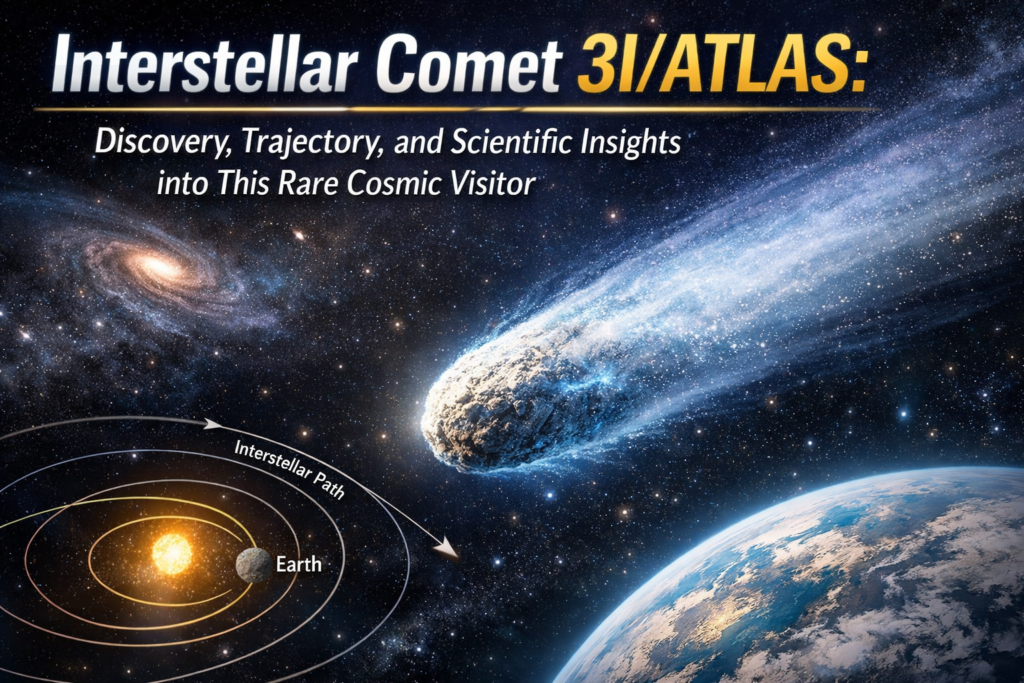
Interstellar Comet 3I/ATLAS: Discovery, Trajectory, and Scientific Insights into This Rare Cosmic Visitor
In the vast expanse of the universe, few events capture the imagination like the arrival of an interstellar comet—a wanderer from beyond our solar system, carrying secrets from distant stars. The interstellar comet 3I/ATLAS, discovered in 2025, stands as a remarkable example of such a visitor. As the third confirmed interstellar object to grace our skies, following the enigmatic 1I/’Oumuamua and 2I/Borisov, 3I/ATLAS offers astronomers a unique opportunity to study materials from another stellar system. This comet, hurtling through space at incredible speeds, reached its closest approach to Earth on December 19, 2025, at a safe distance of about 1.8 astronomical units (AU), or roughly 170 million miles. For stargazers and scientists alike, this event marks a pivotal moment in understanding the building blocks of distant worlds.
The fascination with interstellar comets lies in their origins. Unlike comets from our own Oort Cloud or Kuiper Belt, these objects are ejected from their home systems, embarking on eternal journeys across the galaxy. 3I/ATLAS exemplifies this, with its hyperbolic trajectory confirming it’s unbound to our Sun. As we delve into its story, we’ll explore its discovery, orbital details, physical makeup, and the profound implications for planetary science. This article aims to provide a comprehensive overview, highlighting why this comet is a treasure trove for researchers and how it compares to its predecessors. Whether you’re an amateur astronomer searching for tips on viewing it or a science enthusiast curious about cosmic chemistry, the tale of 3I/ATLAS is one of wonder and discovery.
With the current date being December 19, 2025—the day of its closest Earth approach—interest in this comet is at an all-time high. Observatories worldwide have turned their telescopes skyward, capturing data that could reshape our knowledge of exoplanetary systems. From its carbon dioxide-rich coma to its reddish hue, 3I/ATLAS challenges existing models and invites speculation about its ancient origins, possibly dating back 7 to 14 billion years. Join us as we unpack the mysteries of this interstellar traveler, optimized for those seeking in-depth facts on interstellar comets, their observation, and their role in broadening our cosmic perspective.




Discovery of Interstellar Comet 3I/ATLAS
The story of 3I/ATLAS begins on July 1, 2025, when the Asteroid Terrestrial-impact Last Alert System (ATLAS) telescope in Río Hurtado, Chile, first spotted this faint object. Operating under observatory code W68, ATLAS is renowned for detecting near-Earth objects and comets, and this discovery added a stellar feather to its cap. Initially cataloged as A11pl3Z, the object appeared as a dim point of light at magnitude 18, situated about 4.51 AU from the Sun and 3.50 AU from Earth, near the border of the constellations Serpens Cauda and Sagittarius.
What made this detection extraordinary was the object’s velocity—entering the inner solar system at a staggering 61 kilometers per second relative to the Sun. Early observations hinted at its interstellar nature, but confirmation required meticulous follow-up. Precovery images, or pre-discovery sightings, were unearthed from the Zwicky Transient Facility (ZTF) dating back to June 14-29, 2025, and even earlier ATLAS data from May 7, 2025. These archival finds extended the observation arc, solidifying its hyperbolic path.
By July 2, 2025, the Minor Planet Center (MPC) officially announced the discovery, assigning it the interstellar prefix “3I” and the cometary designation C/2025 N1 (ATLAS). At that point, 122 observations from 31 observatories had been compiled. Initial ambiguity surrounded whether it was an asteroid or comet, but images from multiple telescopes revealed a marginal coma—a hazy envelope of gas and dust—and a potential tail-like feature, confirming its cometary status.
This discovery process underscores the collaborative nature of modern astronomy. Telescopes like the Southern Astrophysical Research (SOAR) and the NASA Infrared Telescope Facility provided crucial photometry data shortly after detection. Scientific papers, such as those by teams led by researchers like Seligman, quickly emerged, detailing the preliminary characteristics. The rapid response from the global astronomical community highlights how advanced surveys like ATLAS are revolutionizing our ability to catch these rare interstellar interlopers before they vanish back into the void.
For context, the detection of 3I/ATLAS came at a time when astronomers were eagerly awaiting the next interstellar visitor. With only two prior confirmations in human history, this third sighting in 2025 amplified excitement, prompting immediate scheduling of observations with flagship instruments. The comet’s entry near the galactic plane added an element of challenge, as the dense star field could obscure details, yet it also provided a backdrop for stunning astrophotography opportunities shared by enthusiasts worldwide.
Orbital Path and Trajectory of 3I/ATLAS
The orbital characteristics of 3I/ATLAS paint a picture of a true cosmic nomad. Its path is defined by a hyperbolic eccentricity of approximately 6.14, far exceeding the value of 1 that marks a closed elliptical orbit. This means the comet is not gravitationally bound to our Sun and will eventually exit the solar system, never to return. The orbital epoch, based on data up to August 7, 2025, includes a semi-major axis of -0.26 AU—a negative value indicative of its unbound state.
Perihelion, the closest point to the Sun, occurred on October 29, 2025, at 1.36 AU, where the comet reached a maximum speed of 68.3 kilometers per second. Its hyperbolic excess velocity, or v-infinity, stands at 58 kilometers per second, making it the fastest known interstellar object to date. The inclination is a steep 175.11 degrees, nearly retrograde and just 4.89 degrees from the ecliptic plane, with a longitude of ascending node at 322.16 degrees and argument of periapsis at 128.01 degrees.
Throughout its journey, 3I/ATLAS has several notable close approaches. It skimmed past Mars on October 3, 2025, at 0.19 AU, followed by Venus on November 3 at 0.65 AU. The highlight for Earth observers is the December 19, 2025, flyby at 1.8 AU, posing no threat but offering prime viewing conditions. Looking ahead, it will approach Jupiter on March 16, 2026, at 0.36 AU, potentially allowing for extended observations by spacecraft in the vicinity.
The trajectory’s near-straight line due to high eccentricity distinguishes it from typical solar system comets, which follow more curved paths. Analyses of its past path suggest it may have encountered up to 25 stars in the last 10 million years, though its exact parent star remains unidentified. Likely originating from the Milky Way’s thin or thick disk, this comet could be a relic from a low-metallicity star system, ejected by gravitational interactions with giant planets or passing stars.
Ephemerides from sources like JPL Horizons provide detailed predictions, showing the comet’s path through constellations such as Sagittarius, Ophiuchus, Libra, Virgo, and Leo. A solar conjunction on October 21, 2025, temporarily obscured it during perihelion, but post-conjunction observations resumed, capturing its outbound leg. This orbital profile not only aids in tracking but also informs potential future missions, like intercepts by probes such as Juno or Juice.
Physical Characteristics and Composition of 3I/ATLAS
Physically, 3I/ATLAS is a compact powerhouse of activity. Estimates place its nucleus diameter between 0.32 and 5.6 kilometers, with more precise figures from non-gravitational accelerations suggesting 0.52 to 0.75 kilometers—likely under 1 kilometer overall. Its mass is around 4.4 × 10^10 kilograms, and it rotates with a synodic period of about 15.48 to 16.16 hours, derived from imaging and light curve data.
The comet’s absolute magnitude is greater than 15.4, with a cometary magnitude of 12.5, peaking at an apparent magnitude of around 11 during its brightest phase. What sets it apart is its vigorous activity: a coma extending up to 700,000 kilometers, dominated by carbon dioxide (CO2) with a radius of about 348,000 kilometers in near-infrared. Non-gravitational accelerations, peaking at 89.3 × 10^-9 AU per day squared before perihelion, indicate outgassing forces altering its path slightly.
Compositionally, 3I/ATLAS is a chemical oddity. James Webb Space Telescope (JWST) observations revealed a coma rich in CO2 (emission rate 129 kg/s), alongside water vapor (6.6 kg/s), carbon monoxide (CO at 14 kg/s), and traces of OCS (0.43 kg/s). The CO2-to-water ratio of 8.0 is unusually high, suggesting formation beyond the CO2 frost line in its original system. Water ice appears fine-grained and possibly amorphous, while Very Large Telescope (VLT) data detected cyanogen (CN) gas at 17.6 g/s and atomic nickel (Ni) vapor at 4.6 g/s—levels comparable to solar system comets.
Notably absent are significant amounts of C2, C3, or NH2, indicating a depletion in carbon-chain compounds. The coma exhibits a reddish color, possibly due to tholins or irradiated organics, with dust grains ranging from 1 to 100 micrometers ejected at speeds of 2 to 22 meters per second. Dust production includes about 6 kg/s of small particles and 60 kg/s of larger ones, contributing to a fan-shaped emission and anti-solar tail.
These traits suggest 3I/ATLAS formed in a cold, distant environment, preserving pristine materials from its protoplanetary disk. Its reddish spectrum and extreme negative polarization resemble trans-Neptunian objects, hinting at surface processing by cosmic rays over billions of years.
Scientific Observations and Key Findings
The observational campaign for 3I/ATLAS has been extensive, leveraging a suite of ground- and space-based instruments. Starting with ATLAS and ZTF precoveries from May 2025, the comet’s activity was noted as early as 6.4 AU from the Sun via TESS data. Hubble Space Telescope (HST) images from July 21, 2025, detailed the coma and constrained the nucleus size.
JWST’s NIRSpec instrument on August 6, 2025, provided breakthrough spectroscopy, confirming the CO2 dominance and volatile mix. VLT observations from July to August tracked increasing CN and Ni emissions, while SPHEREx detected an extended CO2 coma and water ice features. Swift telescope hinted at water vapor and hydroxyl (OH) in late July.
Ground facilities like Gemini South, Nordic Optical Telescope, and Gran Telescopio Canarias captured multi-band imaging, revealing asymmetric structures and jet wobbling indicative of rotation. Polarimetry studies showed high negative values, and light curves from May to August documented brightening trends.
Planetary missions joined the fray: Mars orbiters like ExoMars Trace Gas Orbiter (TGO) and Tianwen-1 imaged the coma during the October Mars flyby. Future opportunities include Juno and Juice during the 2026 Jupiter approach. These multi-wavelength efforts have yielded insights into protoplanetary chemistry, with proposals for further JWST time exploring mid-infrared aspects.
Key findings include the comet’s potential age—older than our solar system—and its role in understanding interstellar object populations. Speculation about artificial origins, raised by some researchers, was debunked by natural cometary activity, emphasizing the need for data-driven conclusions.
Comparisons with Other Interstellar Objects
3I/ATLAS joins an elite club, but it stands out from its predecessors. 1I/’Oumuamua, discovered in 2017, was asteroid-like with no initial coma, a v-infinity of 26 km/s, and eccentricity of 1.2. It exhibited non-gravitational acceleration possibly from outgassing, but lacked a visible tail.
2I/Borisov, found in 2019, was more comet-like with a tail, v-infinity of 32 km/s, and eccentricity of 3.4. Its composition featured typical volatiles but with a higher dust ejection rate pre-perihelion.
In contrast, 3I/ATLAS boasts a v-infinity of 58 km/s and eccentricity of 6.14, making it faster and straighter in path. Its CO2-rich coma (higher CO2/water ratio) and reddish hue differ from Borisov’s, suggesting diverse formation environments. While all three are small and active to varying degrees, 3I/ATLAS’s southern hemisphere origin counters expectations for northern-apex visitors, enriching models of galactic object distribution.
These comparisons highlight the diversity of interstellar objects, informing estimates that thousands may traverse our system annually, though most go undetected. Studying them bridges solar system and exoplanet science, revealing commonalities and uniqueness in cosmic building blocks.
How to Observe Interstellar Comet 3I/ATLAS
For astronomy enthusiasts, observing 3I/ATLAS is feasible with modest equipment. On December 19, 2025, during its closest Earth approach, it reaches magnitude 11—not naked-eye visible but accessible with 3- to 4.5-inch telescopes or binoculars under dark skies.
Locate it in the evening sky, moving through Virgo or Leo post-perihelion. Star charts and apps provide real-time positions, accounting for its rapid motion. Best viewing is from the Southern Hemisphere, but Northern observers can catch it low on the horizon.
Photographers have captured stunning images from backyards using astrophotography setups, stacking exposures to reveal the coma and tail. Avoid light-polluted areas, and use filters for better contrast. While not as bright as some comets, its interstellar status makes any sighting memorable.
Safety first: No risk from the comet, but always use proper eye protection for solar-related events. Community forums share tips, fostering a global watch party for this rare visitor.
Implications for Astronomy and Future Research
The arrival of 3I/ATLAS has profound implications. Its chemistry offers clues to distant planetary formation, particularly midplane disk processes where CO2 ices dominate. As a potential relic from “Cosmic Noon,” it provides a window into early galaxy evolution.
Future research may involve missions to intercept similar objects, with concepts like Comet Interceptor gaining traction. Enhanced surveys could detect more interstellar visitors, refining population statistics.
Debates on origins—natural vs. speculative artificial—underscore the need for interdisciplinary approaches. Overall, 3I/ATLAS advances our quest to understand if our solar system’s chemistry is unique or universal.
Conclusion: The Enduring Legacy of 3I/ATLAS
As interstellar comet 3I/ATLAS fades from view, its legacy endures. This 2025 visitor has enriched our knowledge, from hyperbolic orbits to exotic compositions, inspiring generations. In the grand cosmic narrative, it reminds us of the interconnectedness of stars and the endless discoveries awaiting in the night sky.