
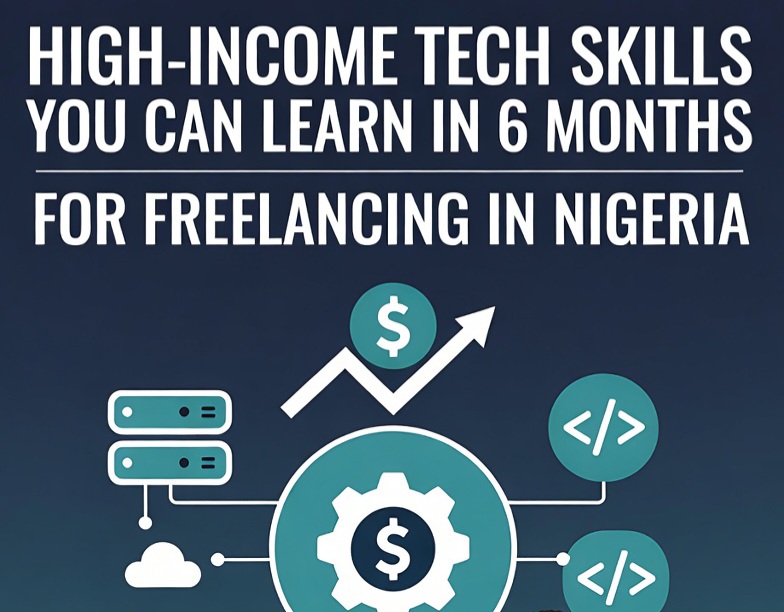
Meta Description: Discover the top high-income tech skills you can learn in 6 months to start freelancing in Nigeria. Our guide covers in-demand skills like Web Development, Digital Marketing, UI/UX Design, and more to boost your earning potential. Start your journey today!
Introduction: The Nigerian Freelancing Revolution
The digital economy in Nigeria is experiencing an unprecedented boom. With increasing internet penetration, a vibrant youth population, and a global shift towards remote work, freelancing has become a powerful avenue for financial independence and professional growth. For many Nigerians, the traditional 9-to-5 job is no longer the only path to a stable, high income. The question is no longer if you can build a lucrative career online, but which skills will get you there the fastest.




This article is your strategic roadmap. We will explore high-income tech skills that are globally in demand and perfectly align with the Nigerian context. The best part? With focused effort, you can acquire a marketable proficiency in any of these fields within 6 months. We’re not just talking about basic knowledge; we’re talking about skills that can command rates from $20 to $100+ per hour on international freelance platforms and within the local tech ecosystem.
Let’s dive into the top tech skills that can transform your income in half a year.
1. Full-Stack Web Development (The Digital Foundation Builder)
Why It’s High-Income: Every business, from a Lagos-based SME to a global corporation, needs an online presence. Full-stack developers, who can handle both the front-end (what users see) and back-end (server, database) of a website or web app, are incredibly valuable. The demand consistently outstrips supply.
- Months 1-2: Front-End Fundamentals. Master the core trio: HTML, CSS, and JavaScript. Build simple, responsive websites. Dive into a front-end library like React.js (highly recommended for its popularity) or Vue.js.
- Months 3-4: Back-End Basics. Choose a server-side language. Node.js (using JavaScript) is a great choice for consistency. Alternatively, Python with Django or PHP with Laravel are powerful. Learn to work with databases like MySQL or MongoDB.
- Months 5-6: Integration & Portfolio. Learn to connect your front-end and back-end. Understand APIs, Git for version control, and basic deployment. Your goal is to build 3-4 impressive portfolio projects (e.g., an e-commerce site, a blog CMS, a simple SaaS application).
Freelancing Opportunities in Nigeria: Building websites for local businesses, working with startups on their MVPs (Minimum Viable Products), and securing contracts on international platforms like Upwork and Toptal. Specializing in e-commerce solutions (using platforms like Shopify or WooCommerce) is particularly lucrative.
2. Digital Marketing & SEO Specialization (The Traffic & Sales Generator)
Why It’s High-Income: In a crowded digital space, businesses desperately need experts who can make them visible, generate leads, and drive sales. Skills in Search Engine Optimization (SEO), paid advertising, and content strategy are perpetually in demand because they directly impact a company’s revenue.
- Months 1-2: Core Foundations. Deep dive into Google Analytics and Google Search Console. Understand SEO fundamentals: keyword research, on-page optimization, and technical SEO basics. Get certified in Google Ads (Search and Display).
- Months 3-4: Content & Social Strategy. Learn content marketing—creating blogs, guides, and copy that ranks and converts. Master a social media platform for business (e.g., Facebook/Instagram Ads, LinkedIn marketing). Understand email marketing funnels.
- ·Months 5-6: Specialization & Data. Choose a niche: Local SEO (perfect for Nigerian businesses), E-commerce SEO, or Performance Marketing. Learn to use tools like Ahrefs or SEMrush (start with free trials). Your portfolio should include case studies—even hypothetical ones—showing how you could improve a website’s traffic or conversion rate.
Freelancing Opportunities in Nigeria: Managing social media for brands, running targeted ad campaigns for Nigerian and international clients, performing SEO audits for websites, and offering complete digital marketing strategy consultancy. The ability to show ROI (Return on Investment) is your key to high rates.
3. UI/UX Design (The User Experience Architect)
Why It’s High-Income: User Interface (UI) and User Experience (UX) Design are critical for creating digital products that are not just beautiful but also intuitive and effective. A good design directly influences user retention and satisfaction, making skilled designers highly sought after.
- Months 1-2: Principles & Tools. Learn core principles of design: typography, color theory, layout, and hierarchy. Master a primary design tool—Figma (free to start and industry standard) is highly recommended. Also, learn the basics of user research and wireframing.
- Months 3-4: UX Process & Prototyping. Deepen your UX skills: user personas, user flows, information architecture. Create low-fidelity and high-fidelity prototypes. Learn how to conduct usability testing.
- Months 5-6: Portfolio & Interaction. Build a strong portfolio with 2-3 detailed case studies. Show your process from problem identification to research, wireframes, mockups, and a final interactive prototype. Learn about design systems and micro-interactions to add polish.
Freelancing Opportunities in Nigeria: Designing websites and mobile apps for local tech startups, redesigning existing products for better usability, and working with developers as a design partner on global platforms like Dribbble and Behance.
4. Data Analysis & Visualization (The Insight Storyteller)
Why It’s High-Income: Data is the new oil, and businesses need professionals who can extract, clean, analyze, and present insights from it to drive decision-making. This skill cuts across all industries—finance, healthcare, e-commerce, and more.
- Months 1-2: Foundational Skills. Start with Microsoft Excel (master pivot tables, formulas). Then, move to SQL for database querying—it’s essential for extracting data. Learn basic statistics.
- Months 3-4: Analysis & Visualization Tool. Pick a powerful visualization tool. Power BI (great for corporate clients) or Tableau are top choices. Learn to build interactive dashboards. Start learning the basics of Python for data analysis (libraries like Pandas & NumPy).
- Months 5-6: Portfolio Projects & Storytelling. Work on real-world datasets (find them on Kaggle). Create end-to-end projects: ask a business question, extract/clean data, analyze it, and create a compelling dashboard that tells a story. Your portfolio should demonstrate your ability to turn data into actionable advice.
Freelancing Opportunities in Nigeria: Helping businesses make sense of their sales data, creating performance dashboards for marketing agencies, and offering data-driven consultancy to SMEs looking to optimize operations.
5. Cybersecurity Fundamentals (The Digital Protector)
Why It’s High-Income: As Nigerian businesses digitize, the threat of cyber attacks (ransomware, phishing, data breaches) grows exponentially. There is a massive skills gap globally and locally, making foundational cybersecurity knowledge extremely valuable.
- Months 1-2: Networking & Systems. You must understand what you’re protecting. Study computer networking fundamentals (TCP/IP, DNS, HTTP/S). Get comfortable with operating systems, especially Linux command line.
- Months 3-4: Core Security Concepts. Learn about key vulnerabilities (OWASP Top 10), encryption, authentication, and network security. A great structured path is to study for the CompTIA Security+ certification—it’s vendor-neutral and respected globally.
- Months 5-6: Practical Skills & Specialization. Get hands-on with safe, legal labs on platforms like TryHackMe or Hack The Box. You could specialize in areas like Vulnerability Assessment, Security Awareness Training (a huge need for Nigerian companies), or basic Incident Response.
Freelancing Opportunities in Nigeria: Conducting basic security audits for small businesses, providing cybersecurity awareness training for staff, and helping companies implement essential security policies. This field often leads to high-value retainer contracts.
6. Content Creation & Video Editing (The Narrative Engineer)
Why It’s High-Income: Video is the dominant form of online content. From YouTube and TikTok to corporate explainer videos, skilled editors who can craft engaging narratives are in constant demand. This skill combines creativity with technical prowess.
- Months 1-2: Software Mastery. Choose a professional editing software and master it. Adobe Premiere Pro is the industry standard. DaVinci Resolve is a powerful free alternative. Learn cutting, transitions, audio balancing, and basic color correction.
- Months 3-4: Storytelling & Motion. Move beyond simple cuts. Learn the principles of storytelling, pacing, and sequencing. Introduce basic motion graphics and titles using Adobe After Effects or the Fusion tab in DaVinci Resolve.
- Months 5-6: Niche & Portfolio. Find a niche: YouTube editing, social media ads, podcast editing, or corporate videos. Build a compelling reel showcasing your best work. Understanding what makes content “viral” or engaging for a specific platform will set you apart.
Freelancing Opportunities in Nigeria: Editing for Nigerian YouTubers and content creators, creating ad campaigns for brands, producing product demo videos for e-commerce sites, and offering video content strategy.
Your 6-Month Action Plan: From Learning to Earning
1. Choose ONE Skill: Resist the urge to multitask. Depth beats breadth. Assess your interests and the market, then commit.
2. Structured Learning: Use a mix of free resources (YouTube, FreeCodeCamp) and affordable, structured courses (Coursera, Udemy, AltSchool Africa, Udacity). Consistency is key—dedicate 2-3 hours daily.
3. Build in Public: Create a LinkedIn profile and Twitter account focused on your skill. Share your learning journey, small wins, and project progress. This builds your network and personal brand.
4. Create a Portfolio: Your portfolio is your most important asset. It’s proof of your skills. Work on personal projects, volunteer for non-profits, or do pro-bono work for a few initial clients to build it.
5. Start Pitching: Begin on Nigerian-focused platforms like Efiko and Brigd, then expand to global markets like Upwork, Fiverr, and LinkedIn ProFinder. Your first few jobs are for experience and reviews, not top dollar.
6. Iterate and Scale: As you complete jobs, ask for testimonials, refine your rates, and build case studies. Move from one-off projects to longer-term retainer contracts for stable income.
Conclusion: The Future is in Your Hands
The barrier to entry for a high-income tech career in Nigeria has never been lower. What separates those who succeed from those who don’t is not a university degree, but clarity, commitment, and consistent action. The six high-income skills outlined here—Full-Stack Development, Digital Marketing, UI/UX Design, Data Analysis, Cybersecurity, and Video Editing—are your tickets to a thriving freelance career.
The global market is eager for talent. In 6 months, you can transition from curiosity to competence, and from competence to a profitable client base. Start today. Choose your path, dedicate yourself to the process, and join the growing wave of Nigerian digital professionals building wealth and freedom on their own terms.
Ready to launch your freelance tech career? Begin by researching your chosen skill today and commit to your first hour of learning. Your future self will thank you.