Remote Video Editor Jobs Open to Nigerians 2026: YouTube, TikTok & Brands

Remote Video Editor Jobs Open to Nigerians 2026/2027: YouTube, TikTok & Brands
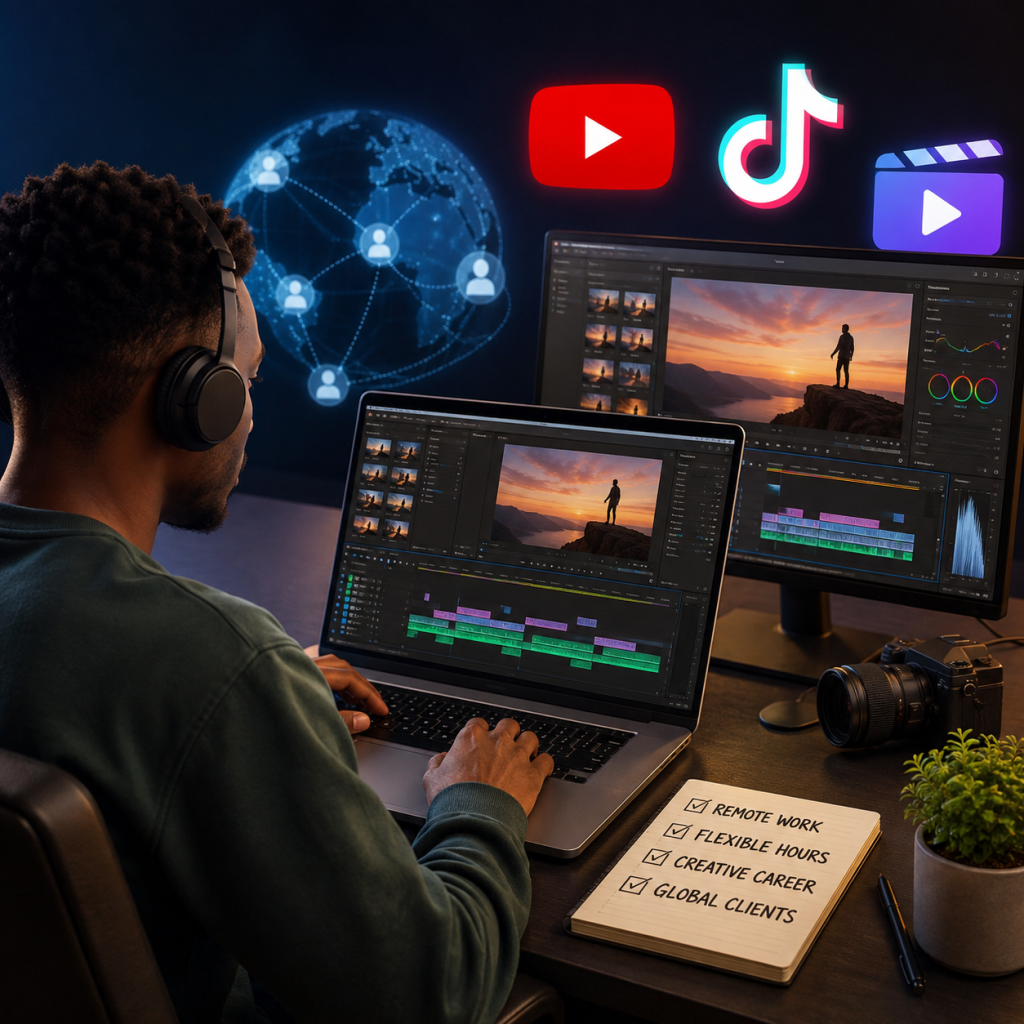
Imagine waking up on a Tuesday morning in Lagos, Abuja, or Port Harcourt. Instead of rushing out to beat the crazy morning traffic, you brew a cup of coffee, turn on your laptop, and log in to a workspace where your clients are based in New York, London, or Sydney. Your job? Turning raw video footage into engaging, high-retention content for millions of viewers. This isn’t a pipe dream—this is the reality for thousands of Nigerian video editors right now, and as we move deeper into 2026 and look toward 2027, the opportunities are only multiplying.
The global creator economy has exploded. What used to be a hobby for teenagers in their bedrooms has evolved into a multi-billion-dollar industry. YouTube channels operate like fully-fledged media companies, TikTok creators are launching massive brands, and traditional businesses are realizing that if they aren’t using video marketing, they are practically invisible. But here is the secret: most of these creators and business owners hate editing, or simply don’t have the time for it. They need skilled professionals to take their raw files and turn them into gold.
For a Nigerian creative, this is the ultimate equalizer. The internet does not care about your geographical location; it only cares about your skill, your internet speed, and your ability to meet deadlines. If you have been looking for a way to earn in foreign currency (Dollars, Pounds, or Euros) while living in Nigeria, landing a remote video editing job is arguably one of the most lucrative and future-proof paths you can take.
In this comprehensive, step-by-step guide, we are going to break down everything you need to know about finding, applying for, and dominating remote video editing jobs in 2026 and 2027. We will cover the specific niches in high demand, the tools you need to succeed, how to bypass the unique challenges faced by Nigerians, and exactly where to find high-paying clients.



The State of Remote Video Editing in 2026/2027: Why Nigerians Are in High Demand
You might be wondering, “With all the editors in the US, UK, and Asia, why would an international client hire a Nigerian?” The answer boils down to three massive advantages that Nigerian freelancers currently possess in the global marketplace:
- Native English Proficiency: Unlike many other outsourcing hubs in non-English speaking countries, Nigerians have a deep, nuanced understanding of the English language. Video editing isn’t just about cutting clips together; it’s about understanding comedic timing, cultural references, emotional pacing, and storytelling. Being able to understand the subtle tone of a Western client gives Nigerian editors a massive edge.
- Incredible Work Ethic and Adaptability: Nigerians are known globally for their resilience and hustle. When dealing with fast-paced social media trends, clients want editors who can adapt quickly, learn new editing styles (like the ever-evolving fast-paced retention edits), and deliver under tight deadlines.
- Cost Arbitrage (Win-Win Pricing): Let’s be brutally honest—currency exchange rates play a huge role. A salary or project fee of $1,500 a month might barely cover rent for an editor living in California, but when converted to Naira, it provides a very comfortable, upper-middle-class lifestyle in Nigeria. This allows Nigerian editors to offer highly competitive rates while still earning a premium income locally.
Furthermore, the demand for video content is completely outstripping the supply of good editors. Every single day, thousands of new podcasts are launched, hundreds of thousands of TikToks are recorded, and traditional brands realize they need to transition from text-based blogs to video-first marketing. The pie is large enough for everyone.
The Most Profitable Video Editing Niches for 2026/2027
Before you start applying for jobs, you need to understand that “video editing” is a massive umbrella term. To command high rates and get hired easily, you need to specialize. Let’s look at the most profitable niches you should target.
1. YouTube Long-Form Editing (The Holy Grail)
YouTube is no longer just a video platform; it is the new television. Top creators are uploading documentaries, massive challenge videos, and deeply researched video essays. These videos require intense editing, sound design, color grading, and motion graphics. Because of the heavy workload, YouTubers are constantly hiring dedicated editors.
Sub-niches include:
- Faceless Channels (Cash Cow Channels): These are channels where the creator never shows their face. They rely entirely on stock footage, motion graphics, and voiceovers. Examples include channels about finance, space, history, and top-10 lists. They pump out videos rapidly and usually hire teams of remote editors.
- Documentary Style: Think of channels like Magnates Media or Moon. These edits require advanced skills in After Effects and a deep understanding of pacing. The pay here is exceptional because the editing is the star of the show.
- Talking Head & Educational: Creators sitting in front of a camera teaching a subject. The editor’s job is to remove pauses, add B-roll, pop-up text, and keep the viewer engaged.
2. Short-Form Content (TikTok, Instagram Reels, YouTube Shorts)
Short-form content is the undisputed king of organic reach in 2026. Every creator, coach, real estate agent, and brand wants to go viral on TikTok and Reels. The editing style here is highly specific: fast pacing, animated captions, sound effects on every transition, and aggressive zooms to retain viewer attention (often referred to as the “Alex Hormozi style” or “Ali Abdaal style”).
If you can master short-form editing, you will never run out of work. Many editors work on retainer models, charging a client anywhere from $500 to $2,000 per month to deliver 15 to 30 short videos.
3. Brand, E-commerce, and Corporate Editing
Companies selling physical products need Video Sales Letters (VSLs), dropshipping ads, and UGC (User Generated Content) edits. In this niche, the goal of your edit isn’t just to entertain; it is to convert a viewer into a buyer. If you can edit a video that makes people click “Buy Now,” brands will pay you whatever you ask.
Corporate editing involves editing online courses, internal company training videos, and real estate property walkthroughs. This niche is generally less flashy, requires fewer crazy effects, but demands high professionalism and clean cuts.
Top Platforms to Find Remote Video Editing Jobs as a Nigerian
Knowing how to edit is only 50% of the equation; knowing where to find high-paying international clients is the other 50%. Here are the best platforms and methods to secure remote editing jobs in 2026 and 2027.
1. YTJobs.co (The Ultimate Creator Hub)
If you want to work specifically with YouTubers, this is the absolute best platform on the internet. YTJobs was built specifically to connect creators with video editors, thumbnail designers, and scriptwriters. Unlike general freelance platforms, the clients here already understand the value of a good editor.
How to win on YTJobs: Create an outstanding profile, upload a showreel that instantly demonstrates your pacing and sound design skills, and apply to jobs directly. Make sure you understand YouTube culture (CTR, AVD, retention metrics) because creators will test you on this.
To get started and browse hundreds of open positions, you can visit their official platform here: Sign Up on YTJobs.
2. Upwork and Fiverr
These are the traditional giants of freelancing. While they can be highly competitive, millions of dollars are exchanged on these platforms daily. Upwork is generally better for long-term contracts and hourly pay, while Fiverr is great for one-off projects that can lead to recurring clients.
Pro-tip for Nigerians on Upwork: Do not race to the bottom by charging $5 an hour. Optimize your profile for a specific niche (e.g., “Expert Real Estate Video Editor” or “Gaming YouTube Editor”). Use your Upwork Connects wisely by applying to jobs posted in the last 24 hours where the client has a verified payment method and a history of hiring.
3. Social Media Inbound and Outbound (Twitter/X & LinkedIn)
In 2026, your social media profile is your resume. Many of the highest-paying editing jobs are never posted on job boards; they are found through networking.
- Twitter (X): The YouTube editing community is massive on X. Post breakdowns of your edits, share tips on Premiere Pro, and reply to big creators. Many YouTubers will simply tweet, “Looking for a new editor, drop your portfolios below.” If you have been building an audience, you will get noticed.
- LinkedIn: This is where you find corporate clients, agency owners, and B2B businesses. Optimize your LinkedIn headline to say something like, “Helping B2B Brands Drive Sales through High-Retention Video Editing.” Reach out to marketing managers and offer them a free sample edit.
4. Direct Cold Emailing
Cold outreach remains one of the most effective ways to land clients. Find a YouTuber or a brand whose content you know you can improve. Download one of their recent videos, edit a 30-second to 1-minute highly polished version of it (this is called a “spec edit”), and email it to them.
Sample Cold Email Template:
“Hi [Creator Name], I’ve been following your channel for a while and loved the recent video on [Topic]. I noticed you are posting great content, but I believe faster pacing and better sound design could boost your average view duration (AVD). I actually took the liberty of re-editing a 45-second clip from your last video to show you what I mean. Here is the link: [Frame.io or Google Drive Link]. If you like this style, I’d love to chat about helping you edit your future videos. Keep up the great work!”
Essential Skills You Need to Stand Out in 2026
To secure the best remote jobs, you must move beyond basic cutting and trimming. The modern video editor is part director, part sound engineer, and part retention strategist.
Mastery of Industry-Standard Software
While mobile apps like CapCut are amazing for quick TikToks, high-paying clients expect you to know professional software. In 2026, the big three are:
- Adobe Premiere Pro: The industry standard. If you want to work for agencies or large YouTube teams, you must know Premiere. Its seamless integration with After Effects and Photoshop makes it unbeatable for complex workflows.
- DaVinci Resolve: Rapidly growing in popularity because it offers Hollywood-level color grading, incredible audio tools (Fairlight), and node-based compositing (Fusion)—all in one software. Plus, the studio version is a one-time payment, unlike Adobe’s monthly subscription, which is a big relief for freelancers dealing with currency fluctuations.
- CapCut PC: Do not underestimate CapCut Desktop. For short-form content, its auto-captions, built-in stickers, and AI features can cut your editing time in half. Many top-tier TikTok editors use CapCut PC exclusively.
Storytelling, Pacing, and Retention
Clients don’t pay you to know where the cut button is; they pay you to keep people watching. You must understand how to use J-cuts and L-cuts to make conversations flow naturally. You need to know when to let a shot breathe to build emotion, and when to rapid-fire cut to build excitement. If you can prove to a client that your edits increase their audience retention graph, you will never be out of a job.
Sound Design and Audio Mixing
Audio is 50% of the video experience. A visually stunning video with terrible audio will be clicked off immediately, while people will forgive mediocre visuals if the audio is crisp. You must know how to clean up background noise, level dialogue perfectly to -6db, and layer sound effects (whooshes, risers, impacts) to give the edit life.
Color Correction and Grading
Knowing how to fix white balance, match cameras, and apply a stylized look (like the moody, cinematic teal-and-orange look) elevates you from an amateur to a professional. This is especially critical for documentary and brand editing.
Overcoming the Unique Challenges of Being a Nigerian Freelancer
Let’s be realistic. Working remotely from Nigeria comes with its own set of hurdles. However, none of these are dealbreakers if you prepare adequately. Here is how top Nigerian freelancers navigate the terrain.
1. The Power Supply Dilemma
Constant electricity is not guaranteed, and missing a deadline because “NEPA took the light” is the fastest way to lose an international client. To survive, you must optimize your hardware. Desktop computers are powerful, but they shut off immediately during a power cut. You need a laptop. Specifically, the Apple Silicon MacBooks (M1, M2, or M3) are highly recommended because they offer incredible video editing performance while the battery can easily last 10-15 hours on a single charge. If you use Windows, invest in a strong inverter system or a high-capacity power station (like an EcoFlow or Bluetti).
2. Internet Connectivity
Uploading a 50GB raw video folder on a 3G network is impossible. You need reliable internet. While fiber optics (like FiberOne or IPNX) are great if you live in major cities like Lagos or Abuja, the ultimate game-changer in recent years has been Starlink. If you can afford the initial hardware cost, Starlink provides high-speed, uncapped internet anywhere in Nigeria. Alternatively, 5G routers from MTN or Airtel are highly effective for heavy video uploads.
3. Receiving Payments in Foreign Currency
This is usually the biggest fear for beginners: “How do I actually get my money in Nigeria?” Direct bank transfers to Nigerian domiciliary accounts can be slow and attract ridiculous fees. Thankfully, fintech has solved this problem. In 2026, Nigerian freelancers use platforms like:
- Geegpay & Grey.co: These platforms provide you with virtual USD, GBP, and EUR bank accounts. Your foreign clients can pay into these accounts just like a local transfer. You can then swap the foreign currency to Naira at highly competitive parallel market rates and withdraw directly to your local bank account within minutes.
- Payoneer: A global standard for freelancers. It integrates seamlessly with Upwork and Fiverr, allowing you to withdraw directly to your local bank.
- Cryptocurrency: Many modern clients and agencies (especially in the tech and Web3 space) prefer paying via stablecoins like USDT or USDC. You can receive these via Binance or Bybit and use P2P to convert them to Naira instantly.
4. Navigating Time Zones
If your client is in Los Angeles (PST) and you are in Lagos (WAT), they are 8 or 9 hours behind you. This means their afternoon is your midnight. You must set clear boundaries. Let them know your working hours. Use scheduling tools, and communicate proactively. A simple message like, “I am logging off for the night, but I will have the first draft ready for you by the time you wake up tomorrow,” builds immense trust.
How to Build a Portfolio That Gets You Hired Instantly
Your resume means absolutely nothing in the video editing world. Clients do not care what university you attended or what certificates you have. They only care about your showreel. Here is how to build a portfolio that guarantees you get hired.
1. Do Not Be a Generalist
A portfolio with a wedding video, a music video, a real estate tour, and a gaming video looks confusing. A YouTube creator wants to see that you can edit YouTube videos. Create separate portfolios for separate niches. Use Notion, a simple Carrd website, or even an organized Google Drive folder to present your work cleanly.
2. The Power of the Spec Edit
What if you don’t have any past clients? Make them up. Go to YouTube, download a podcast episode from Joe Rogan or a long video from MrBeast. Edit that raw footage into highly engaging TikTok shorts. Redesign the graphics, add your own sound effects, and put them in your portfolio. When you apply for a job, you can honestly say, “Here are examples of short-form content I edited.” The client doesn’t care if you were officially hired for it; they just want to see the quality of the work.
3. The Showreel
Your showreel is a 60-second video mashing up your best work. It needs to be the most perfectly edited video you have ever created. It should demonstrate your ability to sync visuals to music, use typography, and handle color grading. Keep it under one minute—attention spans are short, and clients usually make a hiring decision in the first 15 seconds.
Expected Salary and Earning Potential in 2026/2027
Let’s talk numbers. How much can a remote video editor in Nigeria actually make? The beauty of the internet is that you are paid based on global market value, not local Nigerian minimum wage.
- Beginner Level: If you are just starting and doing simple edits (basic cuts, standard captions), you can expect to earn between $10 to $15 per hour, or $50 to $100 per video. A beginner working consistently can easily make $500 to $1,000 a month.
- Intermediate Level: Once you understand pacing, motion graphics, and sound design, your value skyrockets. Intermediate editors charge $20 to $35 per hour, or $150 to $300 per long-form YouTube video. Retainer contracts at this level range from $1,500 to $3,000 a month.
- Expert/Lead Editor: These are editors who can take complete creative control, direct a team, and guarantee high retention rates. Experts easily command $3,000 to $7,000+ per month. On top of their base pay, many expert YouTube editors now negotiate performance bonuses (e.g., an extra $500 if the video crosses 1 million views).
When you convert these figures to Naira, it becomes abundantly clear why remote video editing is one of the most lucrative careers in the country today.
The Impact of Artificial Intelligence on Video Editing
You cannot talk about the future of video editing in 2026/2027 without discussing Artificial Intelligence. Is AI going to replace video editors? The short answer is: No, but a video editor using AI will replace an editor who doesn’t.
AI tools are deeply integrated into the editing workflow now. Premiere Pro’s text-based editing allows you to cut out dead space simply by deleting words in a transcript. Tools like Topaz Video AI can upscale low-quality 1080p footage to crisp 4K. Generative AI tools like Midjourney or Runway are being used by editors to create custom B-roll, backgrounds, and visual effects in seconds instead of searching stock footage sites for hours.
Instead of fearing AI, embrace it. Use ChatGPT to help you brainstorm video hooks and titles. Use AI voice cleanup tools (like Adobe Podcast AI) to fix terrible microphone audio sent by clients. By automating the boring, repetitive parts of editing, you free up your time to focus on the creative storytelling—which is the one thing AI cannot replicate.
Frequently Asked Questions (FAQs)
Can I do professional video editing on my mobile phone?
For high-end client work, no. While you can definitely start your journey and learn the basics of pacing and cuts using CapCut on a smartphone, international clients expect industry-standard deliverables. Mobile apps compress video quality and lack the deep sound engineering, multi-cam editing, and heavy motion graphics capabilities of a PC. If you want to earn the big dollars, you must transition to a laptop or desktop computer as soon as possible.
Do I need a university degree in Film or Media to get hired?
Absolutely not. The creator economy operates purely on a proof-of-work basis. A 19-year-old with an incredible showreel will always get hired over a 30-year-old with a Master’s degree in film but a boring portfolio. Your portfolio is your degree.
How do I handle clients who ask for a “Free Test Edit”?
Test edits are standard in the industry, especially for big YouTubers, to see if your style matches theirs. However, a major red flag is if a client asks you to edit a full 20-minute video for free. A reasonable test edit should be no longer than 1 to 2 minutes of footage. Alternatively, offer to do a paid trial: “I don’t do free test edits, but I’d be happy to edit the first video at a 50% discount to ensure we are a good fit.”
Is the market too saturated in 2026?
The market for “mediocre” editors who just slap clips together is saturated. But the market for highly skilled editors who understand viewer psychology, storytelling, and retention is completely empty. Creators are begging for reliable, talented editors. If you commit to being in the top 20% of editors, you will have more work than you can handle.
Conclusion: Your Next Steps
The roadmap to landing remote video editing jobs from Nigeria in 2026 and 2027 is clear. The demand from YouTubers, TikTokers, and brands is at an all-time high. The barriers to entry have never been lower, yet the financial rewards have never been higher.
If you are starting today, here is your immediate action plan: Pick one software (Premiere Pro or DaVinci Resolve) and dedicate the next 30 days to mastering it through YouTube tutorials. Edit mock projects every single day to build your portfolio. Once you have 3 to 5 solid pieces of work, optimize your profiles on platforms like YTJobs and Upwork, and start sending out cold emails.
Expect rejection initially—it is part of the game. But all it takes is one “Yes” from a foreign client to completely change your financial trajectory. The creator economy is waiting for you. Boot up your computer, organize your timeline, and start editing your way to global success.