
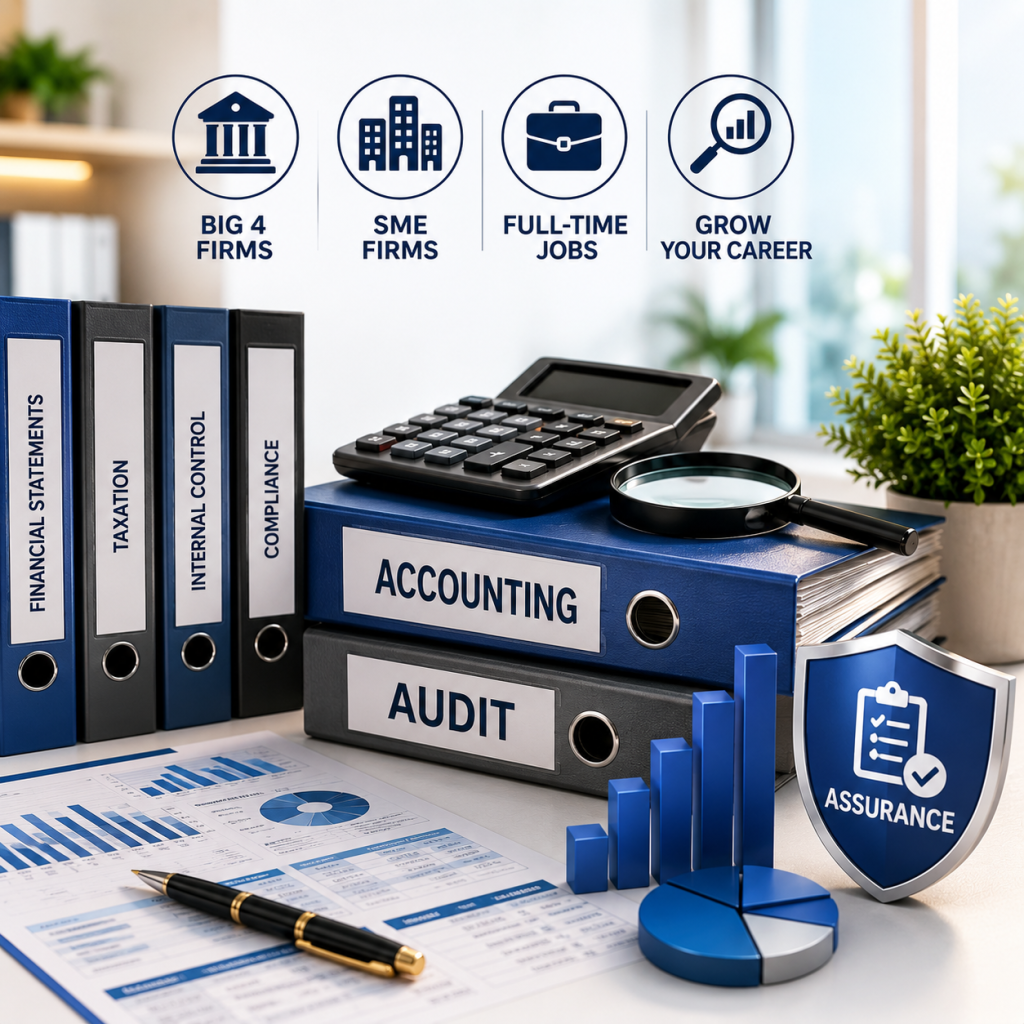
Accountant & Auditor Full-Time Jobs in Nigeria: Big 4 & SME Firms Hiring
The Nigerian financial sector is expanding rapidly, and if there is one career path that remains permanently resilient, it is accounting and auditing. Whether the economy is booming or going through a recession, businesses need to balance their books, comply with tax laws, and optimize their spending. This reality makes accountant and auditor full-time jobs in Nigeria some of the most sought-after and stable career choices available today.
Right now, the job market is heavily polarized into two distinct but highly rewarding paths: the prestigious multinational Big 4 accounting firms and the fast-growing Small and Medium-sized Enterprises (SMEs). Both sectors are actively hiring, but they offer completely different work environments, recruitment processes, salary structures, and career trajectories.
If you are a fresh graduate trying to land your first finance role, a mid-level professional looking for a strategic switch, or someone curious about how much auditors actually earn in Nigeria, you have come to the right place. In this comprehensive guide, we will explore everything you need to know about navigating the accounting and auditing job market in Nigeria, focusing heavily on Big 4 and SME opportunities.
The Landscape of Accounting and Auditing Jobs in Nigeria
Nigeria is Africa’s largest economy, and its corporate landscape is incredibly diverse. From tech startups in Yaba to massive oil conglomerates in Victoria Island and Port Harcourt, every single registered business requires accounting services. This universal need has created a massive job market for finance professionals.



Why the Demand for Accounting Professionals is Surging
The demand for accountants and auditors in Nigeria has never been higher, and several factors are driving this surge. First, the regulatory environment is becoming stricter. Government bodies like the Federal Inland Revenue Service (FIRS) are aggressively enforcing tax compliance, meaning companies can no longer afford sloppy bookkeeping. Second, the rise of fintech and digital banking in Nigeria has created a whole new ecosystem of finance roles that didn’t exist a decade ago.
Investors are also demanding more transparency. Whether a Nigerian company is seeking foreign direct investment or trying to secure a loan from a local bank, they need audited financial statements. This puts auditors right at the center of business growth and corporate governance.
Key Responsibilities of an Auditor and Accountant Today
Before diving into where to work, it is important to understand what the job actually entails. The roles of accountants and auditors are complementary but distinct.
- Accountants: They are the builders. Their day-to-day work involves recording financial transactions, managing payroll, reconciling bank statements, preparing financial reports, and ensuring that the company’s internal finances are healthy. They look inward.
- Auditors: They are the inspectors. An auditor comes in (either internally or externally) to review the work done by the accountant. Their job is to ensure accuracy, detect fraud, verify compliance with accounting standards (like IFRS), and identify financial risks. They look at the bigger picture and report to stakeholders or management.
Breaking into the Big 4 in Nigeria (PwC, KPMG, EY, Deloitte)
For many accounting graduates in Nigeria, landing a job at a Big 4 firm is the ultimate career dream. These firms are globally recognized, and having their name on your CV opens doors anywhere in the world.
What is the Big 4?
The “Big 4” refers to the four largest professional services networks in the world. They offer audit, assurance, taxation, management consulting, and advisory services. In Nigeria, all four have a massive presence. They are:
- PricewaterhouseCoopers (PwC)
- KPMG
- Ernst & Young (EY)
- Deloitte
Working here means dealing with top-tier clients—commercial banks, multinational FMCGs, and massive telecom companies. It is an environment of high prestige, high pressure, and immense learning.
Big 4 Recruitment Processes & Timelines
Getting into the Big 4 is notoriously competitive. They receive tens of thousands of applications every year for a limited number of slots. Their recruitment cycle usually happens once or twice a year, and the process is grueling. It can take anywhere from three weeks to three months. Here is a detailed breakdown of what to expect from each firm.
KPMG Nigeria Hiring Process
KPMG has a very structured and sometimes fast-paced recruitment process. It generally starts with an online application that takes about 30 minutes. Once submitted, candidates are quickly invited to write an aptitude test to determine their analytical skills. KPMG also conducts a Business Awareness Test to assess behavioral competencies.
If you pass these online tests, you move to the Assessment Center. This is the hardest part. The Assessment Center usually involves a panel interview, group work exercises where you collaborate with other candidates to solve a business problem, and a presentation. Some candidates might also attend an in-person event where interviews and group assessments happen in one day, leading to a quick job offer if successful.
PwC Nigeria Hiring Process
PwC’s process is known to be rigorous and multi-staged. It kicks off with an online application, followed by the SHL online test, which is a psychometric assessment measuring numerical reasoning and cognitive capability. They also require an online personality test to evaluate your behavioral traits and strengths.
Candidates who pass the online stage are invited for a physical verification test at the PwC office to ensure they actually wrote the online tests. Next comes a panel interview. Finally, candidates go through an Assessment Day, which involves group tasks and interviews with senior staff or partners. Successful candidates receive their offers shortly after.
EY Nigeria Hiring Process
EY generally follows a slightly more streamlined process compared to PwC. It starts with an aptitude test combining Mathematics and English, often modeled around the GMAT standard. If you clear the numerical and verbal reasoning hurdles, you are invited to an Assessment Day. This day is packed with group exercises and multiple interviews, including a final sit-down with senior management. EY places a strong emphasis on finding candidates who fit their corporate culture and can articulate their personal story.
Deloitte Nigeria Hiring Process
Deloitte’s selection process typically involves four main stages. After the online application, candidates take an aptitude test designed to push their analytical, numerical, verbal, and critical reasoning skills to the limit. Following a successful test, candidates undergo a first-round interview, which is largely behavioral and focused on getting to know the candidate. Those who succeed move to a second-round or final partner interview, where deeper case discussions and technical questions are asked before an offer is extended.
Core Requirements to Land a Big 4 Job
While the Big 4 are prestigious, their basic entry requirements for graduate trainees in Nigeria are quite specific. Most firms require:
- A minimum of a Second Class Upper (2:1) degree from a recognized university. Interestingly, your degree does not strictly have to be in Accounting. Graduates of Economics, Engineering, and even Political Science are regularly hired if they are smart and well-prepared.
- A minimum of 5 O’level credits (including Mathematics and English) in one sitting.
- Completion of the mandatory NYSC program (or an exemption letter).
- Age limits often apply. Deloitte and KPMG typically cap the age for entry-level roles at 27 and 26 respectively, though PwC and EY have been known to be more flexible with age restrictions recently.
Pros and Cons of Working in a Big 4 Firm
The Pros: The training is unmatched. You will be exposed to complex financial systems and global best practices. Having Big 4 experience makes you highly employable anywhere in the world. They also sponsor your professional exams (ICAN or ACCA) and provide study leave.
The Cons: The work-life balance can be brutal. During “busy season” (typically between January and April when most companies are finalizing their end-of-year audits), working late into the night and on weekends is the norm. The pressure to pass your professional exams while working full-time is also immense.
Accounting and Auditing in Nigerian SME Firms
While the Big 4 grab all the headlines, Small and Medium-sized Enterprises (SMEs) are the actual backbone of the Nigerian economy. Tens of thousands of SMEs—ranging from retail chains, real estate firms, logistics companies, to local manufacturing plants—need accountants.
The Role of SMEs in Nigeria’s Economy
SMEs account for the vast majority of businesses in Nigeria. Because these companies do not have the massive budgets of multinationals, they rely heavily on internal accountants to wear multiple hats. An accountant in an SME is often the financial controller, the tax officer, and the payroll manager all rolled into one.
How SME Hiring Processes Differ from the Big 4
If the Big 4 hiring process is a marathon, the SME hiring process is a sprint. SMEs usually hire when there is an immediate vacancy that needs to be filled urgently. Their recruitment process is far less structured.
You won’t have to deal with SHL psychometric tests or grueling assessment centers. Typically, you apply by sending your CV to an HR email address or through a job portal. If shortlisted, you might have one or two interview stages—usually a quick chat with the HR manager, followed by a technical interview with the business owner or the head of finance. You could literally apply on a Monday and get a job offer by Friday.
Benefits of Starting Your Career in an SME
Many finance professionals actively choose SMEs over massive firms, and here is why:
- Broader Experience: In a Big 4 firm, you might be restricted to checking one specific line item (like fixed assets) for a whole year. In an SME, you manage the entire accounting cycle from start to finish. You handle invoicing, bank reconciliations, tax remittances, and final accounts.
- Better Work-Life Balance: SMEs generally stick to standard 8-to-5 working hours. You are far less likely to be stuck in the office at 10 PM on a Saturday.
- Less Red Tape: You often report directly to the CEO or Managing Director. If you have a brilliant idea on how to cut costs, you can implement it immediately without waiting for approvals from five different managers.
Salary Expectations: Big 4 vs. SME Accounting Jobs in Nigeria
Let’s talk about the numbers. Salary is often the biggest deciding factor when choosing between a Big 4 firm and an SME. The compensation landscape for accountants in Nigeria varies wildly depending on your employer, your experience, and your professional qualifications.
Entry-Level Salaries
For a fresh graduate just entering the job market, the gap between SMEs and large firms is noticeable but not always astronomical at the very beginning.
- SMEs: Entry-level accountants at smaller firms typically earn between ₦80,000 and ₦150,000 per month. The pay depends heavily on the profitability of the business and its location (Lagos and Abuja SMEs generally pay more).
- Big 4 Firms: Graduate trainees entering Deloitte, PwC, KPMG, or EY can expect starting salaries that typically range from ₦250,000 to ₦400,000 monthly, alongside robust benefits packages like health insurance, 13th-month bonuses, and exam sponsorships.
Mid-Level and Senior-Level Salaries
As you gain experience and acquire professional certifications, your earning potential skyrockets.
- Mid-Level (3 to 7 years experience): A mid-level accountant in an SME might earn between ₦250,000 and ₦400,000 monthly. However, a mid-level auditor in a Big 4 firm or a large corporation will pull in anywhere from ₦500,000 to ₦900,000 monthly.
- Senior-Level & Chartered Accountants: Once you become a fully qualified chartered accountant with significant experience, the salary scales are excellent. Senior accountants and Finance Managers at large organizations or Big 4 firms easily earn between ₦600,000 and ₦1,200,000 or more per month. Financial Controllers and Directors can earn well over ₦2,000,000 to ₦5,000,000 monthly, translating to tens of millions of Naira annually.
Industry-Specific Salary Breakdowns
Beyond the firm size, the sector you work in heavily influences your take-home pay. For instance, the Oil and Gas sector remains the highest-paying industry for accountants in Nigeria, with qualified professionals earning between NGN 30 million and NGN 150 million annually. The Banking and Financial Services sector is also highly lucrative, offering between NGN 18 million and NGN 80 million per year for qualified talent.
Must-Have Qualifications (ICAN vs. ACCA)
A university degree is just the starting point. To truly climb the ladder in accounting and auditing in Nigeria, you must become chartered. This brings up the eternal debate among Nigerian finance professionals: ICAN or ACCA?
ICAN (Institute of Chartered Accountants of Nigeria)
ICAN is the prestigious local qualification. If your goal is to build a long-term career entirely within Nigeria, ICAN is incredibly powerful. It is statutorily required if you want to sign off on audit reports for Nigerian public companies. It is deeply respected across all Nigerian-owned businesses, government parastatals, and local SMEs. Furthermore, sitting for ICAN exams is generally more affordable than ACCA since fees are paid in Naira.
ACCA (Association of Chartered Certified Accountants)
ACCA is a globally recognized qualification based in the UK. If you have dreams of working in international banks, top-tier multinationals, or relocating abroad (to the UK, Canada, or the UAE), ACCA is the superior choice. It offers unmatched global portability. The major downside for Nigerian residents is the cost, as exam and subscription fees are paid in British Pounds (GBP), making it quite expensive due to foreign exchange rates.
Should You Get Both?
The honest answer is that holding both is the ultimate career advantage. Many smart professionals utilize the ACCA-ICAN Mutual Recognition Agreement. They complete one qualification and then write just a few conversion papers to bag the other. Having both makes you an undisputed heavyweight in the Nigerian job market.
Essential Skills Needed to Thrive as an Accountant or Auditor in Nigeria
Gone are the days when accounting was just about sitting in a corner with a calculator and a massive ledger book. Today’s finance professionals need a blend of hardcore technical expertise and refined soft skills.
Technical Hard Skills
- Proficiency in Accounting Software: Knowing Microsoft Excel is no longer a special skill; it is a basic requirement. You must be proficient in VLOOKUPs, pivot tables, and financial modeling. Additionally, you need hands-on experience with accounting software like Sage, QuickBooks, Xero, and enterprise systems like SAP or Oracle.
- Knowledge of IFRS and Tax Laws: Understanding International Financial Reporting Standards (IFRS) is critical, especially for auditors. You must also stay updated on Nigerian tax regulations, including VAT, PAYE, and Withholding Tax, as the government frequently updates these policies.
- Data Analytics: The future of auditing involves analyzing massive datasets to spot anomalies. Basic knowledge of data visualization tools like PowerBI or Tableau gives you a massive edge over traditional accountants.
Soft Skills for Career Advancement
- Communication Skills: Accountants don’t just crunch numbers; they have to explain what those numbers mean to people who know nothing about finance. You need to be able to present complex financial data simply to CEOs, board members, and clients.
- Integrity and Ethics: In auditing, your reputation is your currency. You will be faced with situations where clients or bosses might want you to “bend the rules.” A strong ethical compass is non-negotiable.
- Time Management: Meeting tax deadlines and audit reporting deadlines is stressful. Missing a FIRS deadline can cost a company millions in fines. You must be highly organized.
Where to Find the Best Accounting and Auditing Jobs in Nigeria
You have the degree, you have the skills, and you are studying for your professional exams. How do you actually find these jobs?
Top Job Portals and Networking Strategies
For SME roles and general accounting jobs, local job portals are your best friend. Websites like Jobberman, MyJobMag, and HotNigerianJobs regularly post accounting vacancies daily. Make it a habit to set up email alerts for keywords like “Accountant,” “Audit Trainee,” or “Finance Officer.”
For the Big 4, the strategy is different. You must monitor their official career websites directly. They usually open their graduate trainee portals at specific times of the year, often between July and September. Following their official social media pages ensures you don’t miss the announcement.
Leveraging LinkedIn and Professional Associations
LinkedIn is an absolute goldmine for finance professionals in Nigeria. Optimize your profile to highlight your accounting software skills and any parts of ICAN or ACCA you have passed. Don’t just apply for jobs—connect with HR managers and Senior Auditors at firms you want to work for. A polite, professional direct message expressing your interest can sometimes bypass the traditional application pile.
Additionally, being an active student member of ICAN or ACCA gives you access to their district society meetings and networking events. Many unadvertised jobs are filled through word-of-mouth recommendations at these gatherings.
How to Prepare for Accounting Job Interviews
Getting shortlisted is only half the battle. Passing the assessments and interviews requires intense preparation.
Preparing for Aptitude Tests and Assessment Centers
If you are applying to the Big 4, the aptitude tests (like SHL or GMAT-style questions) are where over 70% of candidates fail. You cannot pass these by relying purely on your university knowledge. You must practice specifically for them. Use online platforms like AssessmentDay or JobTestPrep to practice numerical, verbal, and logical reasoning tests under strict time conditions.
For Assessment Centers, remember that the recruiters are watching how you interact with others. During group exercises, don’t just try to dominate the conversation. Listen to others, bring quiet members into the discussion, and ensure the group sticks to the time limit. Leadership isn’t just about talking the loudest; it’s about guiding the team to a solution.
Common Interview Questions for Accountants and Auditors
Whether you are interviewing at a massive audit firm or a local SME, expect a mix of technical and behavioral questions. Common technical questions include:
- “Walk me through the three financial statements.”
- “How do you handle a discrepancy you find in a bank reconciliation?”
- “What is the difference between Accounts Payable and Accounts Receivable?”
- “Explain the recent changes to the Nigerian Finance Act.”
For behavioral questions, use the STAR method (Situation, Task, Action, Result). Prepare stories in advance that answer questions like:
- “Tell me about a time you had to explain a complex financial issue to a non-financial person.”
- “Describe a situation where you worked under tight deadlines.”
- “Why do you want to work for our firm specifically?”
Long-Term Career Pathways and Opportunities
The beauty of a career in accounting and auditing is its incredible upward mobility. Where you start is rarely where you end up. Let’s look at how your career could progress over a decade.
If you start in a Big 4 firm, the typical progression is from Associate to Senior Associate, then Manager, Senior Manager, and finally, Partner. Reaching the Partner level is the pinnacle of a career in professional services, often bringing in immense wealth and prestige.
However, many professionals leave the Big 4 after three to five years once they are fully qualified. This is known as “exiting to industry.” Big 4 alumni are highly sought after by banks, FMCGs, and tech companies for roles like Financial Controller, Head of Internal Audit, or Chief Financial Officer (CFO). Because of the rigorous training they received, they often command premium salaries when they make this switch.
If you start in an SME, your path is different but equally rewarding. You might begin as an Accounts Assistant, move up to Finance Manager, and eventually become the Finance Director. Alternatively, the holistic experience you gain in an SME is perfect for entrepreneurship. Many SME accountants eventually open their own tax consultancy or bookkeeping firms, serving multiple small businesses on a retainer basis.
Final Thoughts and Next Steps
The accounting and auditing profession in Nigeria is dynamic, challenging, and financially rewarding. The choice between aiming for the high-pressure, high-reward environment of the Big 4 or the broad, hands-on experience of an SME depends entirely on your personal career goals and work style.
If you thrive on competition, want global exposure, and don’t mind long hours, you should focus all your energy on cracking the Big 4 recruitment process. Practice those aptitude tests, finish your professional exams quickly, and prepare for a rigorous corporate climb.
If you prefer a balanced lifestyle, want to see the direct impact of your work on a growing business, and enjoy handling all aspects of finance, the SME route is an excellent choice. SMEs will teach you how to build a business from the ground up.
Whichever path you choose, continuous learning is your greatest asset. The financial landscape is constantly evolving with new technologies and regulations. Stay updated, master your software tools, and never stop networking.
Get Started with your ACCA professional qualification journey here to boost your chances.
Or register as an ICAN student today to begin your local chartered journey.