
How to Apply for FG’s N10bn TETFund Research Grant
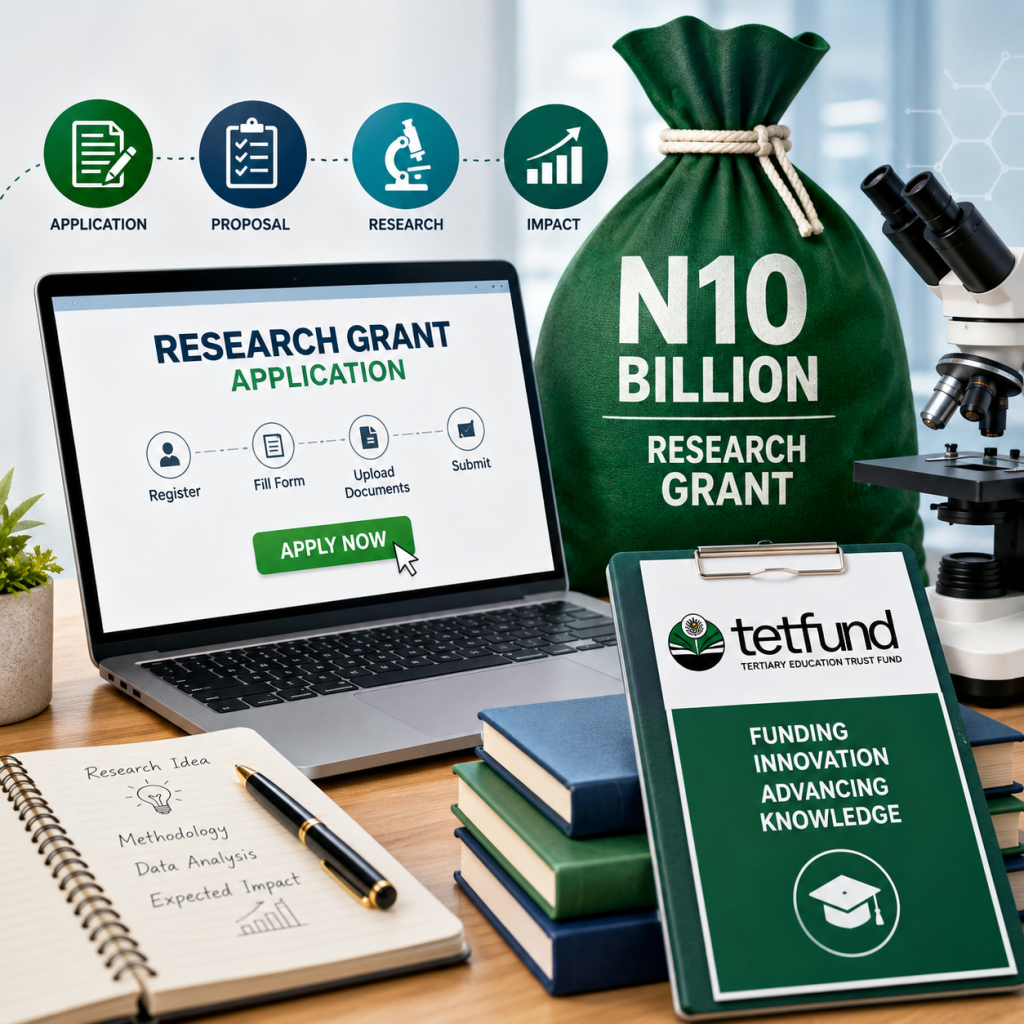
The Federal Government of Nigeria has officially announced the allocation of N10 billion for the 2026 National Research Fund (NRF) Grant Cycle under the Tertiary Education Trust Fund (TETFund). This substantial funding is a dedicated effort to support high-quality academic research aimed at solving critical developmental, economic, and academic challenges facing the nation. For academic professionals and researchers stationed in public tertiary institutions across the country, this represents a golden opportunity to secure financial backing for innovative, high-impact projects.
Applying for the TETFund National Research Fund requires a deep understanding of the guidelines, strict adherence to deadlines, and a well-structured concept note. In this comprehensive guide, we will walk you through everything you need to know about the N10bn TETFund research grant, from eligibility criteria and priority thematic areas to a detailed, step-by-step application process via the official portal.
Understanding the 2026 TETFund National Research Fund (NRF)
Following the successful execution of the 2025 NRF cycle—which saw over N6.09 billion disbursed to fund 174 distinct research projects—the 2026 cycle has been upgraded to a massive N10 billion. Designed to promote cutting-edge research, the NRF operates differently from the standard Institution Based Research (IBR) grants. While the IBR is administered at the institution level with a maximum cap of N2,000,000 per project, the NRF is managed centrally by TETFund and can offer up to N50,000,000 per research project.




Eligibility Criteria: Who Can Apply for the N10bn Grant?
Before you begin the rigorous process of drafting your concept note, it is vital to confirm that you and your research team meet the strict eligibility requirements set by the TETFund screening committee.
1. Institutional Requirements
The grant is exclusively available to lecturers and researchers currently employed in public tertiary institutions in Nigeria. Private university lecturers are not eligible to serve as Principal Investigators (PIs), though multidisciplinary collaboration is highly encouraged. The public tertiary institution where the PI is based will act as the coordinating institution. This means your university or polytechnic will serve as the primary guarantor, ensuring that all disbursed funds are applied appropriately and transparently to the research project.
2. The Principal Investigator (PI) Qualifications
Every application must be led by a Principal Investigator. The PI is the lead researcher who assumes full responsibility for the overall conduct, ethical compliance, and financial management of the proposed project. While you do not strictly need to be a full professor to apply, you must possess the requisite academic qualifications, research experience, and a verifiable track record in your specific thematic area. Additionally, the PI must initiate the application process; team members cannot apply on behalf of the PI.
The 30 Priority Thematic Research Areas for 2026
TETFund has identified 30 priority thematic areas that align with Nigeria’s immediate and long-term socio-economic needs. Your proposed research must fall squarely into one of these 30 areas, which are broadly grouped into three primary categories:
Category 1: Humanities and Social Sciences
If your expertise lies in the arts, social sciences, or law, your research must address systemic societal issues. The approved thematic areas under this category include:
- Citizenship and National Integration
- Conflict, Defence, and Security
- Economic Development and Globalisation
- Education and Human Capital
- Gender, Equity, and Social Inclusion
- Governance, Politics, Law, and Ethics
- History, Culture, and Identities
- Humanities, Social Sciences, and Technology Integration
Category 2: Science, Engineering, Technology, and Innovation
This category targets scientific breakthroughs, technological advancements, and infrastructural solutions:
- Agriculture and Food Security
- Geosciences
- Health and Social Welfare
- Industry and Innovation
- Information Technology, Computing, and Telecommunications
- Power and Energy
- Science and Engineering
- Space Science and Technology
- Sustainable Use of Natural Resources
Category 3: Cross-Cutting Themes
Cross-cutting areas represent emerging global sectors and interdisciplinary challenges that require multi-faceted solutions:
- The Blue Economy
- Clean and Affordable Energy
- Entrepreneurship and Wealth Creation
- Environment, Housing, Urban, and Regional Development
- Innovation and Technology in National Defence Capabilities
- Resource Governance
- National System of Innovation
Step-by-Step Guide on How to Apply for the N10bn TETFund Research Grant
The application process for the 2026 National Research Fund is entirely digitized and paperless. Submitting hard copies to the TETFund office in Abuja will instantly disqualify your application. Below is the detailed, step-by-step process.
Step 1: Preparation and Aligning with the Research Brief
Before logging into any portal, you must download and carefully study the official NRF Research Brief and the Proposal Guidelines. These documents outline the exact scoring metrics the National Research Fund Screening and Monitoring Committee will use to evaluate your concept note. Formulate a multidisciplinary team, clearly define the problem statement, and ensure your proposed solution offers tangible benefits to the Nigerian economy.
Step 2: Creating an Account on the TETFund NRF Portal
To begin the application, you must access the correct portal. There is often confusion among researchers regarding which TETFund platform to use.
- The Correct Portal: You must visit the official NRF portal at nrf.tetfund.gov.ng.
- The Wrong Portals: Do not use teras.ng (which is for institutional interventions) or impact.tetfund.gov.ng (for impact assessments). Also, ensure you type the dot after “nrf”—typing nrftetfund.gov.ng will lead to an error page.
On the homepage, click on “Create Account” under the Principal Investigator sign-in section. Only the PI should create the primary project account. Co-researchers and team members will be added later and will use the “Researcher sign-in” route.
Step 3: Developing and Submitting the Concept Note
The 2026 application process begins exclusively with the submission of a Concept Note. A concept note is a concise summary of your proposed research project. It must clearly articulate the research problem, the methodology, the expected outcomes, and the estimated budget. You must submit this document through the NRF portal before the strict deadline. Ensure your institution’s Research Management Office (RMO) or equivalent directorate is aware of your application, as university clearance is often a mandatory internal prerequisite.
Step 4: Concept Note Screening and Evaluation
Submitting a concept note does not guarantee access to the N10bn grant. Once the portal closes, all submitted concept notes will undergo rigorous evaluation by the National Research Fund Screening and Monitoring Committee (NRFS&MC). The committee will assess the notes based on their relevance to the 30 thematic areas, innovativeness, feasibility, and potential national impact.
Step 5: Full Proposal Submission
If your concept note successfully passes the evaluation stage and is deemed “fundable,” you will receive an official notification inviting you to prepare and submit a Full Research Proposal. This detailed document will require exhaustive information regarding your literature review, detailed methodology, project timelines (Gantt charts), and a granular budget breakdown. The full proposal must also be submitted through the same online platform.
Step 6: Proposal Defense
Applicants who pass the full proposal screening phase will be invited for an in-person or virtual defense. The Principal Investigator, accompanied by at least one core member of the research team, must present and defend the proposal before the NRFS&MC. This defense will test the team’s technical competence, the viability of the budget, and the practical application of the research outcomes.
Step 7: Final Approval by the Board of Trustees
Proposals that successfully clear the defense stage will be recommended to the TETFund Board of Trustees. Once the Board grants final approval, the funds will be disbursed to the PI’s coordinating institution in tranches, based on the approved project milestones.
How to Write a Winning TETFund Concept Note
Because the initial screening phase is where the majority of applicants are eliminated, your concept note must be impeccable. Here are proven strategies to ensure your submission stands out:
- Clarity of the Problem Statement: Avoid excessive academic jargon. State the problem clearly and explain why it is a pressing issue for Nigeria today.
- Justification and Alignment: Explicitly state which of the 30 priority thematic areas your research falls under. Do not leave it to the committee to guess. Detail how your research aligns with national policies or development goals.
- Multidisciplinary Approach: TETFund heavily favors research that bridges multiple disciplines. A proposal that combines engineering, social sciences, and information technology to solve a localized agricultural problem will score higher than a strictly isolated study.
- Realistic Budgeting: While the grant offers up to N50 million, your budget must realistically reflect the scope of your research. Inflated budgets are an immediate red flag for evaluators.
Important Dates and Deadlines for the 2026 Grant Cycle
Timing is critical. The NRF portal has a history of experiencing heavy traffic as deadlines approach, so early submission is highly recommended.
- Portal Opening Date: The application portal officially opens for the submission of concept notes on Monday, August 31, 2026.
- Application Deadline: The absolute deadline for submission is October 15, 2026. TETFund has explicitly stressed that there will be no extension to this deadline. Eligible researchers have approximately six weeks to finalize and upload their documents.
Official Registration Portal and Support Contacts
To begin your application, visit the official registration link and sign up as a Principal Investigator.
Get Started Here: TETFund NRF Application Portal (nrf.tetfund.gov.ng)
If you encounter technical glitches, especially regarding login credentials, it is advised to use the “Forgot password?” link on the NRF portal first. If the issue persists, or if you require further clarification regarding the guidelines, you can reach out to the TETFund NRF Secretariat through their official support channels:
- General Support: nrfgrants@tetfund.gov.ng
- Direct Secretariat Emails: zanginas@tetfund.gov.ng, odoju@tetfund.gov.ng, ukimci@tetfund.gov.ng, and ugwubs@tetfund.gov.ng
- Regional Desks: nrfnorth@tetfund.gov.ng and nrfsouth@tetfund.gov.ng
When sending a support email, remember to copy your institution’s Research Management Office (RMO) to ensure internal tracking.
Securing a grant from the N10bn TETFund National Research Fund can be a career-defining achievement. By strictly following the institutional requirements, aligning with the stipulated thematic areas, and submitting a well-crafted concept note before the October 15 deadline, you position yourself and your institution at the forefront of Nigeria’s academic and economic development. Start consulting your team, drafting your proposals, and navigating the portal today to avoid the last-minute rush.