
NYSC Posting Letter for Batch C Stream I Will be Released on 27th September, 2026

NYSC Posting Letter for Batch C Stream I Will be Released on 27th September, 2026
The moment thousands of Nigerian graduates have been anticipating with bated breath is finally around the corner. If you are a Prospective Corps Member (PCM) who recently completed your online registration, biometric capturing, and other necessary clearance processes, the tension is probably building up by the minute. The anticipation of knowing exactly where you will spend the next one year of your life in service to the fatherland is both an exciting and nerve-wracking experience. According to the latest mobilization timelines, updates from insider channels, and the natural progression of the National Youth Service Corps (NYSC) calendar, the highly awaited NYSC Posting Letter for Batch C Stream I will officially be released on the 27th of September, 2026.
This single document dictates the trajectory of your next twelve months. It determines the culture you will immerse yourself in, the new friends you will make, the food you will eat, and the climate you will adapt to. For many graduates, this will be their first time stepping out of their geopolitical zones, making the release of the posting letter a monumental event. If you have been refreshing your email or checking social media groups for updates, you can now mark your calendar for the 27th of September. However, knowing the release date is only a fraction of the journey. What happens next? How do you print the letter without falling victim to portal crashes? What exactly do you need to pack for the three-week orientation camp? How do you process a relocation if you are posted to a volatile region?
This comprehensive, high-quality, and deeply detailed article is designed to be your ultimate survival guide. We will walk you through the entire process, from logging into the NYSC portal to checking your status, understanding the strict requirements for camp clearance, navigating the orientation camp daily routine, and strategically planning for your Primary Place of Assignment (PPA). Grab a cup of coffee, sit back, and read through this guide carefully, because missing a single detail here could cause you unnecessary stress at the camp gate.



Understanding the NYSC Call-Up Letter versus the PPA Posting Letter
Before we dive into the technicalities of printing your document, it is crucial to clear up a very common misconception among Prospective Corps Members. Many graduates interchangeably use the terms “Call-Up Letter” and “Posting Letter,” but within the NYSC framework, these two documents serve entirely different purposes at different times of your service year.
The document that will be released on the 27th of September, 2026, is officially known as the NYSC Call-Up Letter. This is the initial mobilization document released by the NYSC management. Its primary function is to summon you for the mandatory three-week orientation camp. It reveals your State of Deployment (for example, Kano, Lagos, or Enugu) and provides the exact address of the NYSC Permanent Orientation Camp in that state. It also contains your unique Call-Up Number, your reporting date, and the deadline for arrival in camp. To put it simply, the Call-Up letter takes you from your home to the orientation camp.
On the other hand, the Primary Place of Assignment (PPA) Posting Letter is given to you on the very last day of your three-week orientation course. After you have completed your military drills, physical training, and Skill Acquisition and Entrepreneurship Development (SAED) classes, the NYSC state coordinator will hand you this second letter. The PPA posting letter directs you to the specific organization, school, hospital, or government ministry where you will work for the remaining eleven months of your service year. So, when everyone is buzzing about the “posting letter” coming out in September, they are directly referring to the Call-Up Letter that determines your state of deployment.
It is also incredibly important to understand that your Call-Up Letter is a legally binding document under the NYSC Act, Cap N84 Laws of the Federation of Nigeria. It is not just a digital notification; it is a government mandate. Once this letter is issued, you are legally bound to report to the designated camp. Failure to report for service as specified in your call-up letter without a valid, documented excuse can lead to remobilization hurdles, loss of your stream slot, and in extreme legal contexts, prosecution. Treat this document with the utmost importance.
Vital Information to Verify on Your 2026 Batch C Call-Up Letter
When the portal finally opens and you download your letter, human nature dictates that your eyes will immediately dart to the “State of Deployment” section. While screaming in joy or sighing in disappointment is completely normal, you must immediately put your emotions aside and verify the technical details on the document. The camp gate officials are notoriously strict, and a single typo on your letter can lead to you being denied entry into the orientation camp.
Here is a detailed breakdown of what you must carefully check on your NYSC Call-Up Letter:
- Your Full Name: Ensure your surname, first name, and middle name are spelled exactly as they appear on your school’s Statement of Result and your Senate Approved List. If there is a mix-up in the arrangement or spelling of your names, you will face severe clearance issues.
- Your Call-Up Number: This is a unique, alphanumeric identifier explicitly tied to your biometric data. It usually follows a format representing the NYSC, your university, your graduation year, and a serial code (e.g., NYSC/UNILAG/2026/123456). Make sure this number matches the one sent to you via SMS when you completed your online registration.
- State of Origin and Gender: Double-check these demographics. NYSC policy strictly prohibits posting PCMs to their State of Origin (except under special concessions or errors). If you notice you have been posted to your own state of origin, flag it immediately, as it may cause administrative issues later.
- Institution and Course of Study: Verify that the university or polytechnic listed is correct, and that your precise course of study (e.g., B.Sc. Mass Communication) is accurately captured.
- State of Deployment and Camp Address: This tells you where you are heading. Note that some states use temporary orientation camps if their permanent camps are under renovation. Always follow the exact address printed on the letter, not what a friend tells you.
- Reporting Date and Time: This is perhaps the most critical detail. NYSC often staggers reporting dates to prevent stampedes and logistical chaos at the camp gates. If your letter instructs you to report on the 29th of September, do not show up on the 27th, and certainly do not arrive on the 3rd of October. Arriving after the portal closes for camp registration means automatic deferment to the next stream.
- The Barcode / QR Code: Every genuine Call-Up Letter has a unique security barcode. Do not fold or squeeze the paper in a way that damages this barcode, as camp officials will scan it at the gate to verify your authenticity and prevent fake corps members from infiltrating the camp.
Step-by-Step Guide: How to Check and Print Your NYSC Batch C Stream I Letter
As the release date of 27th September, 2026, approaches, you need to be technically prepared to access your letter. On the day of release, the NYSC portal experiences massive traffic spikes, with hundreds of thousands of users trying to log in simultaneously. This often leads to server timeouts, slow loading pages, or error messages. Do not panic; this is normal. Just keep trying or wait for off-peak hours (like midnight or early morning).
To ensure a smooth process, follow these detailed, step-by-step instructions to check and print your document:
Step 1: Ensure Stable Internet and the Right Browser
Because the NYSC portal can be heavy during this period, you need a very stable internet connection. It is highly recommended to use a desktop computer or a laptop. If you must use a mobile smartphone, ensure you are using a standard browser like Google Chrome or Mozilla Firefox. On your mobile browser, click on the three dots at the top right corner and select “Desktop Site” or “Desktop View”. This forces the portal to display properly, as the mobile view sometimes hides the print button.
Step 2: Visit the Official NYSC Portal
Be extremely wary of phishing sites and scammers sending fake links to your email or WhatsApp. There is only one official route to access your dashboard. Click the official link below to get started:
Access the Official NYSC Portal Here
Wait for the page to load completely. You will see a padlock icon in your browser’s address bar, confirming that the connection is secure.
Step 3: Log Into Your Dashboard
On the homepage, locate and click on the “Login Here” button. Do not click on “Sign Up” or “Fresh Registration” because you already have an existing account. You will be prompted to enter your registered email address and the password you created during your online mobilization. If you have forgotten your password, use the “Resume/Forgot Password” link to trigger a password reset to your email.
Step 4: Locate the Print Button
Once you successfully log into your personalized dashboard, scroll down to the bottom of the page. If the letters have officially been released for your stream, you will see a prominently displayed link or button titled “Print Call-Up Letter”. If you do not see this button, it simply means your specific stream’s letters are not yet active, or you have been pushed to Stream II. Patience is key here.
Step 5: Download as PDF and Print
When you click the print button, the letter will usually open in a new tab as a PDF document. Do not just print it directly from the browser without saving it. First, click the download icon and save the PDF file to your computer, your phone’s local storage, and back it up on your Google Drive or email draft. Why? Because internet networks at rural orientation camps can be practically non-existent. If you lose your physical paper in camp and need to reprint it, having the PDF offline on your phone will save you from a major breakdown.
When printing the physical copies, you must print them in full color. Black and white copies are often rejected at the camp gate because the official NYSC watermark and your passport photograph must be clearly visible. Print at least four to five copies. You will submit one at the gate, one to your platoon officer, and you will need backups for your personal files.
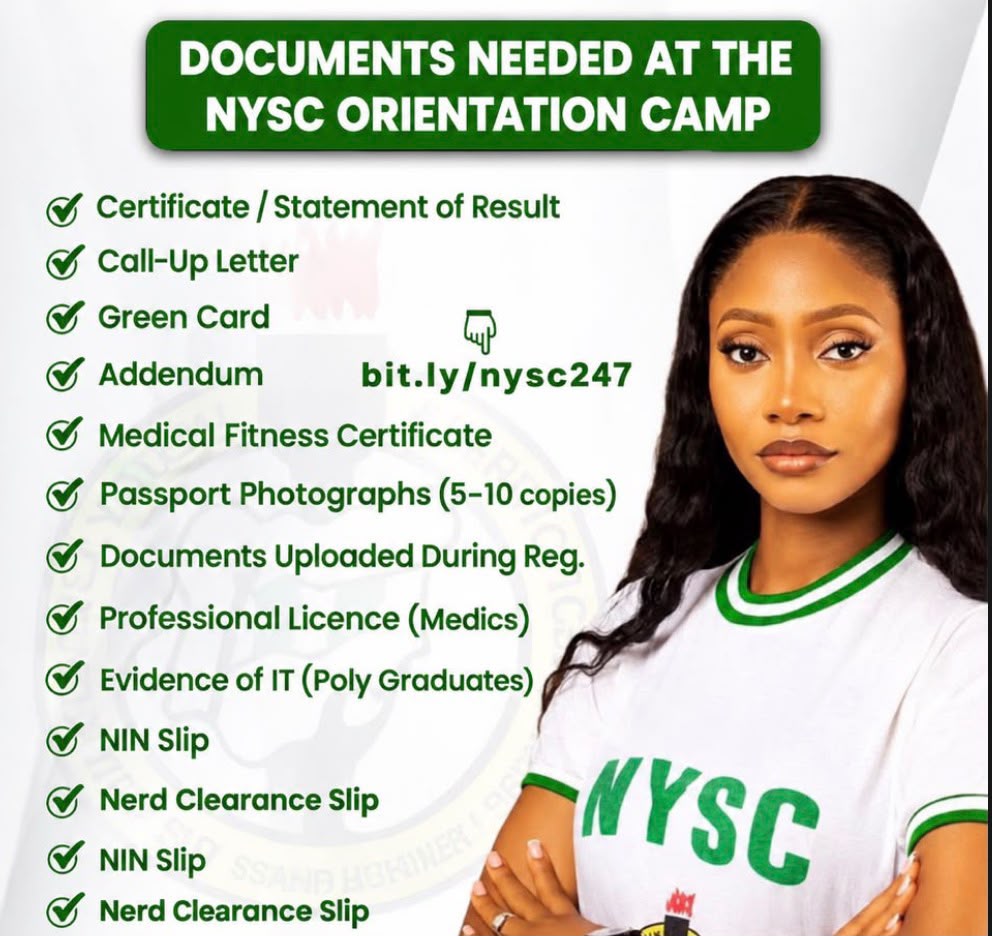
Comprehensive List of NYSC Orientation Camp Requirements for 2026
Packing for the NYSC orientation camp is an art form. You are moving to a military-style environment for 21 days, and you need to strike a delicate balance between bringing enough to survive comfortably and not overpacking to the point where your luggage becomes a burden during physical drills. The requirements are broadly categorized into official documents and personal survival items.
Part A: Mandatory Official Documents for Camp Clearance
If you forget your toothbrush, you can buy one at the camp market (Mammy Market). If you forget your original Call-Up letter, you will be sent back home. Your documents are your primary ticket into the NYSC scheme. Arrange all these documents in a clear, waterproof file folder to protect them from rain and sweat.
- Original Call-Up Letter (Colored): As discussed above, bring the original colored printout and at least four photocopies.
- The NYSC Green Card: This is the final slip you printed after completing your online registration. It contains all your bio-data, academic details, and your passport photograph. Print it in color and bring photocopies.
- Original Statement of Result or Degree Certificate: This must be the original copy issued by your university or polytechnic, bearing the school’s official stamp and signature of the registrar. For polytechnic graduates (HND), you must bring both your National Diploma (ND) and Higher National Diploma (HND) results.
- School Identity Card: You must present the final year ID card issued by your tertiary institution. If you have lost it, you must go to your school’s student affairs division to get a recognized letter of identification or a police extract backing up a valid temporary ID.
- Medical Certificate of Fitness: This has become a strict requirement. It must be obtained from a recognized Government or Military Hospital. The certificate must detail your blood group, genotype, PCV, HIV status, Hepatitis status, and general physical fitness. Private hospital reports are generally rejected.
- Recent Passport Photographs: Bring at least 10 to 15 recent passport photographs. They must have a white background, and you must not wear a face cap, dark glasses, or smile excessively. You will need these pictures for almost every registration point in camp.
- Licenses for Medical Professionals: If you are a graduate of Medicine, Pharmacy, Nursing, Optometry, or Physiotherapy, you must bring the original copy of your professional license or evidence of registration with your respective professional regulatory body. Without this, you will not be registered as a medical professional in camp.
- Documents for Married Women: If you are a married female PCM seeking automatic relocation to your husband’s state of residence, you must bring your original Marriage Certificate, an affidavit of a change of name, newspaper publication of the change of name, your husband’s valid ID card, and a utility bill proving his place of domicile.
Part B: Essential Personal Items and Clothing
Once your documents clear you at the gate, your personal items will dictate how comfortable your 21 days will be. While NYSC provides a basic kit (two white T-shirts, two white shorts, a pair of white canvas shoes, a crested vest, and a khaki suit), they are almost never enough, and the sizes might be completely wrong. You must come prepared.
- Extra White Round-Neck T-shirts and Shorts: You will wear white 90% of the time in camp. The NYSC only gives you two sets. Between morning drills, sweating in the afternoon sun, and SAED lectures, your clothes will get dirty fast. Camp laundry services take days to deliver. Do yourself a favor and buy at least 4 to 6 high-quality, thick cotton white T-shirts and white shorts before traveling.
- White Canvas Shoes and Socks: The shoes provided by NYSC (popularly called “Jungle Boots” and white tennis shoes) might not fit your exact shoe size. Buy a comfortable pair of white rubber or leather sneakers. Rubber is highly recommended because you can easily wipe off the mud and dust with a wet cloth, saving you the stress of washing canvas shoes every night. Bring plenty of white socks.
- A Durable Waist Pouch (Bum Bag): This is the most crucial security item you will own in camp. Theft happens, and you cannot afford to leave your valuables in your hostel locker. Your waist pouch will house your phone, power bank, ATM cards, cash, and pens. You will wear it to the parade ground, to the Mammy market, and you will even sleep with it.
- Mosquito Net and Bedding: NYSC will provide a basic mattress, but you must bring your own bed sheets, pillowcases, and a mosquito net. Malaria is a quick way to ruin your camp experience, so stringing up a net over your bunk bed is non-negotiable.
- Toiletries and Disinfectants: Bring your bathing soap, toothpaste, toothbrush, toilet paper, sanitary pads, a sponge, a small bucket, and a bailer (cup). More importantly, bring a strong liquid disinfectant (like Dettol or Izal). You will be sharing bathroom facilities with hundreds of people, and hygiene must be your top priority.
- Provisions and Dry Food: The camp kitchen provides three meals a day, but the schedule might not align with your hunger pangs, and the menu can get repetitive. Pack dry cereals, milk, chocolate powder, garri, biscuits, and groundnuts. They will save your life when you return to the hostel exhausted after a grueling man-o-war drill.
- Power Bank and Torchlight: Electricity supply in many orientation camps is heavily rationed, usually turned on for a few hours in the morning and evening. A high-capacity power bank (20,000mAh or more) is essential to keep your phone alive. A torchlight or rechargeable lamp is also necessary for navigating the dark camp pathways at 4:30 AM.
- Sufficient Cash and ATM Cards: While Mammy market vendors accept bank transfers, network issues often cause transactions to fail, leading to frustrating delays. Bring enough physical cash (around ₦15,000 to ₦30,000 in smaller denominations) for your daily needs, laundry services, and emergency purchases. Keep it secure in your waist pouch.
Life Inside the NYSC Orientation Camp: What to Expect
For the uninitiated, the NYSC orientation camp can feel like a sudden shock to the system. The transition from a relaxed graduate lifestyle to a regimented, quasi-military schedule takes a few days to get used to. Understanding the daily routine ahead of time will give you a massive psychological advantage over your peers.
Your day typically begins at 4:00 AM. The sharp, piercing sound of the military bugle will jolt you out of sleep. You have about thirty minutes to brush your teeth, take a quick bath (if you didn’t bathe the night before), dress in your pristine white-on-white attire, and rush to the parade ground. Lateness is not tolerated; military personnel (soldiers) will physically enforce compliance, often lightly punishing stragglers with frog jumps or push-ups.
By 5:00 AM, the entire camp is gathered on the parade ground for morning devotion, singing of the national anthem, and the NYSC anthem. This is immediately followed by rigorous physical training, jogging, and parade drills under the supervision of the military commandants. These drills teach you discipline, teamwork, and stamina. After the morning drills, you will hear the bugle for breakfast.
The afternoon sessions are largely dedicated to the Skill Acquisition and Entrepreneurship Development (SAED) program. The NYSC recognized that white-collar jobs are scarce, so SAED was introduced to equip corps members with practical vocational skills. You will sit through lectures and eventually choose a practical class to join—ranging from ICT, digital marketing, and web design, to fashion designing, poultry farming, cosmetology, and baking. Take SAED seriously; many ex-corps members have built thriving businesses from the foundation they laid during these camp sessions.
Evenings in camp are generally more relaxed and fun. You will be divided into platoons (usually numbered 1 to 10), and platoon loyalty becomes a massive part of camp culture. There are inter-platoon football matches, volleyball tournaments, dance competitions, debate nights, drama presentations, and the highly anticipated Mr. Macho and Miss NYSC beauty pageants. The climax of the camp experience is the Carnival Day, where PCMs dress in spectacular cultural attires, cook traditional meals, and celebrate Nigeria’s rich diversity. The 21 days might start off feeling stressful, but by the time the campfire night rolls around, you will find yourself wishing it wouldn’t end.
How to Successfully Apply for NYSC Relocation (Redeployment)
It is a well-known reality that not everyone will be happy with their initial state of deployment. You might be posted to a state that is thousands of kilometers away from your family, a state with harsh climatic conditions, or a region facing security challenges. The NYSC understands these concerns and has a legal framework in place for relocation, popularly known as redeployment. However, relocation is a privilege, not an automatic right, and you must provide verifiable evidence to support your application.
There are three primary legitimate grounds on which you can apply for NYSC relocation:
1. Relocation on Marital Grounds
This concession is exclusively reserved for married female corps members. The NYSC policy dictates that a married woman should not be separated from her husband during her service year. If you fall into this category, you can apply for relocation to the state where your husband resides and works. To do this, you must present a solid portfolio of documents: your original marriage certificate, a sworn affidavit of a change of name, a newspaper publication of the change of name, a letter from your husband’s employer confirming his domicile, and a recent utility bill bearing his name. If your documents are complete, approval is almost always guaranteed.
2. Relocation on Health / Medical Grounds
If you have a chronic or life-threatening medical condition that requires continuous management by a specialist, or a condition that makes the physical demands of the orientation camp dangerous to your health (such as severe Asthma, Peptic Ulcer, Epilepsy, Heart Disease, or Sickle Cell Anemia), you can apply for a medical relocation. You must present a comprehensive medical report from a recognized Government Hospital, Federal Medical Centre, or Military Hospital. Note that the camp medical team (comprising resident doctors) will evaluate your report and physical condition. If they find your claims to be exaggerated or supported by a fake medical report from a private clinic, your application will be instantly rejected.
3. Relocation on Security Grounds
Nigeria’s security landscape fluctuates, and the NYSC management prioritizes the safety of corps members above all else. If you are deployed to a state that has been officially declared highly volatile or is currently experiencing severe insurgency, the NYSC usually opens a window for automatic relocation for interested PCMs from that state. In such cases, you won’t need complex documents; you simply register your intent to relocate with the camp officials based on the prevailing security directives.
The Application Process and the 90-Day Rule
The best and most effective time to process your relocation is right inside the orientation camp. Once you have completed your initial registration and received your state code number, the relocation link will become active on your personalized NYSC dashboard. You will log in, select your reason (Marital or Health), choose your preferred new state, upload scanned copies of your supporting documents, and hit submit. The camp management will review it, and if approved, you will receive a relocation letter on the final day of camp instead of a standard PPA posting letter.
If you fail to relocate while in camp, you can still apply online after you have settled in your initial state, but it becomes administratively harder. However, you must be aware of the strict 90-Day Relocation Ban Policy. According to NYSC regulations, no relocation applications are processed during the final three months (90 days) of your service year. By that time, the system assumes you have fully integrated into the community, and moving you would disrupt your final clearance processes.
Frequently Asked Questions (FAQs) About the Batch C Stream I Posting Letter
To ensure no stone is left unturned, let us address some of the most pressing questions PCMs ask regarding the posting letter, orientation camp, and the general NYSC mobilization process.
Q1: What happens if the portal crashes on the 27th of September and I cannot print my letter?
Answer: Do not panic. Portal crashes on the release day are incredibly common due to hundreds of thousands of PCMs trying to access the site at the exact same second. The NYSC IT department always resolves these bandwidth issues quickly. If it fails during the day, wait until midnight or the early hours of the next morning when traffic is minimal. Your letter will not disappear; it is permanently attached to your dashboard.
Q2: Can I travel out of the country during my service year?
Answer: Yes, but it requires strict official permission. You cannot just abandon your PPA and travel abroad. You must apply for a leave of absence through your Local Government Inspector (LGI), which will be forwarded to the State Coordinator and eventually the Director-General of NYSC. Traveling without official approval will lead to an extension of your service year or an outright remobilization (starting the 11 months all over again).
Q3: What happens if I misplace my Call-Up Letter while traveling to the camp?
Answer: This is exactly why we strongly advise you to save the PDF version on your phone, email, and Google Drive. If you lose the physical copies, you can easily go to a cyber café near the camp or in the host town, log into your email, and reprint the colored copies. If you didn’t save the PDF and the portal closes, you will face massive administrative hurdles to prove your mobilization status.
Q4: Are pregnant women and nursing mothers allowed to participate in the orientation camp?
Answer: The official NYSC policy strictly states that the orientation camp environment is highly unsuitable for pregnant women and nursing mothers due to the physical stress, rudimentary medical facilities, and intense daily routines. Pregnant women and nursing mothers are usually registered at the gate and immediately permitted to leave the camp to go and rest, while their service year continues counting. They will skip the three weeks of physical drills entirely.
Q5: If I miss my Stream I camp, can I automatically join Stream II?
Answer: If you print your Call-Up Letter for Stream I but fail to report to camp due to illness, logistical issues, or personal emergencies, you will not automatically be allowed into Stream II. You will have to wait for the next batch entirely, and you will need to apply for “Revalidation” on your portal when the next registration cycle begins. Always make every effort to report on your assigned date.
Q6: Can I change my date of birth on the portal after printing the Call-Up Letter?
Answer: No. Once the Call-Up Letter has been generated, all your bio-data, including your date of birth, course of study, and institution, is permanently locked into the NYSC database for that batch. Any attempts to alter WAEC or JAMB dates of birth must be done strictly during the online registration phase before mobilization.
Final Thoughts and Encouragement for the Journey Ahead
The release of the NYSC Posting Letter for Batch C Stream I on the 27th of September, 2026, marks the beginning of a profound, life-changing chapter. For many, the National Youth Service Corps is a bridge between the sheltered life of a university student and the harsh realities of the independent adult world. It is a year of self-discovery, networking, skill acquisition, and cultural integration.
If you are posted to a state you never imagined visiting, try to keep an open mind. Some of the most beautiful NYSC experiences happen in regions PCMs initially dreaded. Embrace the local culture, learn a few words of the indigenous language, respect the community traditions, and seek out opportunities to add value to your Primary Place of Assignment. Whether you end up teaching eager students in a rural village, working in a bustling corporate firm in the city, or offering medical aid in a local clinic, your contribution matters.
Make sure you prepare your documents meticulously, pack smartly, and maintain a high level of discipline throughout your orientation course. Obey camp rules, make lifelong friends, participate in platoon activities, and take the SAED classes seriously. The upcoming service year is entirely what you make of it. Keep refreshing that portal, get your printers ready, and prepare to serve the nation with dedication and pride. Wishing you a safe trip to your respective orientation camps and a highly successful, hitch-free NYSC service year!