
Online Part-Time Transcription Jobs in Nigeria 2026 That Pay in Dollars
Let’s be completely honest for a second. If you live in Nigeria right now, you already know that relying solely on a Naira income can be an absolute rollercoaster. With the economic shifts and the unpredictable exchange rates in 2026, earning in foreign currency isn’t just a luxury anymore—it is a basic survival strategy. You need a side hustle. But not just any side hustle. You need something that won’t interfere with your 9-to-5 job, your university classes, or your family time. You need something you can do at midnight when the house is quiet and the MTN or Airtel network is actually cooperating.
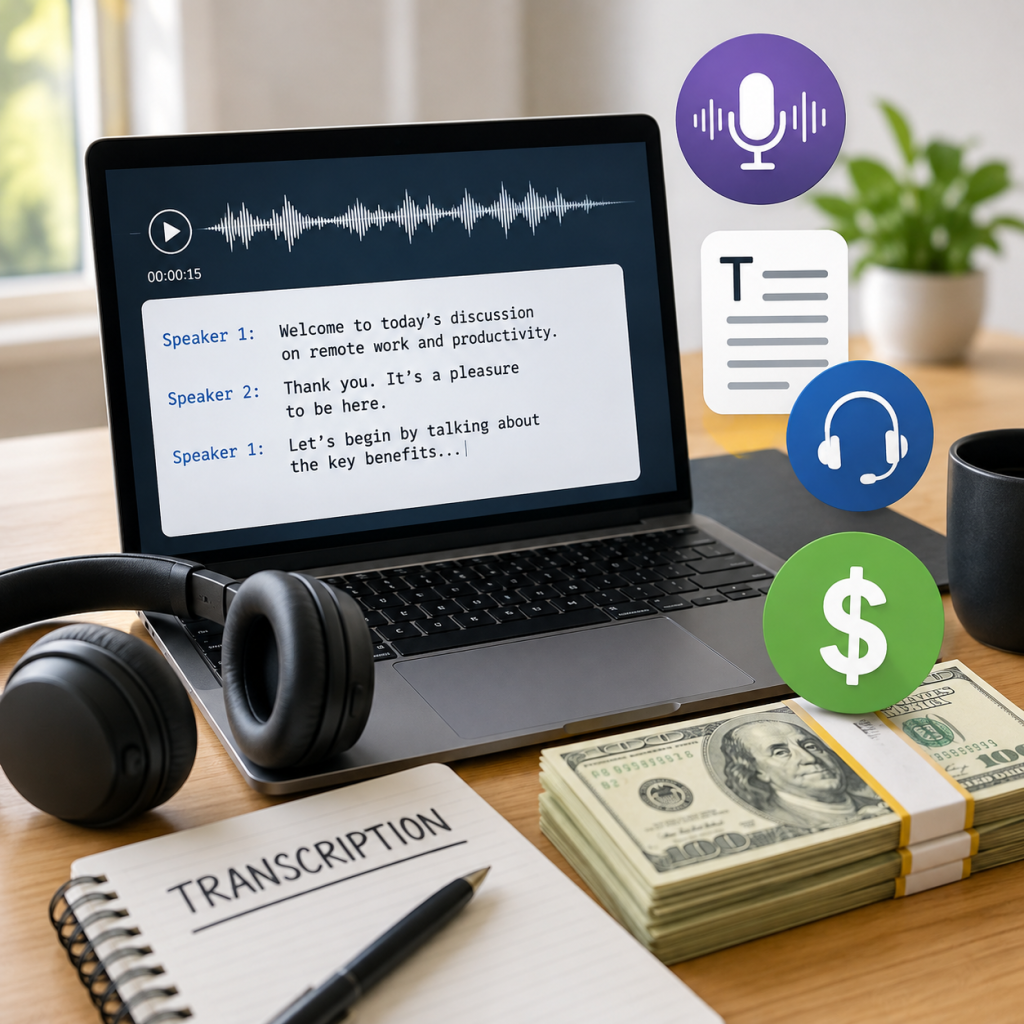
This is exactly why online part-time transcription jobs have become the holy grail for smart Nigerians. Getting paid in US Dollars simply to listen to audio files and type out what you hear sounds like a dream. And frankly, it is one of the most accessible remote jobs out there. You do not need a master’s degree. You do not need to know how to code. You do not need to be a graphic design guru. If you have a decent laptop, a reliable internet connection, a pair of good earphones, and a solid grasp of the English language, you are already 80% of the way there.
But before you rush off to sign up on every website on the internet, you need to understand how the industry actually works in 2026. A lot has changed. AI is getting smarter, but human transcribers are still in high demand because computers still cannot perfectly decode heavy accents, people talking over each other, or complex industry jargon. In this comprehensive guide, I am going to walk you through everything you need to know about starting an online transcription career in Nigeria, avoiding the common scams, passing the entry exams, and most importantly, getting those hard-earned dollars directly into your local bank account.
What Exactly is Online Transcription?
If you have never done this before, let us break it down to the bare basics. Transcription is simply the process of converting spoken language into written text. Companies, content creators, researchers, and professionals constantly record audio and video. They have podcasts, zoom meetings, court hearings, university lectures, and YouTube videos. However, they need these recordings turned into text so they can publish them as blog posts, keep them for legal records, or use them to create subtitles.
That is where you come in. An online transcription platform assigns you a short audio or video file. You put on your earphones, listen to the file, and type out exactly what the speakers are saying into a text document. Once you submit the finished text and it gets approved by an editor, you get paid. It sounds easy, right? Well, it is simple, but it is not always easy. It requires patience, a sharp ear, and a very good understanding of English grammar and punctuation.
There are three main categories of transcription you need to be aware of:
- General Transcription: This is where 90% of beginners start. It involves transcribing everyday audio files like podcasts, interviews, focus groups, and YouTube videos. You don’t need any special background to do this, just good typing skills.
- Medical Transcription: This involves typing out notes recorded by doctors and healthcare professionals. It pays significantly more, but you need to understand complex medical terminology. If you have a background in nursing, pharmacy, or medicine, this is your goldmine.
- Legal Transcription: This covers court proceedings, police interrogations, and legal meetings. Like medical transcription, it requires knowledge of legal terms and extreme attention to detail, as a single wrong word can change the meaning of a legal document.
Why Transcription is the Perfect Part-Time Job for Nigerians in 2026
You might be wondering, out of all the online jobs available—like virtual assistance, social media management, or copywriting—why should you choose transcription? Let’s look at the reality of being a freelancer in Nigeria.
First, the flexibility is unmatched. Most transcription platforms operate on a “claim and work” basis. This means there is a massive dashboard of audio files waiting to be transcribed. You simply log in whenever you have free time, pick a file that suits you, and work on it. If you have a full-time job in Lagos and you spend three hours in traffic coming back home, you can decide to rest, wake up at 1:00 AM, log into your account, transcribe for two hours, and go back to sleep. You are your own boss. Nobody is tracking your screen or forcing you to clock in at a specific hour.
Second, let us talk about the money. Earning in dollars changes everything. Even if you are just making an extra $100 to $200 a month as a part-time beginner, when you multiply that by the current exchange rate, you are looking at a very comfortable side income. It is enough to cover your data subscriptions, fuel your generator, pay utility bills, or save up for a major investment. Experienced transcribers who treat this as a full-time business can easily pull in $500 to over $1,000 monthly.
Finally, there is zero startup cost. You don’t need to buy expensive software or pay a mentor to start. Any website that asks you to pay a “registration fee” to become a transcriber is a scam. Period. All the legitimate platforms are completely free to join. Your only investment is your time and the internet data you use to download the audio files.
The Non-Negotiable Requirements for Getting Started
I see a lot of people trying to do transcription on their mobile phones. Let me save you the headache right now: do not do it. Transcription requires serious typing speed and the ability to toggle between an audio player and a word processor quickly. Trying to do this on a touch screen will frustrate you and result in terrible accuracy. To actually make money and succeed, here is the hardware and software you absolutely must have.
1. A Functional Laptop or Desktop Computer
You don’t need a high-end gaming laptop or an expensive MacBook. A basic Windows laptop (Core i3, 4GB RAM) or a simple Chromebook is more than enough. As long as the keyboard works perfectly and the computer doesn’t freeze when you open a web browser, you are good to go. Make sure some keys on your keyboard aren’t sticking, as this will slow down your typing speed tremendously.
2. Reliable Internet Connection
You need a stable internet connection to download audio files, research spellings of difficult names or places mentioned in the audio, and upload your finished transcripts. You don’t need a fiber-optic connection, but a reliable MiFi or a stable mobile hotspot from a good network provider in your area is essential. Audio files can range from 10MB to over 100MB, so ensure you have a decent data plan.
3. High-Quality Headphones
Do not rely on your laptop’s speakers. You will miss half of what is being said. You need a good pair of earphones or headphones. They do not have to be $300 noise-canceling Bose headphones, but they should be clear enough to help you distinguish between background noise and the speaker’s voice. Over-ear headphones are usually better for long hours because they don’t hurt your ears as much as earbuds do.
4. Fast and Accurate Typing Skills
In the transcription world, time is money. You are paid per audio minute, not per hour of your time. If a 10-minute audio file pays $5, and you type fast enough to finish it in 20 minutes, your hourly rate is fantastic. If it takes you two hours to type that same 10-minute file because you are using the “hunt and peck” typing method with two fingers, your hourly rate will be terrible. You should aim for a typing speed of at least 45 to 50 Words Per Minute (WPM) to be profitable. You can practice and test your speed for free on sites like 10FastFingers or TypingTest.com.
5. Excellent English Grammar and Listening Skills
This is where most beginners fail. Transcription is not just about typing words; it is about typing words correctly. You need to know the difference between “their,” “there,” and “they’re.” You need to know when to use a comma, a semicolon, or a full stop. You will also encounter speakers from America, Australia, the UK, and South Africa. You must have a sharp ear to understand different accents and heavy dialects.
Top Online Transcription Platforms Accepting Nigerians in 2026
Now that you have your gear ready, where do you actually find these jobs? Over the years, some platforms have stopped accepting freelancers from Africa due to tax laws or quality control issues. However, as of 2026, there are still several highly reputable platforms that gladly accept Nigerians, provided you can pass their English entrance exams. Here is a detailed breakdown of the best sites.
1. TranscribeMe
If you are a complete beginner, TranscribeMe is arguably the best place to start. They are known for being very welcoming to new freelancers from all over the world, including Nigeria. What makes TranscribeMe unique is that they chop long audio files into tiny 2-to-4-minute chunks. This means you don’t have to commit to transcribing a grueling two-hour interview. You can just log in, transcribe a 3-minute clip, and log out.
They pay starting rates of around $15 to $22 per audio hour. Payments are made securely via PayPal (we will discuss how Nigerians handle this later). To get in, you have to read their style guide and pass a multi-choice English exam, followed by two short audio tests.
Get started directly here: Join TranscribeMe Freelancer Community
2. GoTranscript
GoTranscript is another massive favorite among Nigerians. They hire globally and are very transparent about their processes. They pay up to $0.60 per audio minute, which translates to $36 per audio hour. The beauty of GoTranscript is that they provide plenty of feedback. If you make a mistake, their editors will correct your work and leave comments so you can learn and improve.
Unlike some platforms that demand high-speed typing right out of the gate, GoTranscript gives you generous deadlines. You might be given six hours to transcribe a 10-minute file. This takes the pressure off beginners. Furthermore, they offer payments through Payoneer, which is incredibly convenient for Nigerians because you can withdraw your funds directly to your local Naira bank account.
3. Upwork
Upwork isn’t a dedicated transcription company; it is a global freelance marketplace. However, it is one of the most lucrative places to find transcription jobs. Instead of taking tests for a company that pays you a fixed rate, you create a profile as a freelance transcriber and bid directly on projects posted by clients.
The advantage here is that you set your own rates. As a beginner, you might start charging $10 per hour. As you get 5-star reviews, you can raise your rates to $20, $30, or even more. You can find clients looking for podcast transcribers, YouTube subtitle creators, or researchers needing interviews transcribed. Upwork pays directly to your Nigerian bank account or through Payoneer.
4. Truelancer and Fiverr
Similar to Upwork, Truelancer and Fiverr allow you to package your transcription services and sell them directly to clients. On Fiverr, you create a “Gig” (e.g., “I will perfectly transcribe your English audio or video for $5”). Clients search for transcribers, find your gig, and place an order. Building a reputation on these sites takes time, but once you rank on the first page, the orders will come in automatically while you sleep.
5. Scribie
Scribie is one of the oldest transcription platforms. They pay slightly lower than others (usually around $5 to $20 per audio hour), but they are an excellent training ground. They also provide a free automated transcript that you just have to correct, which saves you a lot of typing time. If you are struggling to pass the exams on TranscribeMe or GoTranscript, Scribie is a great place to build your confidence, learn the ropes, and make some starter cash.
How to Pass Transcription Entrance Exams (The Secret Sauce)
Let me tell you a harsh truth: 70% of people who apply to transcription websites fail the test on their first try. They get angry, claim the site is a scam, and give up. But the reason they fail has nothing to do with their typing speed. They fail because they did not read the Style Guide.
Every transcription company has a specific set of rules called a Style Guide. This document tells you exactly how they want their text formatted. For example, if a speaker says, “Um, yeah, I was gonna go to the, uh, the store,” how do you type it?
If the style guide asks for Strict Verbatim, you must type every single sound, including the stutters and filler words: “Um, yeah, I was gonna go to the, uh, the store.”
If the style guide asks for Clean Verbatim (which is the most common), you must remove the filler words and correct the slang to proper English. So you would type: “Yeah, I was going to go to the store.”
If you type Strict Verbatim when the client asked for Clean Verbatim, you will fail the test. Even if your spelling is 100% perfect. Here is the step-by-step strategy to pass any transcription test:
- Download the Style Guide: Print it out if you have to. Keep it open on a second screen or your phone. Before you type anything, read it from start to finish.
- Understand Speaker Tracking: Learn how the platform wants you to label speakers. Is it Speaker 1 and Speaker 2? Or Interviewer and Respondent? Make sure you use the exact bolding and formatting they request.
- Master the Tags: Sometimes you will hear a word you simply cannot understand due to background noise. Do not guess! The style guide will tell you to use a tag like [inaudible 00:04:12] with the exact timestamp. Guessing a word incorrectly is a fast way to fail.
- Use Free Tools to Double-Check: Before you submit your test, copy the text and paste it into Grammarly (the free version works fine). It will catch missing commas, double spaces, and typos that your tired eyes might have missed.
How to Receive Your Dollar Earnings in Nigeria in 2026
This is the part everyone cares about the most. Making the money is one thing; bringing it home to Nigeria is another. As we all know, PayPal in Nigeria has a lot of restrictions. While you can open a Nigerian PayPal account to send money, you generally cannot receive money with a standard personal account without jumping through risky hoops. Fortunately, in 2026, there are highly reliable alternatives that transcription companies use, which work perfectly for Nigerians.
The Payoneer Route
Payoneer is the absolute best friend of the Nigerian freelancer. Platforms like Upwork, GoTranscript, and Fiverr all support Payoneer. Opening a Payoneer account is completely free. You will need to verify your identity using a valid Nigerian International Passport, Driver’s License, or National ID Card (NIN).
Once your account is approved, Payoneer gives you virtual bank accounts in the US (USD), UK (GBP), and Europe (EUR). When a transcription site asks for your payment details, you simply give them your Payoneer US routing and account number. Once the dollars drop into your Payoneer, you can withdraw them directly to your Nigerian bank account. Payoneer uses a competitive market exchange rate, ensuring you get excellent value for your hard work.
Virtual Account Providers (Grey.co and Geegpay)
African fintech has evolved massively. Platforms like Grey.co and Geegpay allow Nigerians to create foreign virtual bank accounts seamlessly. If you are working with independent clients or platforms that support ACH/Wire transfers, you can have your dollars sent directly to your Grey or Geegpay USD account. From there, you can swap the dollars to Naira at the parallel market rate and instantly withdraw to your local Zenith, GTB, or Access bank account.
What if a site only pays via PayPal? (Like TranscribeMe)
Some sites only use PayPal. In this scenario, many Nigerians rely on trusted family members or friends living in the US, UK, or Canada. You can link their PayPal email to your transcription account. When the site pays them, they can remit the money back to you in Nigeria via Sendwave, Remitly, or direct crypto transfers. Alternatively, some legally registered Nigerian businesses operate legitimate business PayPal accounts that can receive funds, though this requires having a registered CAC business entity.
Essential Software and Tools to Make Your Job Easier
You cannot do transcription efficiently just by playing a file in Windows Media Player and typing in Microsoft Word. You will waste hours pausing, rewinding, and minimizing windows. Professionals use specific software to speed up their workflow. Here are the tools you must have in your arsenal:
- oTranscribe (Free): This is a web-based app that is an absolute lifesaver. You upload your audio file to the webpage, and it provides a text editor right below it. The magic is in the keyboard shortcuts. You can press ‘Esc’ to pause/play, ‘F1’ to rewind 2 seconds, and ‘F2’ to fast forward. It keeps your hands on the keyboard at all times.
- Express Scribe (Free version available): This is a downloadable software for PC and Mac. It is the industry standard for transcribers. You can load audio files into it and control playback speed. If someone is speaking too fast, you can slow the audio down to 70% speed without distorting the pitch too much.
- Grammarly: As mentioned earlier, nobody is perfect. Grammarly will automatically underline your punctuation errors, missing articles, and misspelled words. It is your final quality control check before submitting a file.
- A Foot Pedal (Optional but Recommended for Pros): If you decide to take this very seriously, you can invest in a USB foot pedal. It plugs into your laptop and links to Express Scribe. You use your foot to press down to play the audio, and lift your foot to pause. This frees up your hands entirely for typing, drastically increasing your words per minute.
Common Pitfalls and Mistakes to Avoid as a Beginner
Transcription can be highly rewarding, but the learning curve can be steep. Many Nigerians quit in the first two weeks because they fall into predictable traps. Here is how to avoid them and protect your peace of mind.
1. Underestimating the Time Required
Beginners often see a job listed as “60-minute audio file for $40” and think, “Wow, I will make $40 in one hour!” That is a massive misconception. The industry standard is that it takes about 4 hours to transcribe 1 hour of clear audio. If the audio is muffled, has multiple speakers, or heavy accents, it could take 5 to 6 hours. Always budget your time appropriately so you do not miss deadlines.
2. Accepting Terrible Audio Quality
When you join a platform, you usually have the ability to preview a file before claiming it. If you press play and it sounds like the recording was made inside a helicopter during a hurricane, leave it alone. It is not worth the stress. Taking on inaudible files will slow you down, lead to a transcript full of blank tags, and likely get rejected by the editor, meaning you won’t get paid at all.
3. Falling for Registration Scams
I cannot stress this enough. Legitimate companies need workers; they do not need your money. If you see a Facebook ad or a Telegram group offering a “premium transcription job in Nigeria” but they ask for a ₦5,000 “account activation fee” or “training fee,” run away immediately. It is 100% a scam.
4. Ignoring Editor Feedback
When you start, your first few transcripts will be reviewed by senior editors. They will likely find mistakes and correct them, lowering your initial rating. Do not take this personally. Read their feedback carefully. If they tell you that you are overusing commas, take note and fix it in your next job. Platforms reward transcribers who learn and adapt, eventually promoting them to reviewers or editors where the pay is much higher.
How to Scale Your Earnings (From Part-Time to Full-Time)
Let’s say you’ve started making a steady $150 a month working a few hours on weekends. How do you scale that up? How do you turn this into a business that replaces your primary income?
First, improve your typing speed aggressively. If you can move from 40 WPM to 70 WPM, you literally double your income because you are finishing files in half the time.
Second, pick a specialized niche. General transcription is great, but it has the lowest pay rate because anyone can do it. Start familiarizing yourself with medical or legal terminology. You can find free glossaries online. Once you feel confident, apply for legal or medical transcription roles on Upwork. These clients are desperate for accuracy and are willing to pay $1.00 to $2.00 per audio minute.
Third, bypass the middleman. Platforms like TranscribeMe and GoTranscript charge the client a high rate and pay you a portion of it. That is the price you pay for them providing you with a steady stream of work. However, once you have experience, you can create a LinkedIn profile marketing yourself as a Freelance Transcriptionist. Reach out to podcasters, university researchers, and YouTube creators directly. Offer to transcribe their content for a direct fee. You get to keep 100% of the profits, and you can build long-term contracts with these clients.
Frequently Asked Questions (FAQs)
Do I need a university degree to become a transcriber?
Absolutely not. Transcription companies care about exactly two things: your ability to follow instructions (the style guide) and your ability to accurately type what you hear. Whether you are a secondary school leaver, a university student, or a retired professional, as long as you pass the online assessment, you are hired.
Will Artificial Intelligence (AI) take over transcription jobs?
This is a major concern in 2026, but the short answer is no, not entirely. AI tools like Whisper and Otter.ai are incredibly fast and good at generating rough drafts of clear audio. However, AI struggles terribly with Nigerian accents, background noise, industry slang, and situations where three people are laughing and talking at once. Instead of destroying the industry, AI has shifted the job role. Many platforms now offer “editing” or “QA” roles, where the AI generates the text, and your job is to listen to the audio and fix the massive mistakes the AI made. It actually makes the job faster for you.
How long will it take to make my first $100?
This depends entirely on your dedication and typing speed. If you treat this as a serious part-time job, working 2 to 3 hours a day, a beginner can easily hit their first $100 within two to three weeks on a platform with consistent workflow. Once you gain speed and experience, you could make that same $100 in just three or four days of dedicated work.
Can I do transcription on my smartphone?
Technically, there are apps that allow it, but practically, it is a terrible idea. Your thumbs cannot type fast enough to make the hourly pay worth your time, and toggling between apps on a phone will drive you crazy. Save yourself the frustration and use a laptop or a desktop.
Do I have to pay taxes on this income in Nigeria?
As an independent contractor earning foreign income, it is legally your responsibility to declare your earnings and pay your personal income tax to the relevant state inland revenue service in Nigeria. The foreign companies will not deduct Nigerian taxes for you. As your income grows, it is advisable to consult with a local tax professional to ensure you are compliant with the law.
Taking Your First Step Today
The beauty of the digital economy in 2026 is that geography no longer dictates your earning potential. You can be sitting in a room in Ibadan, Abuja, or Port Harcourt, providing value to a podcaster in New York or a researcher in London, and getting paid in US Dollars for your effort. Online part-time transcription is not a get-rich-quick scheme. It requires focus, patience, and a willingness to improve your English grammar and typing speed. But if you are willing to put in the initial effort to pass the tests and learn the ropes, it is one of the most reliable and rewarding ways to build an online income stream in Nigeria.
Don’t just read this and move on. Clean up your laptop, buy a cheap but decent headset, go to 10FastFingers to check your current typing speed, and sign up for an account on one of the platforms mentioned above. Read their style guide today, take the practice tests tomorrow, and start your journey towards earning your first dollar online. The work is out there waiting for you.